15 Most Common Crawlability Problems and How to Fix Them
Crawlability problems are technical SEO issues that stop search engines from reaching and reading your website pages, so even strong...
Read ArticleVue apps rely on JavaScript to build crawlable content in the browser. But during rendering, what users see isn’t always what bots process, leading to Vue JavaScript SEO issues.
EdgeComet makes this process easier to plan and control. It also lets you see clearly how bots interact with your pages. That insight makes it easier to improve Vue SEO without touching your existing setup.
Vue often uses hydration to add JavaScript code to HTML that is already there. During this time, the page may not be completely interactive. If a crawler comes by at that time, it might process an incomplete version, which could hurt indexing.
When the state changes, Vue components automatically update. When crawlers visit the page, these updates don't always happen at the same time. Because of this, bots might take a picture of the page that doesn't have all the important parts.
Core elements like metadata, links, and visible content often depend on dynamic JavaScript execution. When rendering relies on timing, consistency drops and indexing becomes less reliable.
The same page can look different depending on state or interaction. For bots, that creates uncertainty around what should actually be indexed.
EdgeComet helps prevent Vue SEO issues by ensuring search engines and AI crawlers always access complete, accessible content. Teams can see how pages are processed without altering the application code.
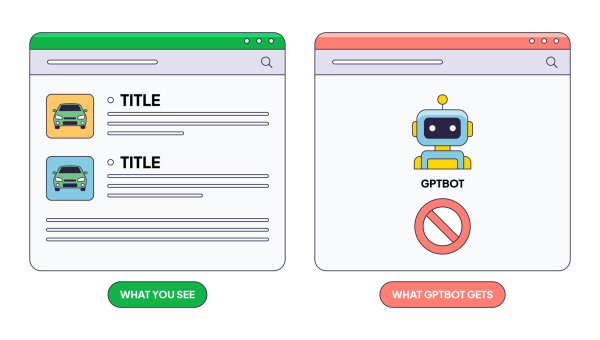
Pages are prepared before crawling happens. Bots don’t depend on hydration or runtime execution, so they receive a complete version every time.
It no longer matters when a bot arrives. Each request returns a consistent result and optimal performance, improving visibility and making indexing more predictable.
Content generated inside Vue components is delivered in a way bots can reliably process, without relying on client-side routing.
Less processing means faster responses. Bots can go deeper before the heavy rendering stops them.
Run EdgeComet on your real traffic with full access to the platform, including rendering, monitoring, and Edge SEO.
Vue.js builds pages from components that update based on state. But not all variants of that state occur during crawling, resulting in gaps in indexing.
Certain content is only visible after page hydration. If a crawler arrives earlier, a portion of the page may never be parsed.
Vue Router fetches content without reloading the entire page. When bots bypass to deeper pages directly, content is not “really ready” there.
Some components load dynamically, only when needed. In many cases, bots never trigger those conditions, so the content is skipped.
Vue gives you flexibility, but without control, that flexibility can reduce visibility. EdgeComet helps improve crawl efficiency and bot accessibility.
Bots see the same version of a page, regardless of timing or state. That makes indexing more consistent.
Pages are delivered faster and with less overhead, which helps bots process more content.
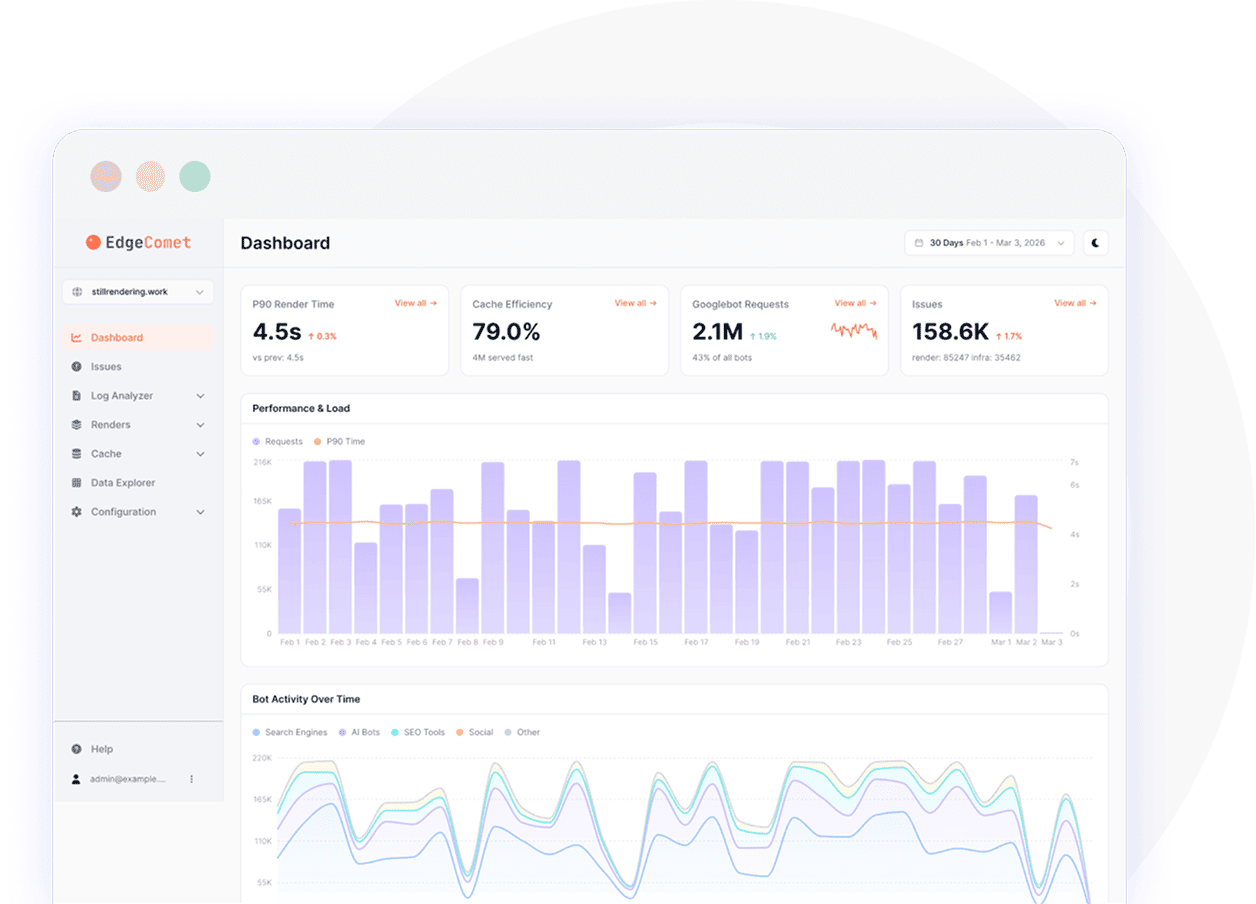
Monitoring lets you see how bots interact with your site and what they actually process, not just what you expect them to see.
With Vue JS SEO optimization, fewer elements are missed during indexing, and overall performance improves.
Improve indexing, visibility, and traffic from day one.
14-days free trial
Not entirely. SEO for Vue JS works well, but since much of the content depends on JavaScript and rendering consistency in the browser, the outcome isn’t always consistent for indexing.
Even lightweight apps rely on dynamic rendering. If content appears after the initial load or depends on timing, crawlers may not process it the same way users see it.
Reactivity updates the page as data changes, but those updates don’t always align with crawling. Bots may capture a version of the page before all changes are applied.
They can render JavaScript-dependent content, but not always under the same conditions as a real user. Timing, resource limits, and execution order can all affect what gets indexed.
In a lot of Vue apps, metadata such as titles, descriptions, and canonical tags are not included in the first HTML. It’s added dynamically once JavaScript runs. If a crawler arrives prior to this, it could miss out on those key signals. That can mean incomplete indexing and reduced visibility in search results.
Vue SPAs build pages in the browser and often change the content they display. This dynamic behavior can confuse crawlers. They may only get a partial page – with a scrolling metadata block, links or interactive elements. As a consequence, search engines don’t necessarily see everything, and things can fall through the cracks when it comes to indexing.
The purpose of rendering is HTML generation on the server or in the browser, whereas page hydration is the next step where Vue attaches JavaScript interactivity to already-rendered content.
Vue JS offers SSR support and Nuxt.js as its SSR/SSG framework, so it is easy to ensure appropriate rendering for Vue-based sites.
Both frameworks have similar dynamic rendering issues, and SEO performance depends on whether SSR or pre-rendering works.
Yes, Google indexes Vue SPAs. However, Googlebot has to render JS to see the content, which relates to crawl and rendering delays and indexing gaps that SSR or static generation would eliminate.
Stay ahead with expert insights on search visibility, AI optimization, and technical SEO
Crawlability problems are technical SEO issues that stop search engines from reaching and reading your website pages, so even strong...
Read Article
Search engine bots don’t treat all pages of your website equally. The way you manage crawlers’ attention will influence how...
Read Article
Most marketing teams used to evaluate the website’s success by analyzing traffic, search result rankings, and general web analytics. However,...
Read Article