
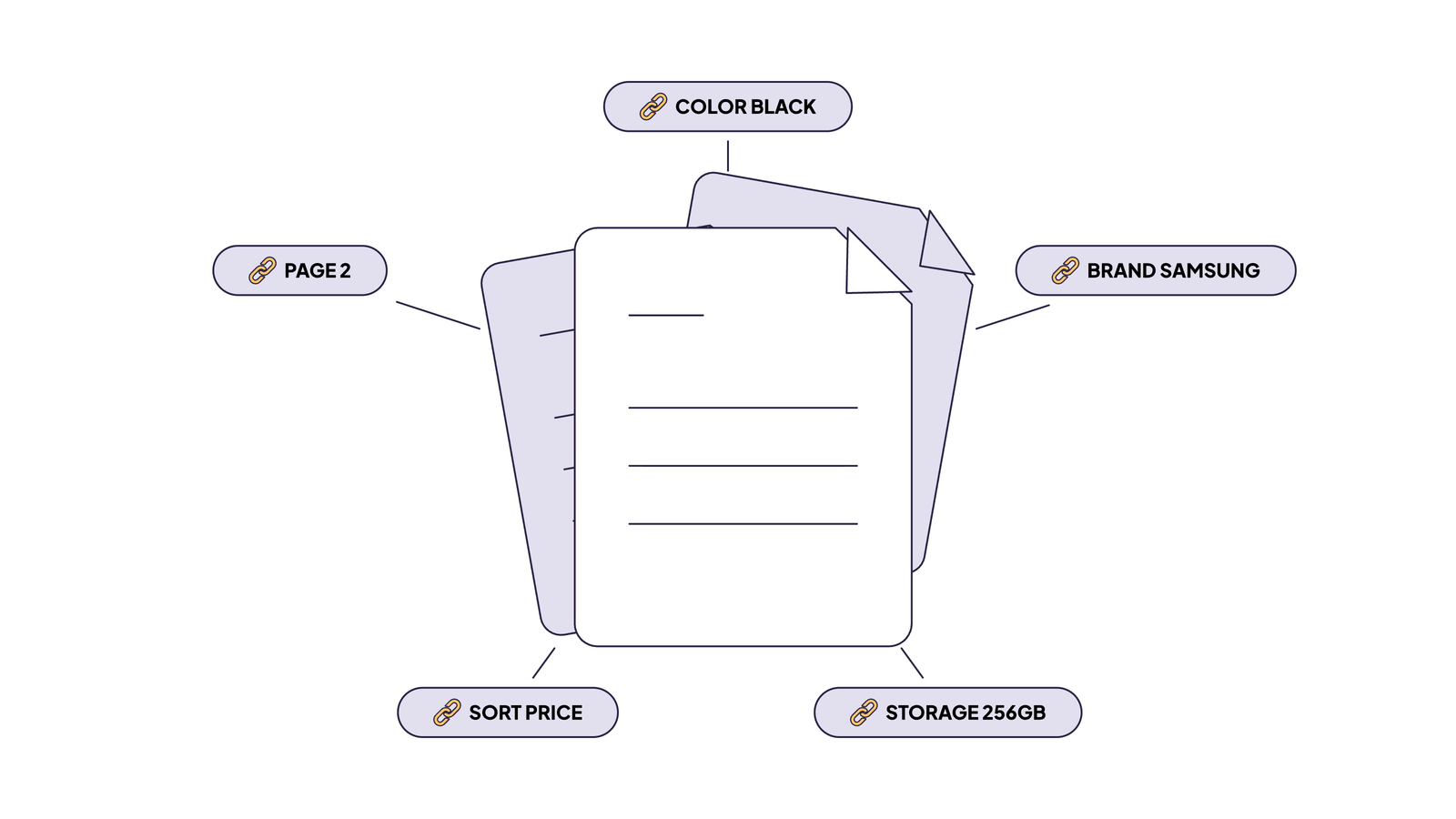
How to Optimize Faceted Navigation SEO for Crawling and Indexing
Faceted navigation SEO comes down to two decisions for every filter URL: may search engines crawl it, and may they...
Read ArticleEdgeComet helps large online stores improve e-commerce technical SEO by making product and category pages accessible to search and AI bots. Monitor crawler activity, fix technical issues, and help more shoppers discover your products.
Large catalogs create thousands of dynamic product URLs. Many get discovered but never actually indexed – so buyers never find them.
Most AI crawlers skip JavaScript entirely. If your product details load dynamically, those AI systems are essentially browsing a blank page.
Fresh SKUs often sit invisible in search for days or weeks. Competitors don't wait – they capture that demand while you're still waiting to appear.
Thousands of category pages fighting for attention means many never get fully rendered. Whole parts of your catalog stay invisible in crawling results.
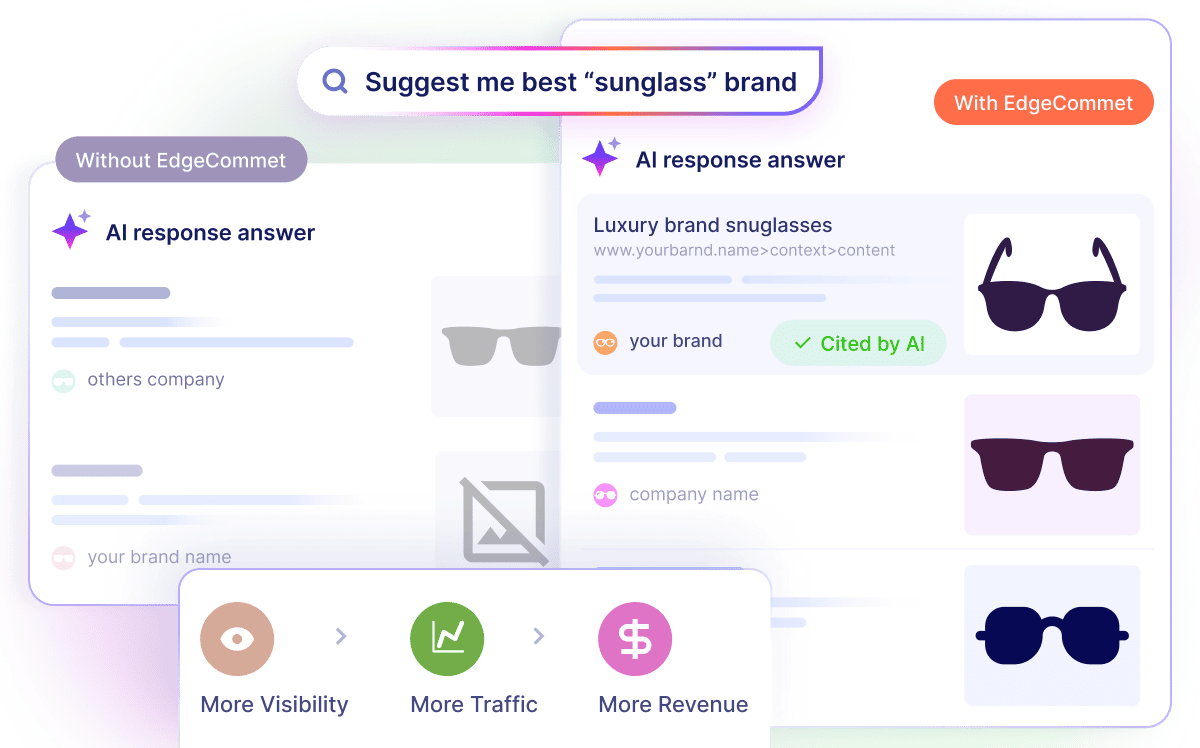
More buyers find products through AI chats, which recommend a single page – not a category. If AI can't read your pages, competitors get the recommendation instead.
EdgeComet helps search engines and AI bots read and index product listings.
JavaScript rendering often slows down how bots interact with your site. When bots wait seconds for every rendered product page, they discover fewer product pages per visit.
EdgeComet generates pre-rendered HTML responses in milliseconds.
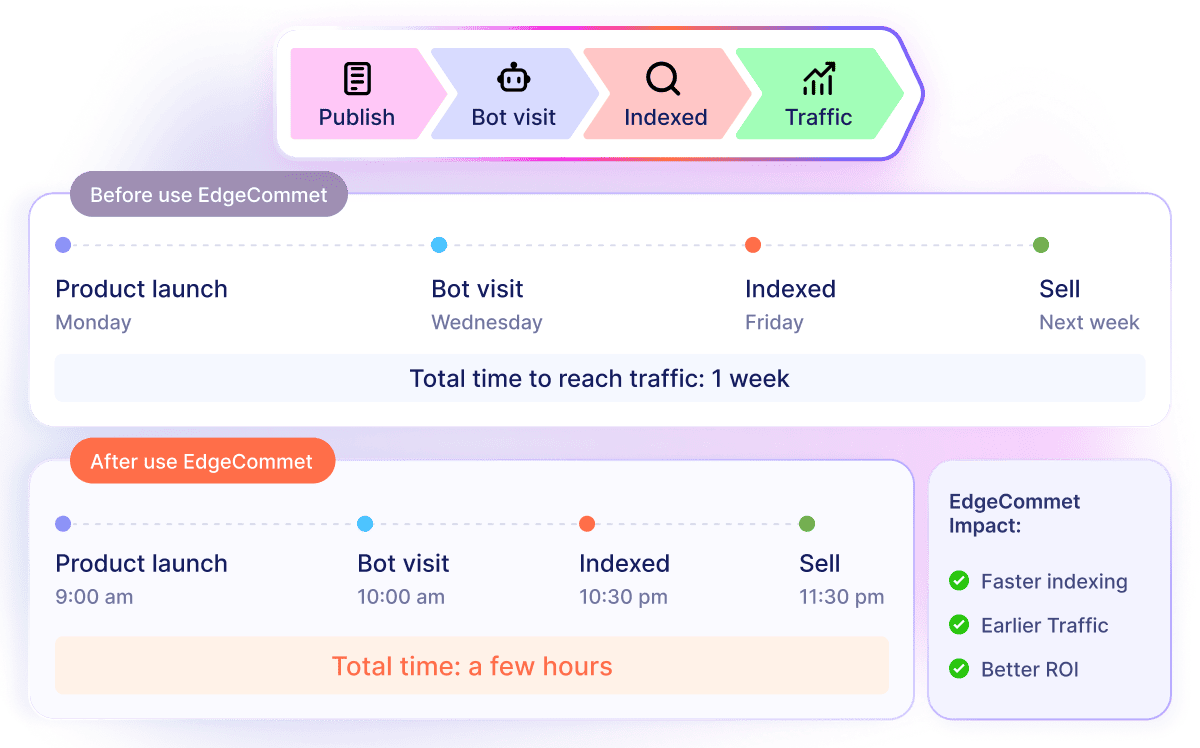
It may take days or weeks for new products to appear in search results. Late indexing results in missed sales opportunities and lost demand.
EdgeComet ensures pages are rendered instantly so they are visible to bots.
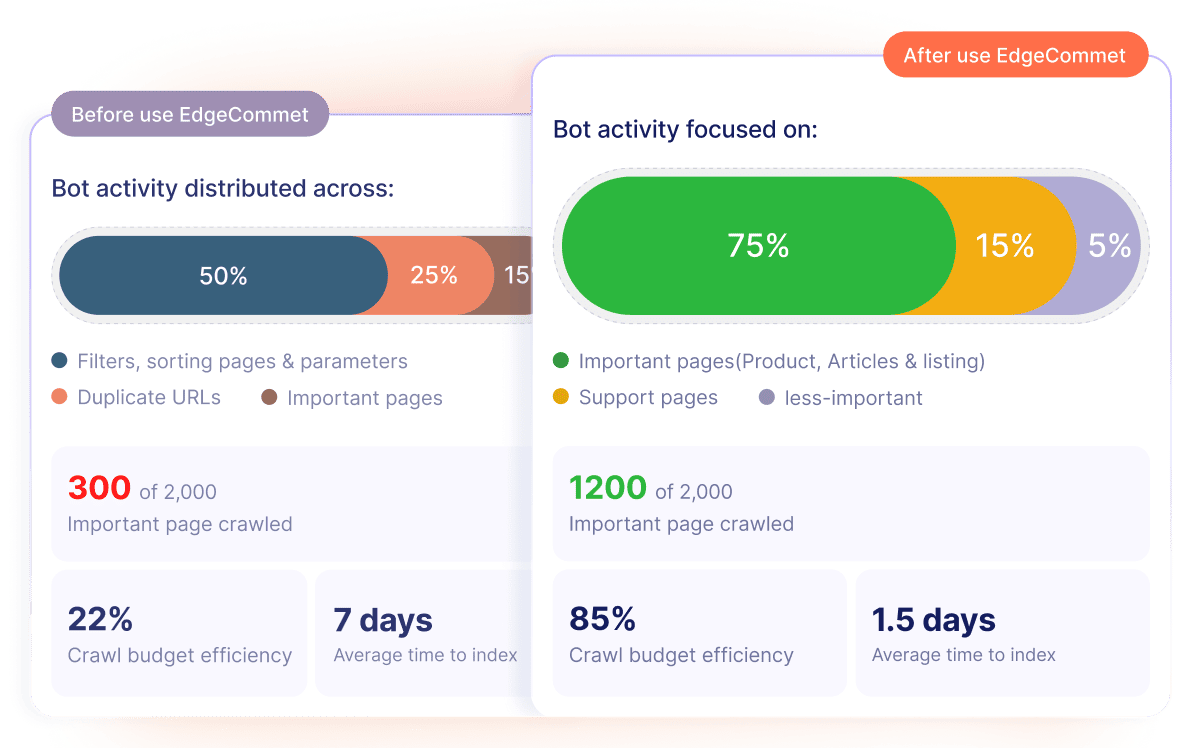
Crawl budget on large catalogs often goes to filters, sort parameters, and out-of-stock products while revenue pages wait.
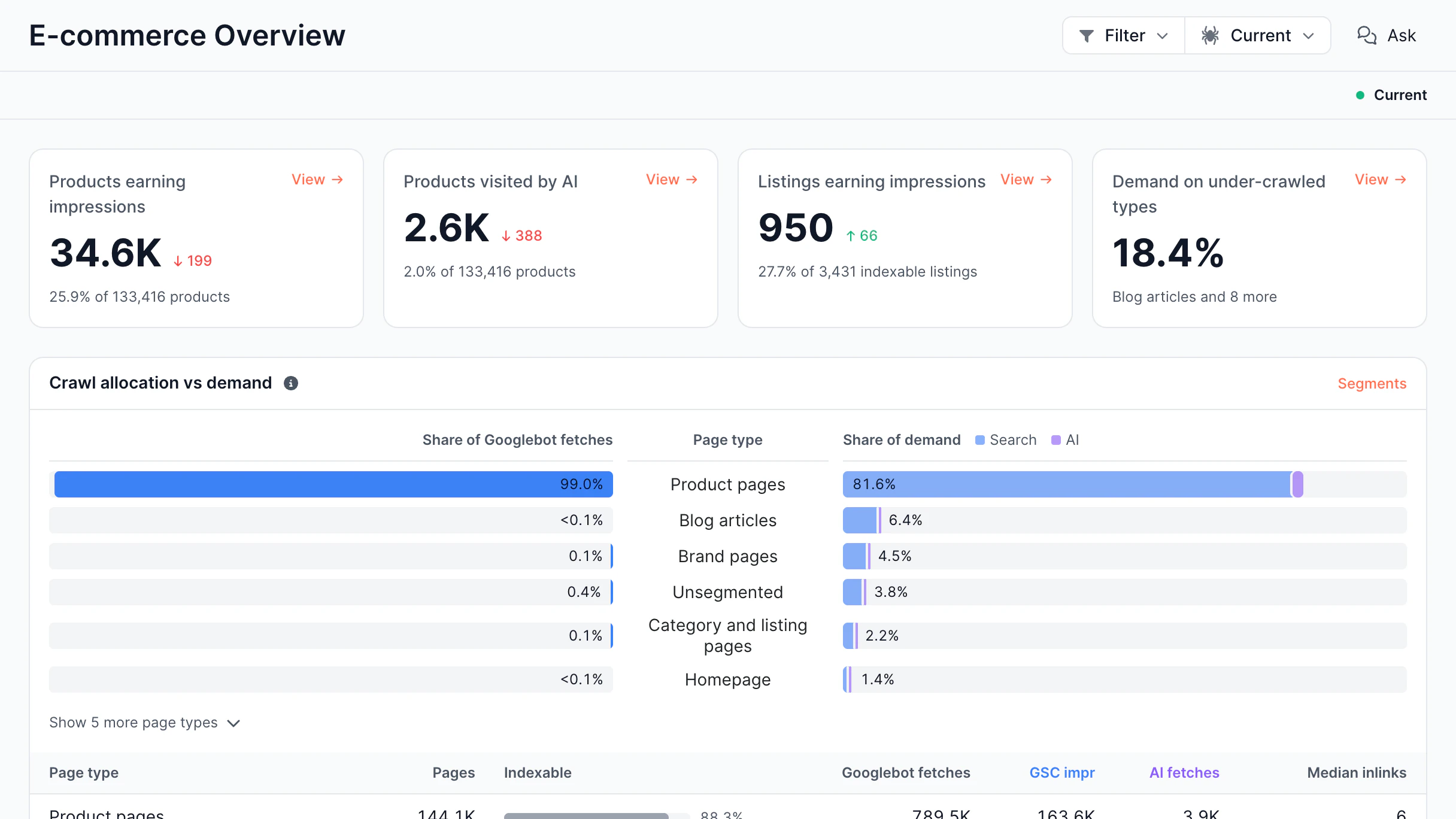
EdgeComet shows Googlebot’s crawl by page type (products, categories, filters, search) and breaks waste down by cause: redirects, 404s, non-canonical URLs.
Moving an e-commerce store to React or a headless setup can introduce SEO issues, even when product pages look correct to shoppers. Missing content, internal links, or metadata can affect how bots access your catalog.
EdgeComet helps identify SEO risks during migration and monitor bot-facing product pages for rendering failures and missing SEO elements after launch.
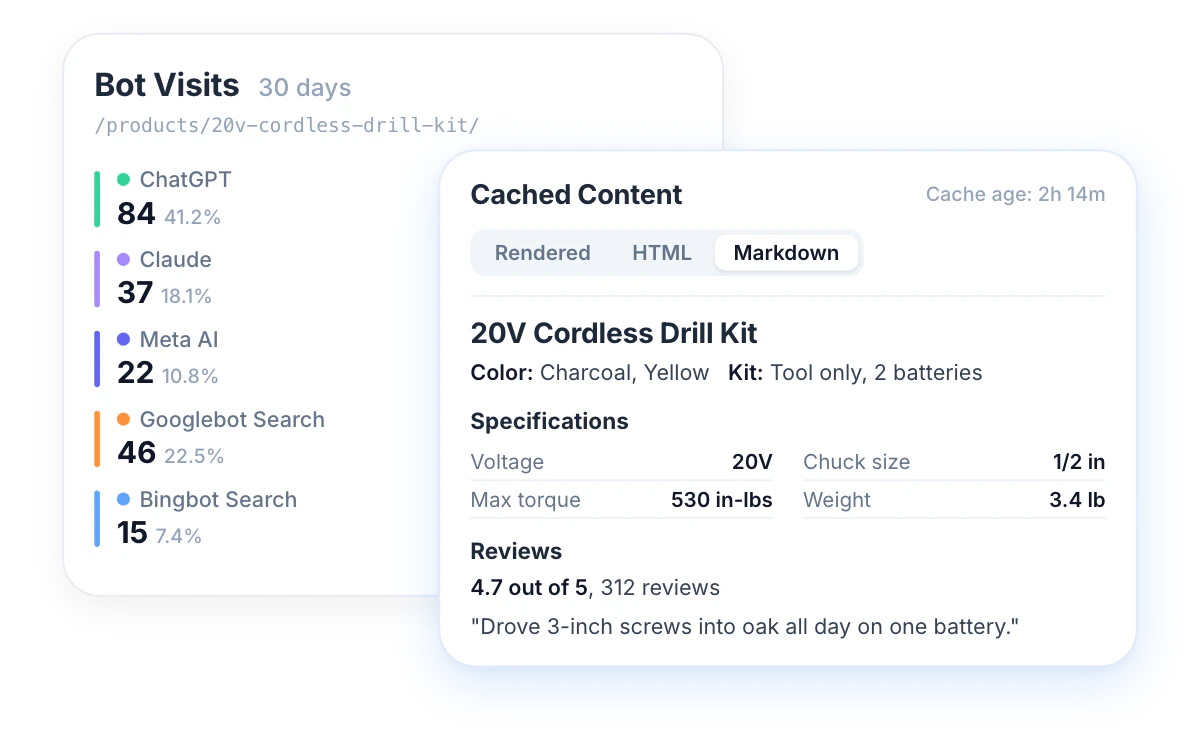
Color and size variants, product specifications, and reviews are often hidden behind JavaScript tabs. AI crawlers may miss these details when they cannot interact with the page.
EdgeComet helps teams check what AI bots receive and make important product information accessible in rendered HTML.
Client-side rendered product pages may require additional processing before Googlebot can access their content. JavaScript errors, blocked resources, or missing internal links can prevent important products from being discovered or indexed.
If organic search can’t scale with listing growth, teams compensate by using paid ads instead of fixing e-commerce indexing issues. Visibility is cheaper than paid acquisition.
69% of AI bots can’t see JavaScript, so dynamically loaded listings never appear in AI-driven results. As AI search grows, unindexed catalogs fall further behind.
On large e-commerce websites, crawlers waste a budget for low-value content, leaving thousands of actual product pages unexplored and invisible in search.
Claude, ChatGPT, Perplexity, and Google AI Overviews are where buyers go today. Over 2 billion users see AI-generated replies monthly, and that keeps growing.
Conversational AI is becoming the most popular way people find what they need to buy.
Users arriving via AI channels convert into sales at around 5 times the rate of organic search.
For online retailers, being visible in AI answers isn't just an advantage – it's a must-have requirement for getting high-intent buyers.
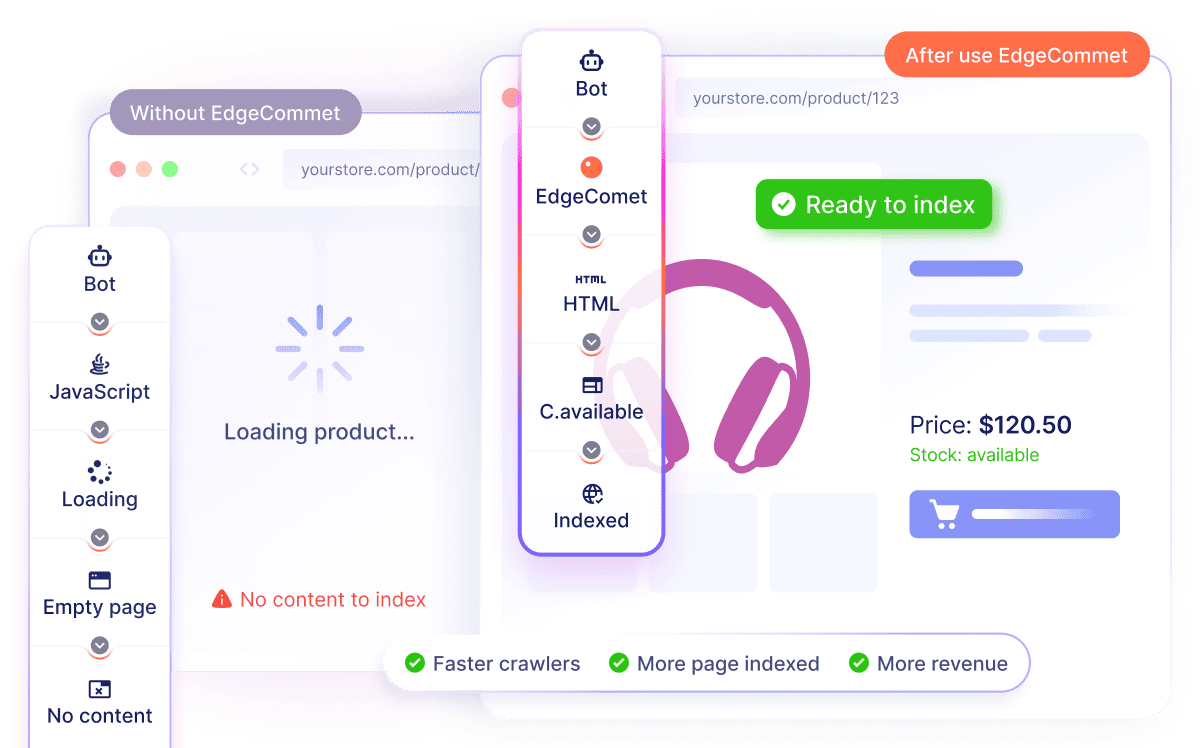
AI crawlers can't render JavaScript, so most e-commerce product pages are displayed as empty when crawled.
EdgeComet pre-renders your content into static HTML before crawlers come, with no changes to your tech stack.
EdgeComet helps your catalogs become visible on platforms where buyers explore products.
EdgeComet shows what bots get after JavaScript rendering, with complete page-level SEO data, so you see the product page Googlebot and GPTBot actually received.
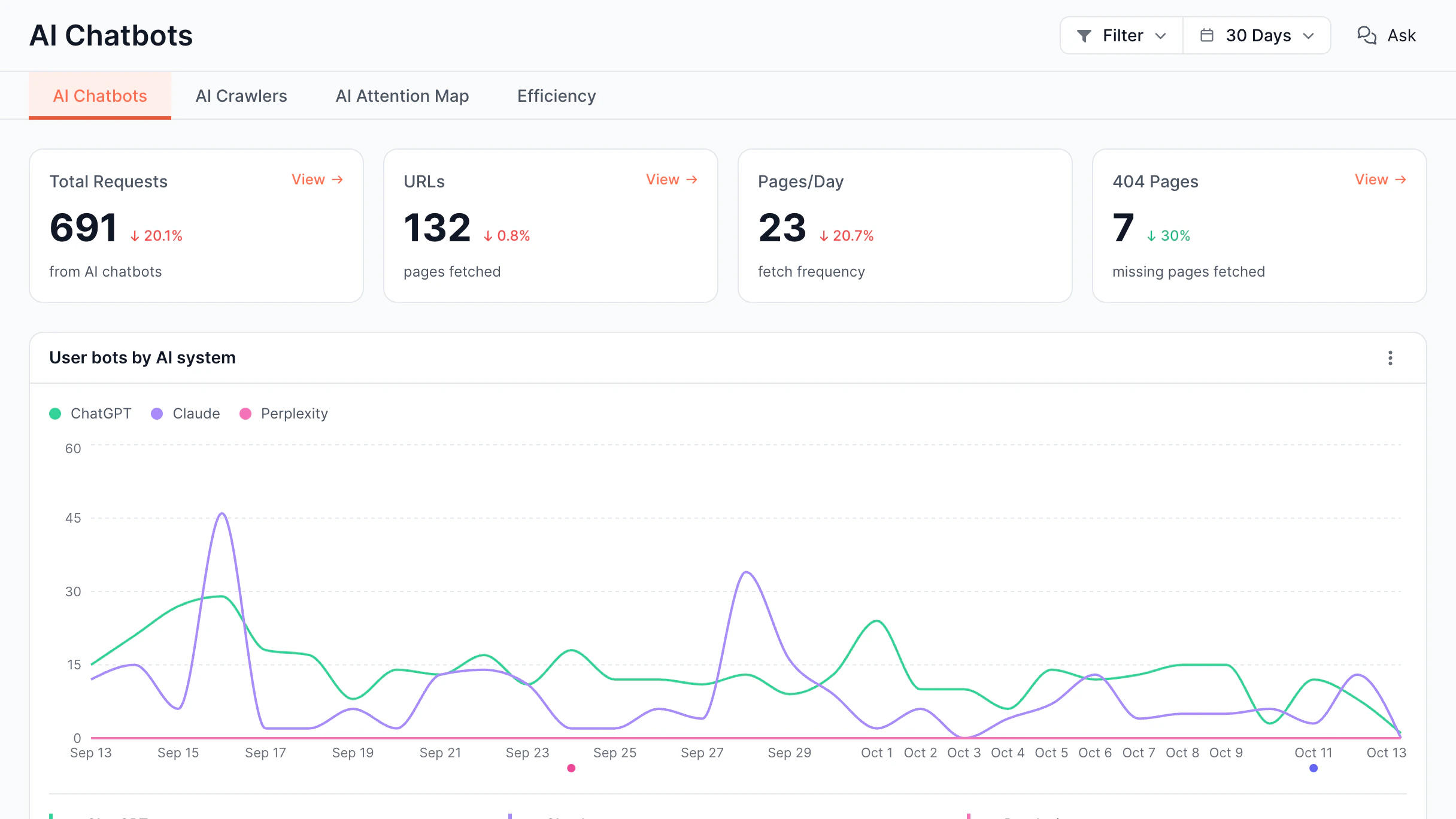
Pages ChatGPT, Claude, and Perplexity fetch while answering users, by day.
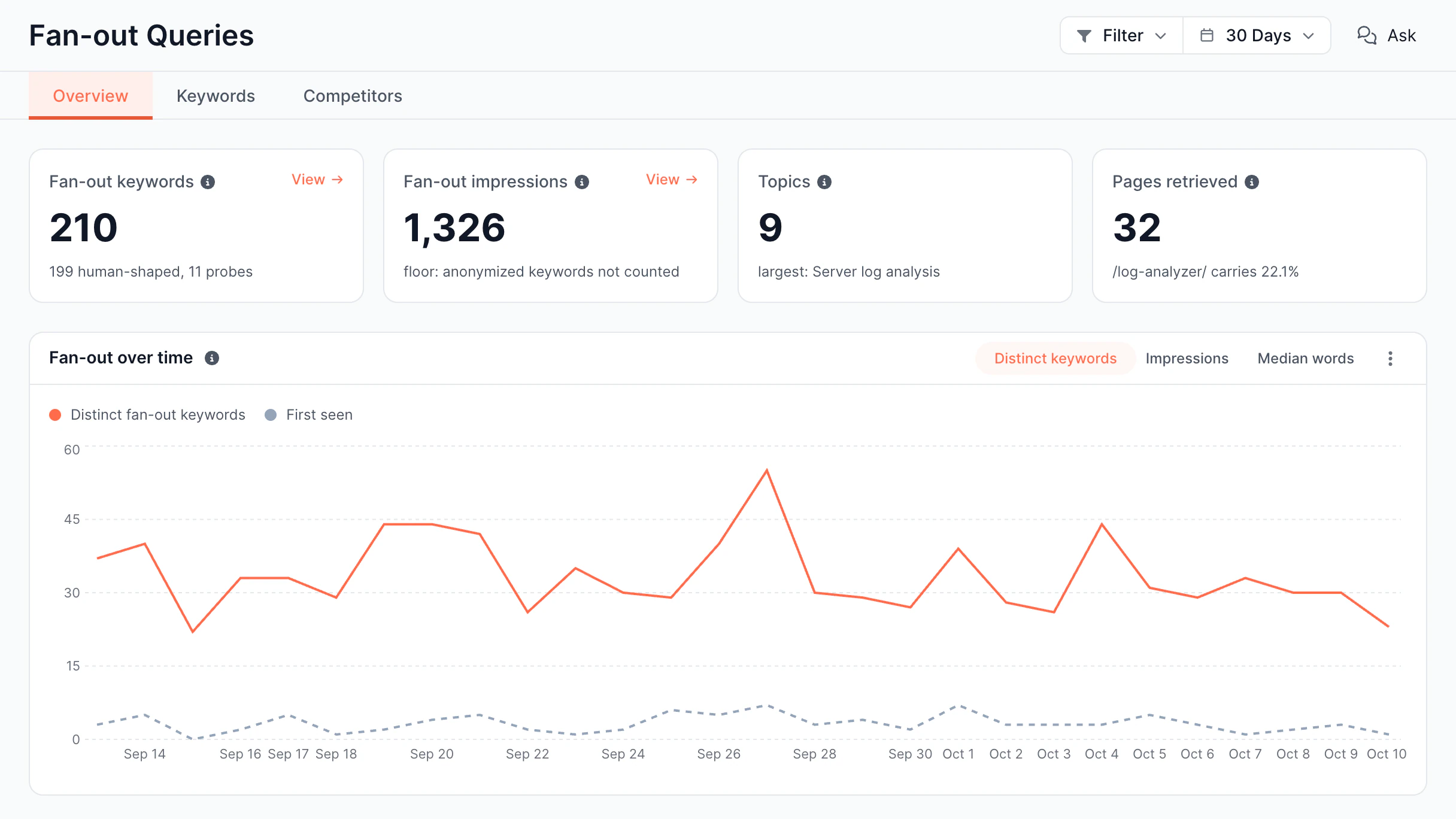
Fan-out keywords from Search Console, grouped into topics, with impressions.
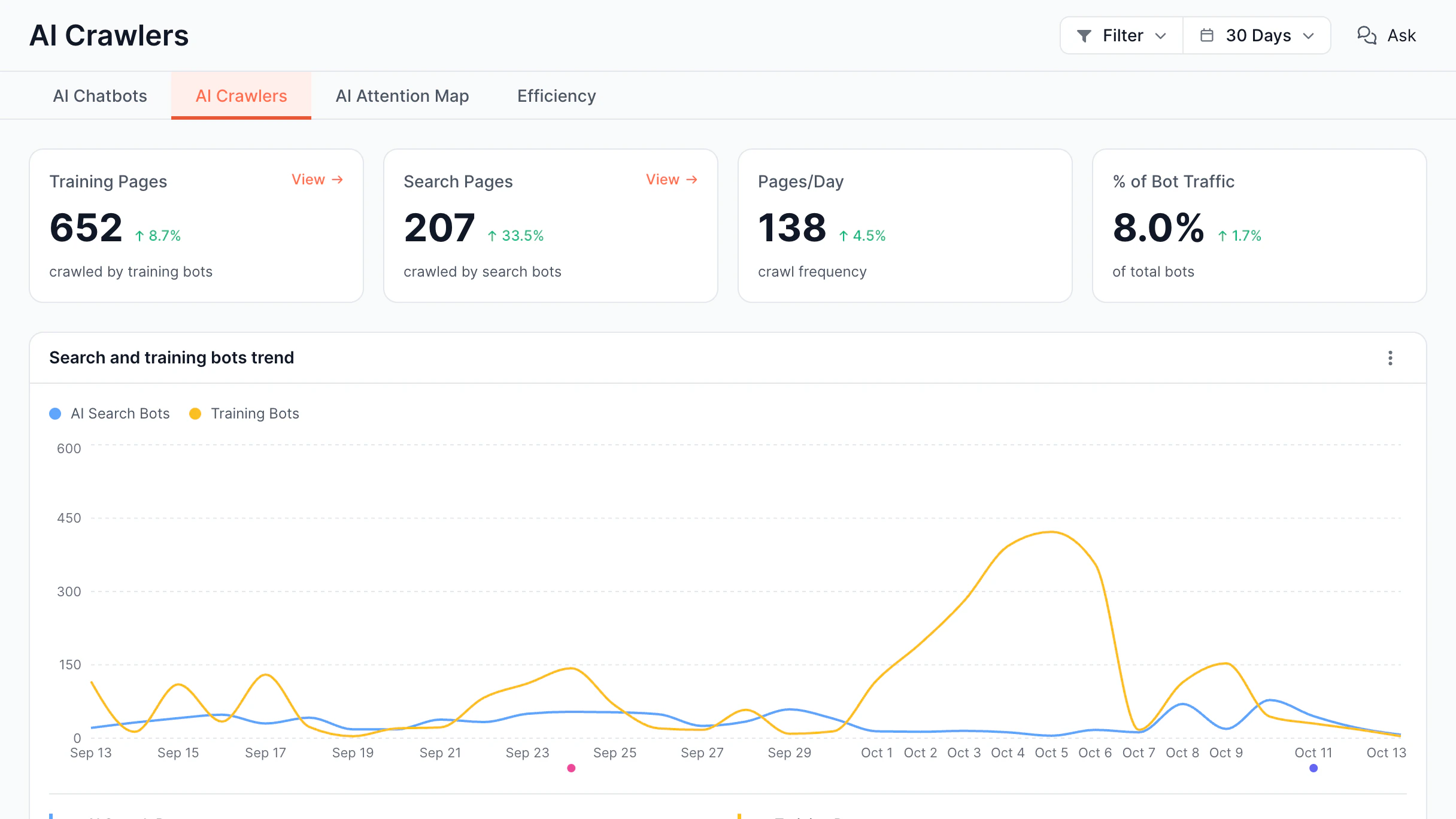
AI training and search bots: pages crawled, pages per day, share of traffic.
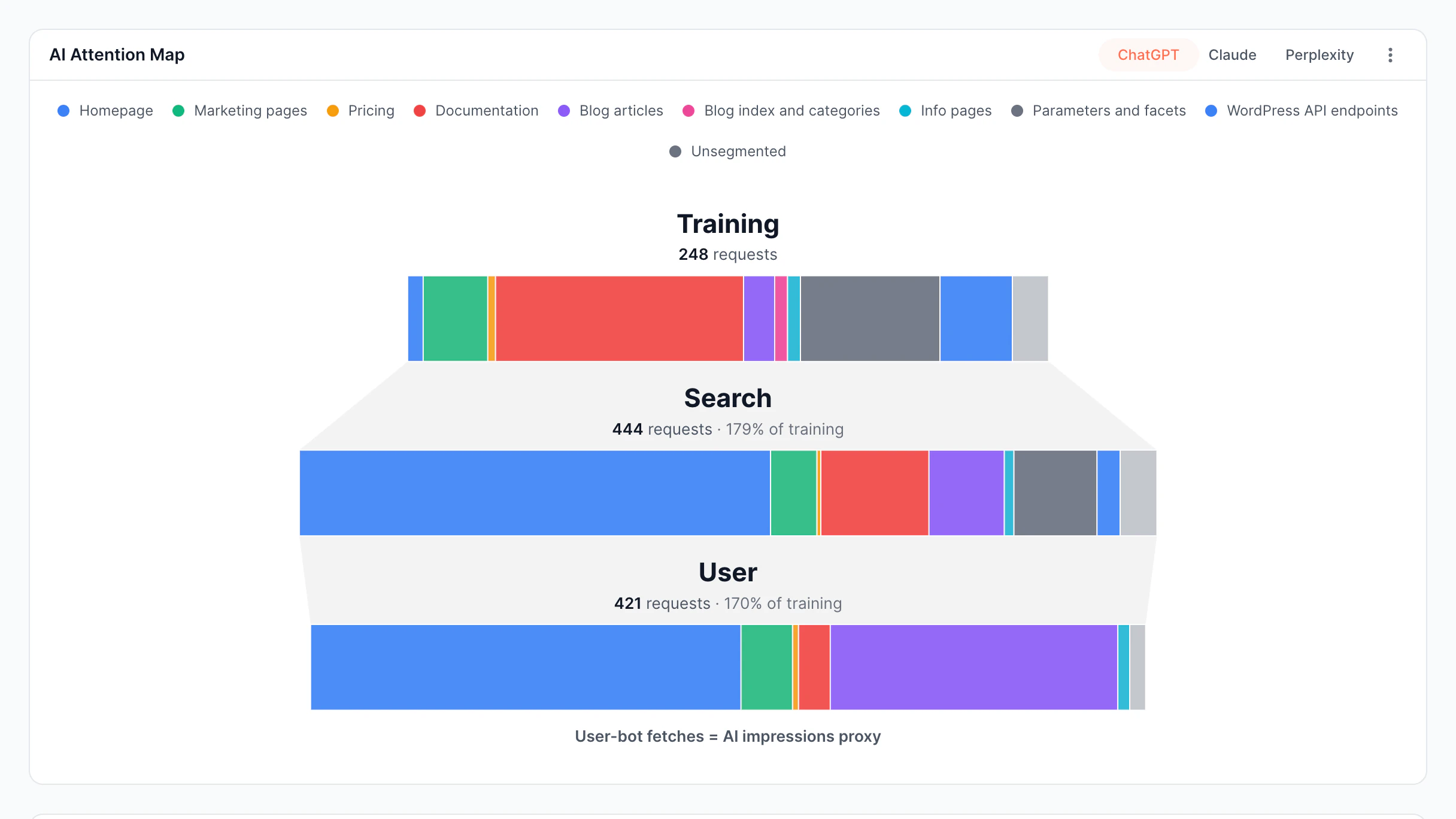
Training, search, and user bot requests by page type, for each AI provider.
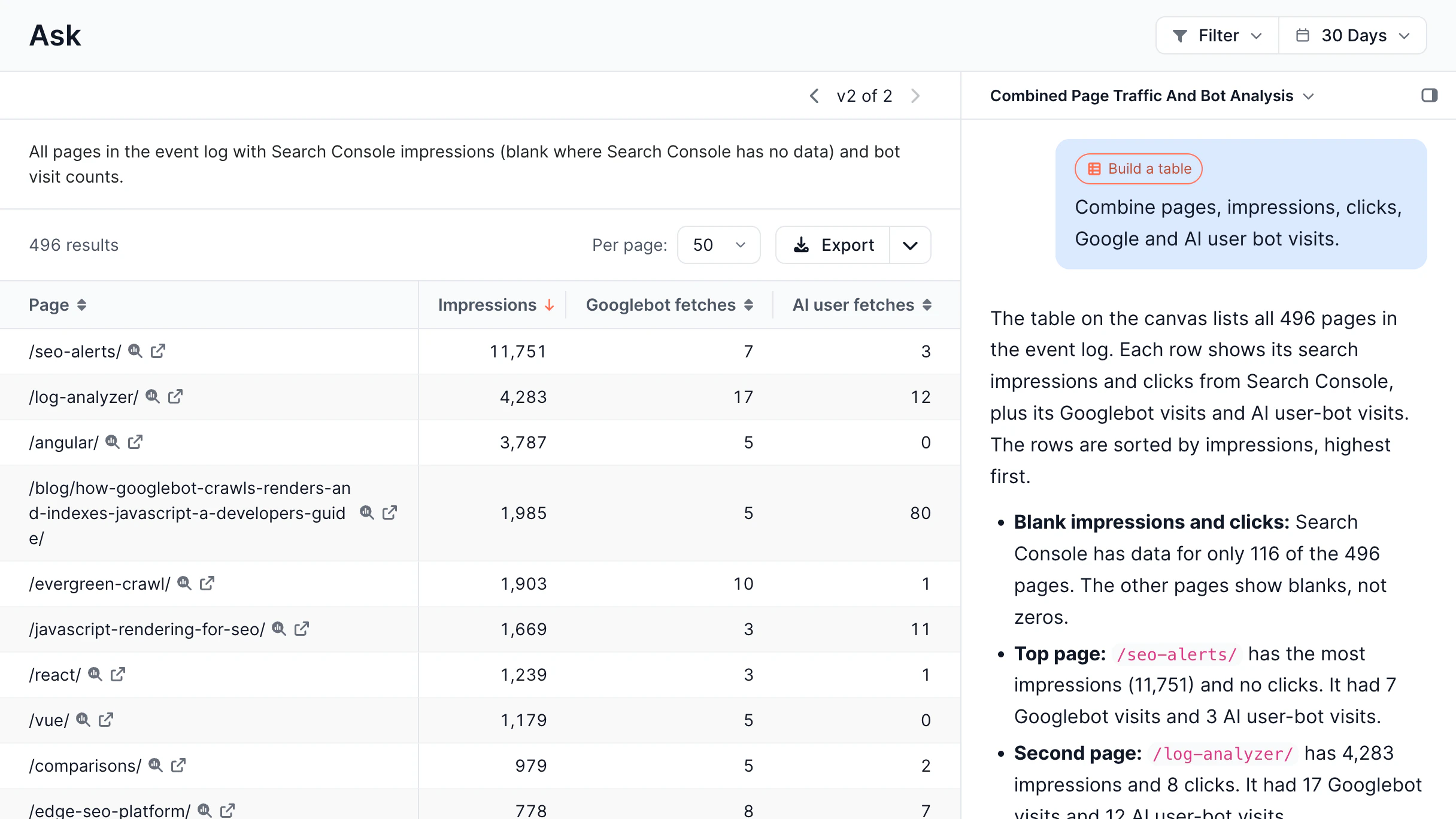
Chat that answers with sortable tables you can export to CSV or Google Sheets.
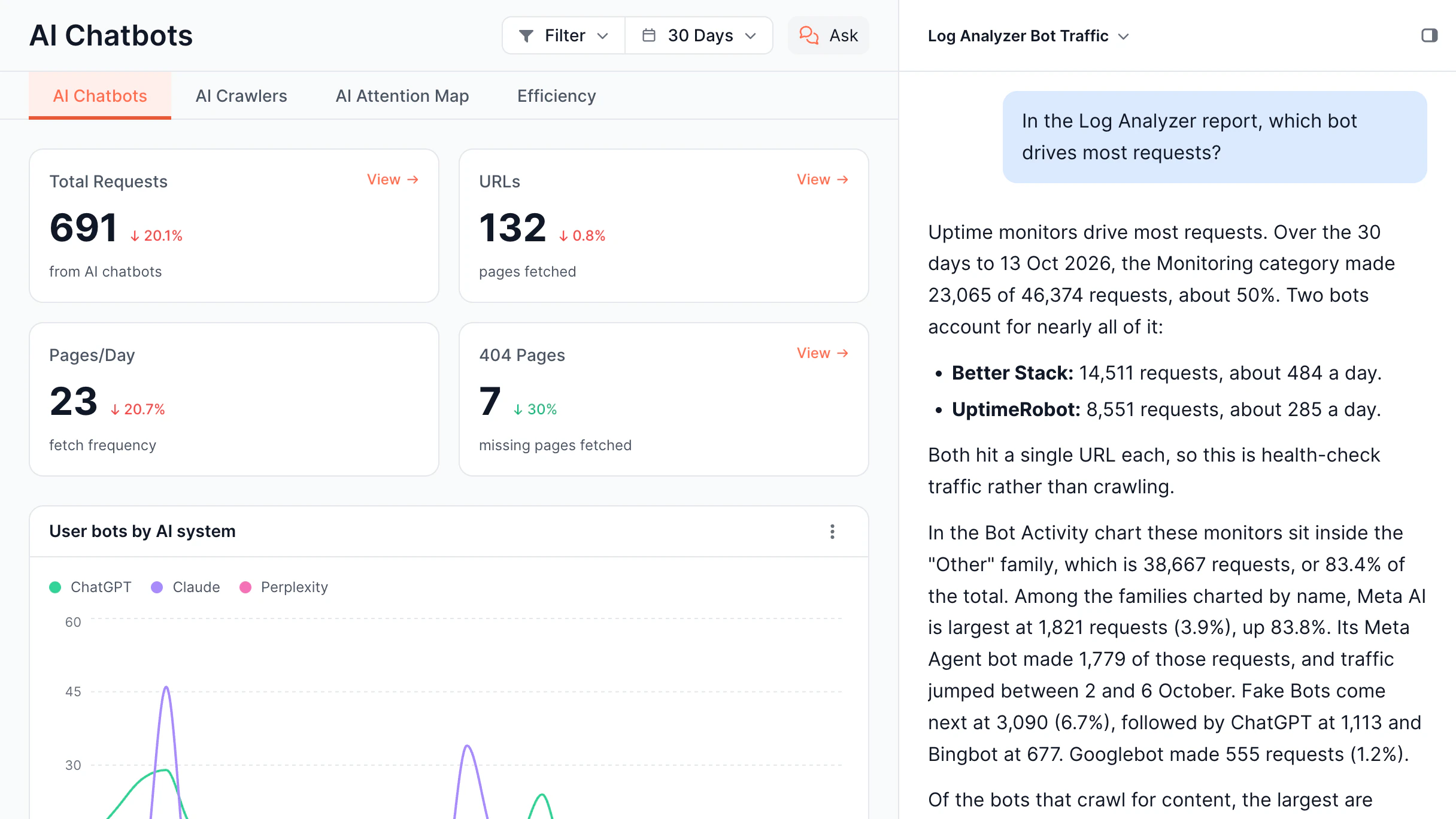
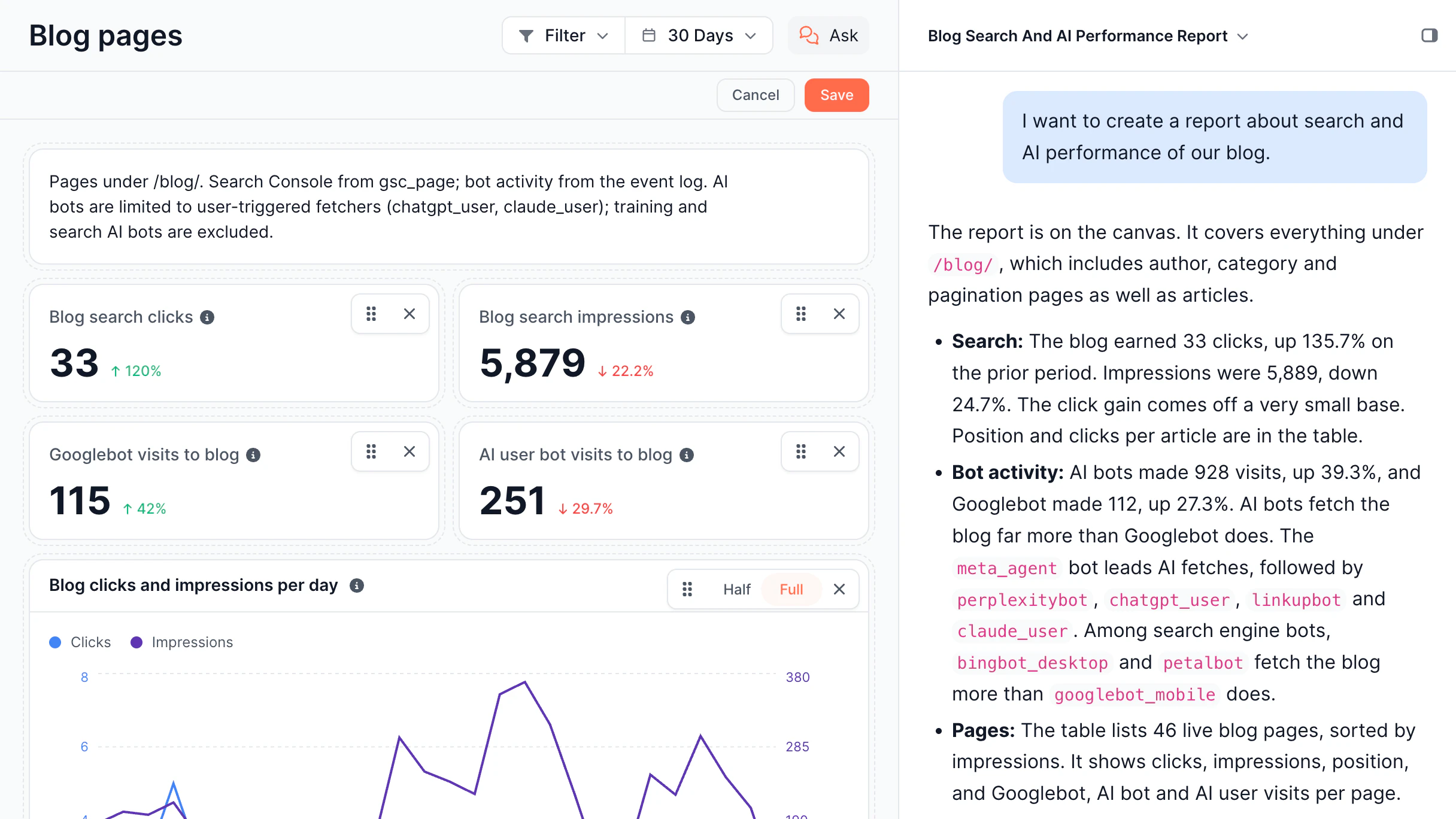
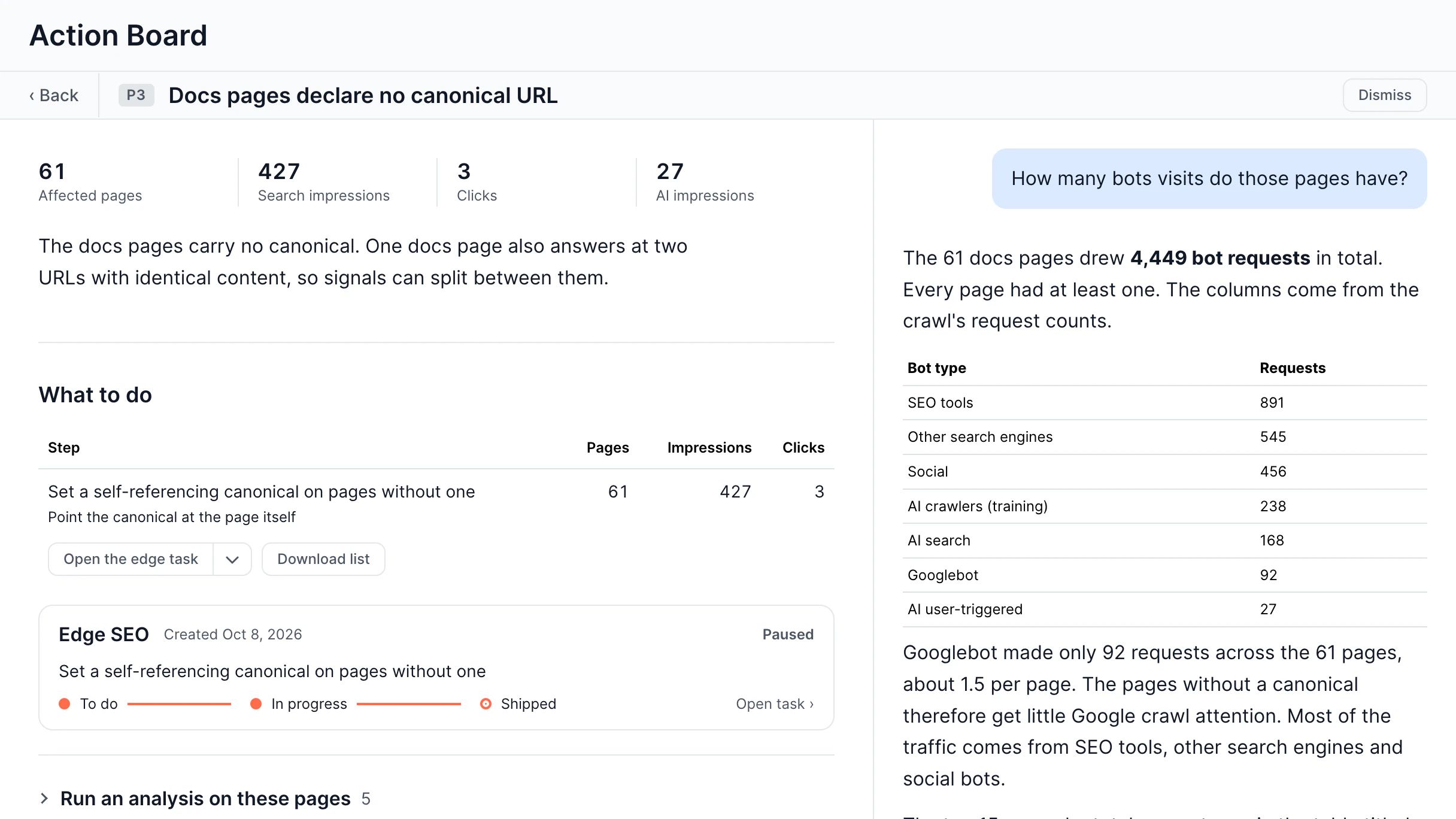
Chat panel next to any report that answers questions about its data.
Custom reports built from a chat request, with widgets you can edit and save.
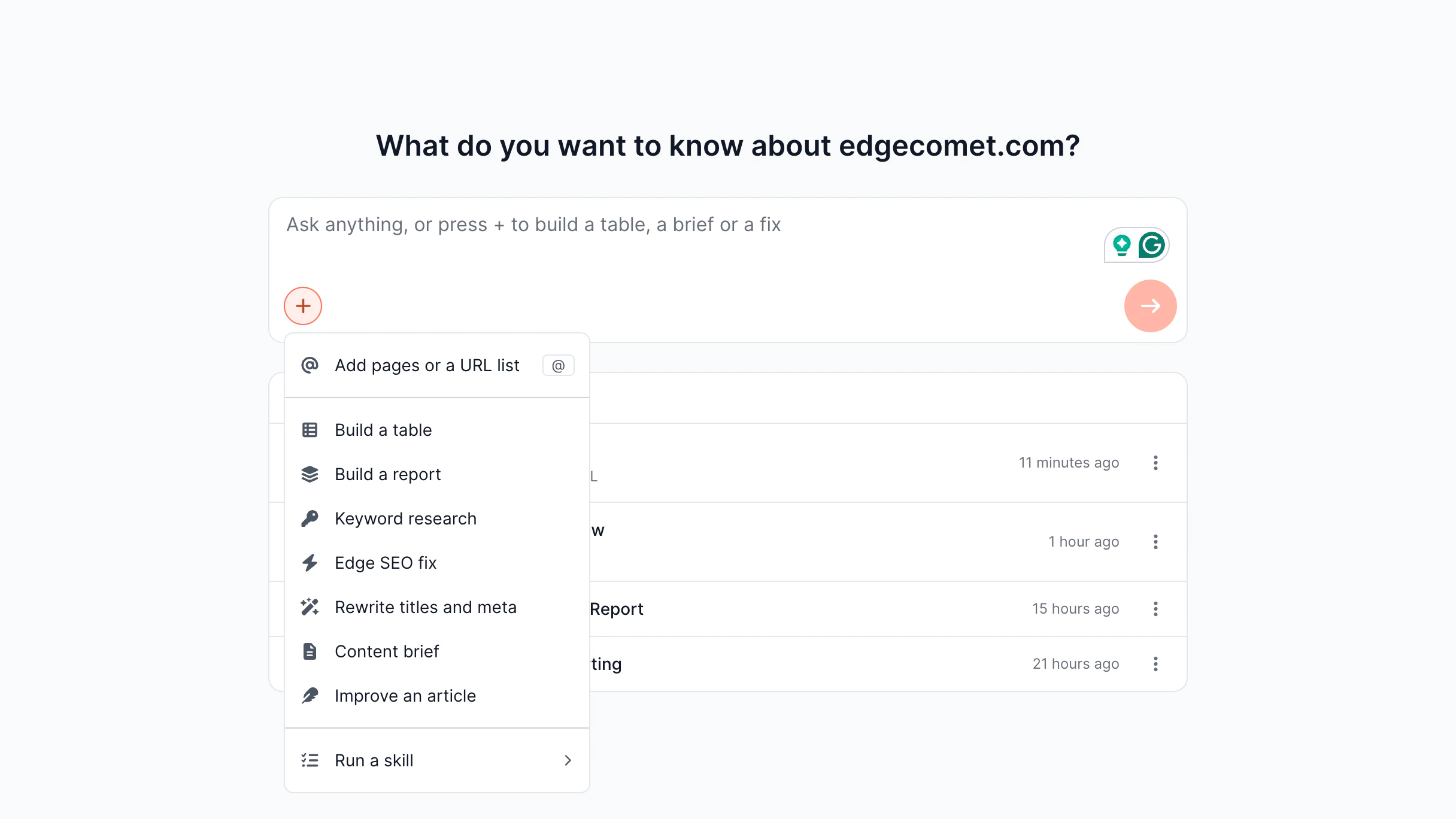
Skills menu: keyword research, content briefs, article and meta rewrites.
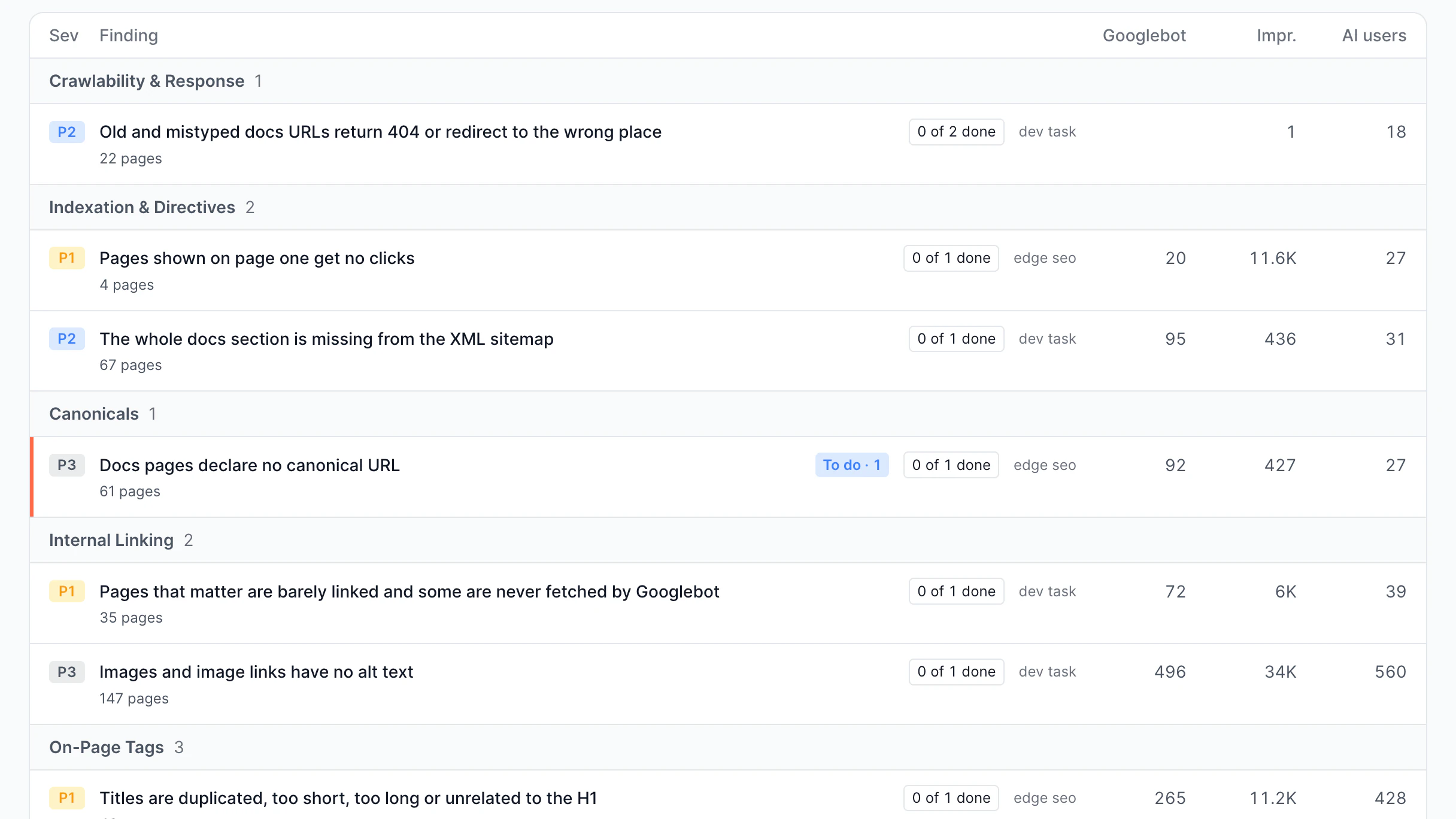
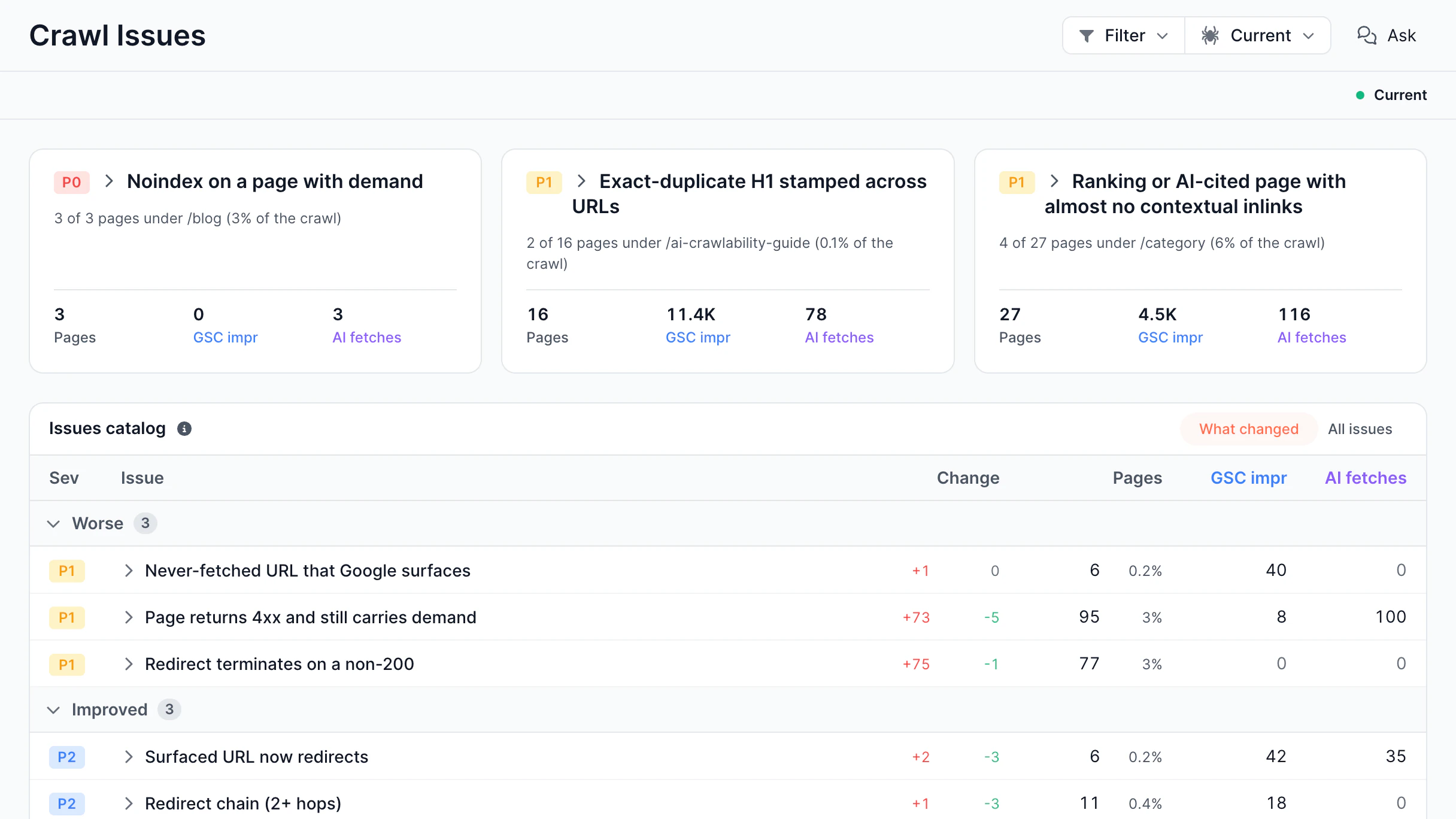
Findings by type and severity, with traffic per issue.
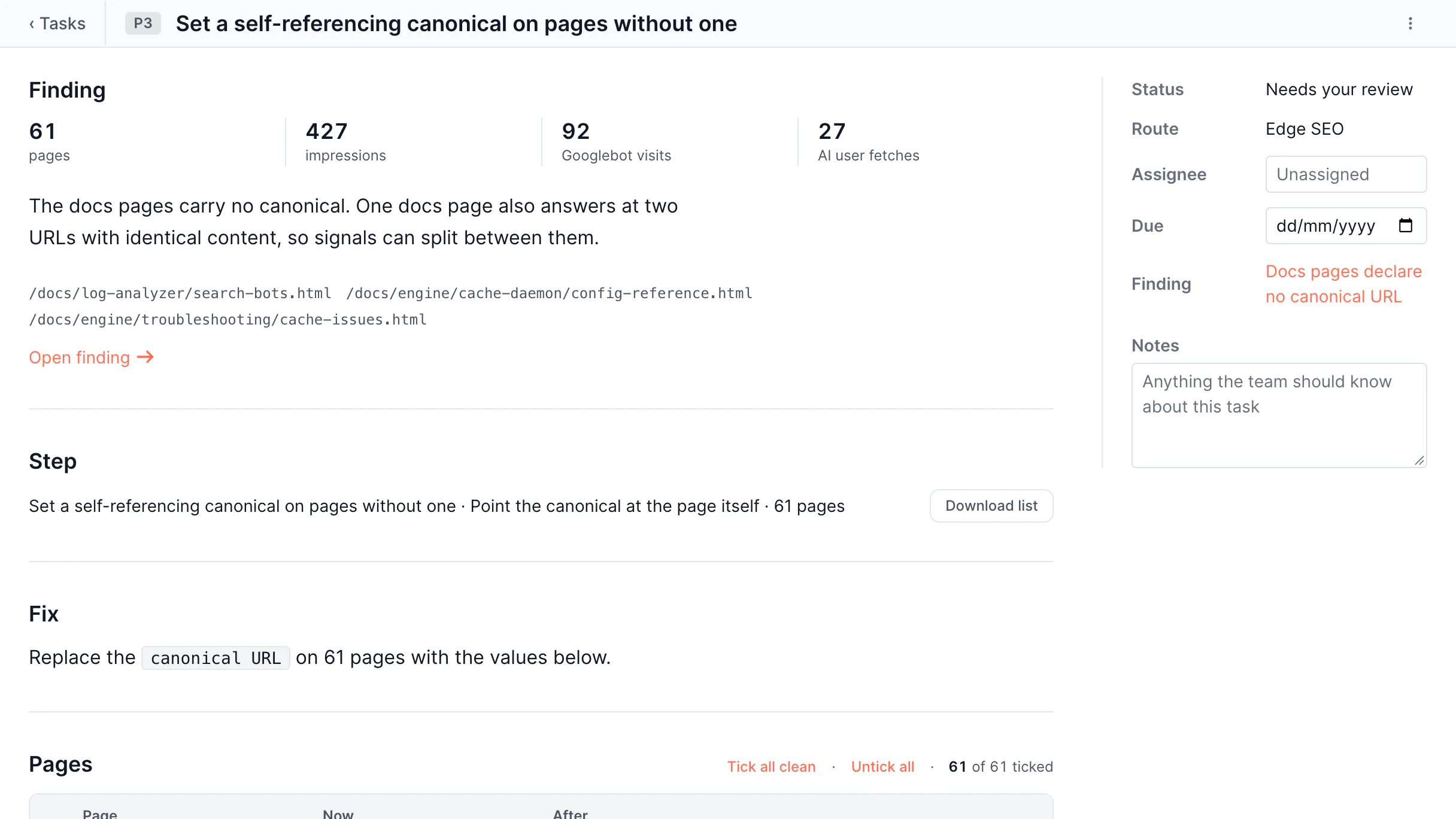
One finding: affected pages, fix steps, task status.
Task page with status, assignee, due date, and notes.
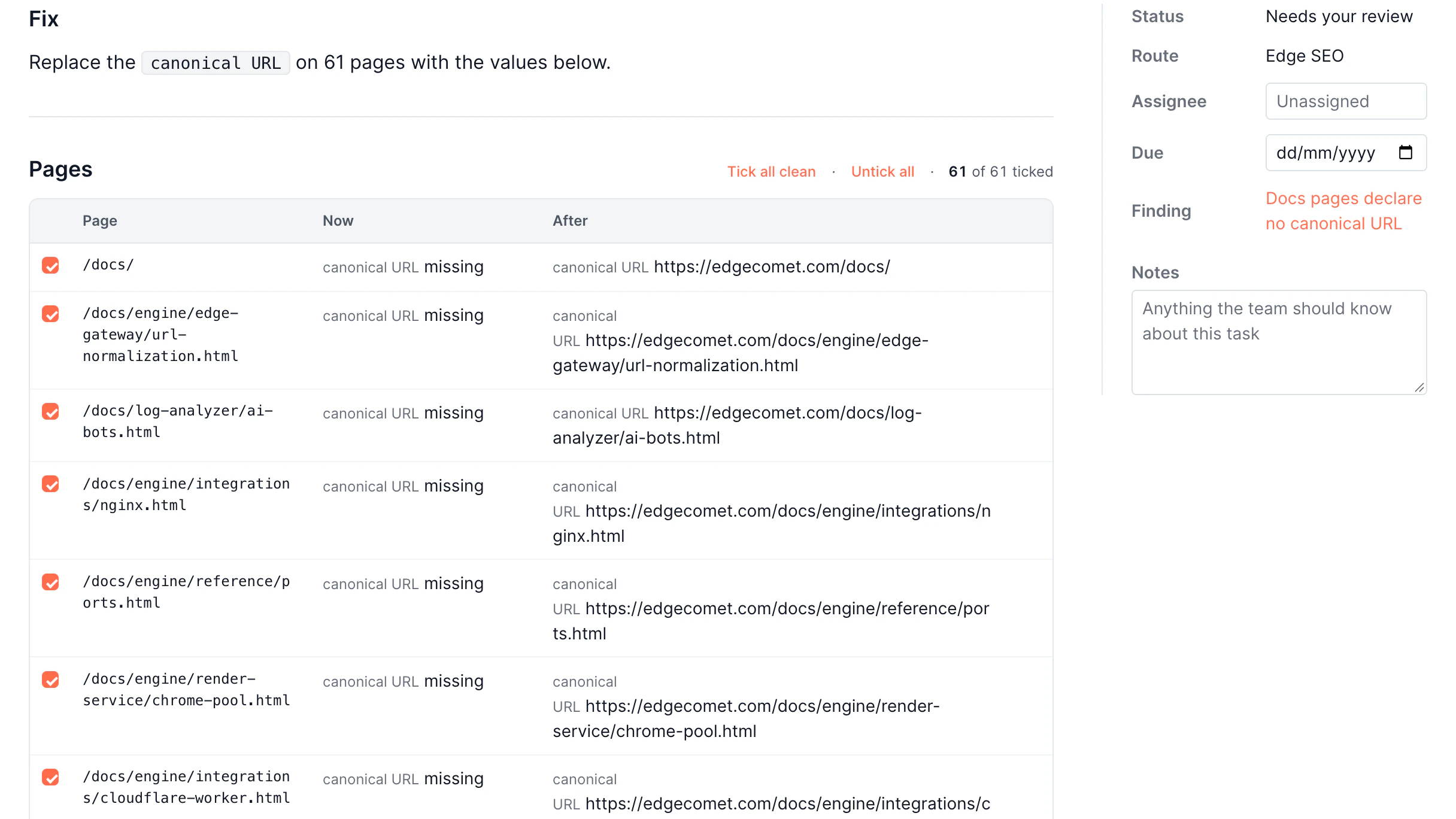
Before and after values per page, with edge deploy.
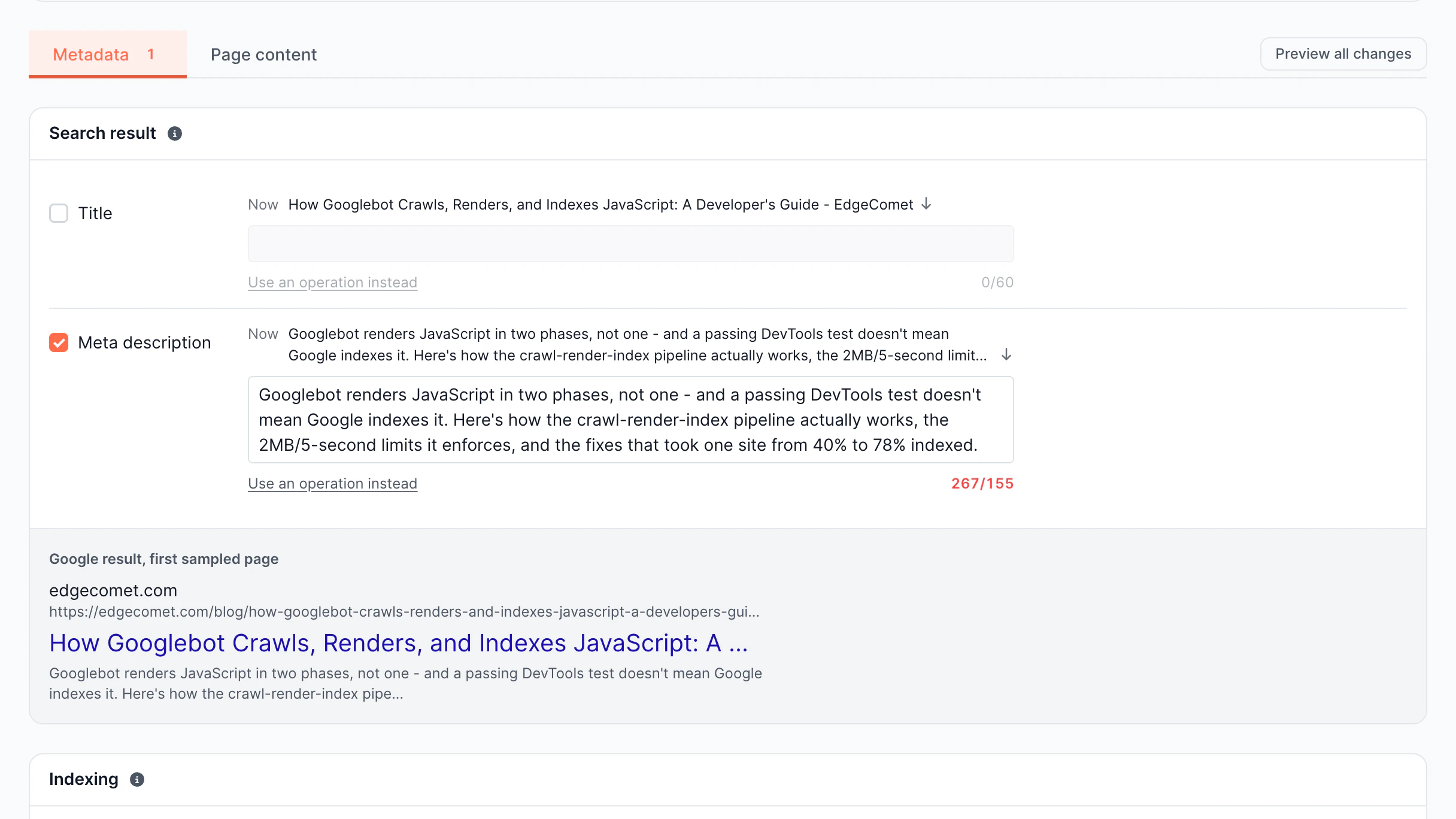
Title and meta overrides with a Google result preview.
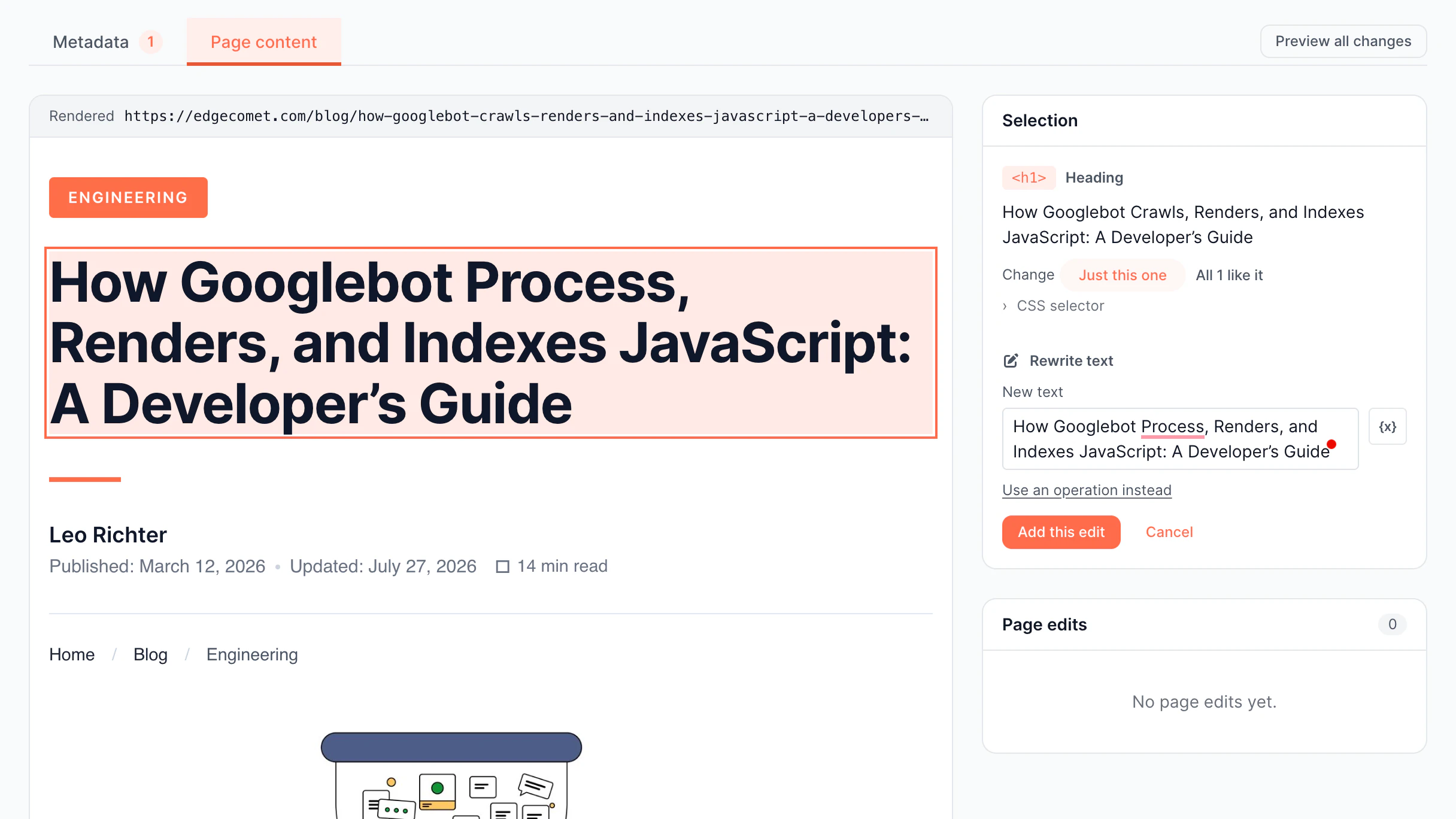
Select an element on the rendered page and edit its text.
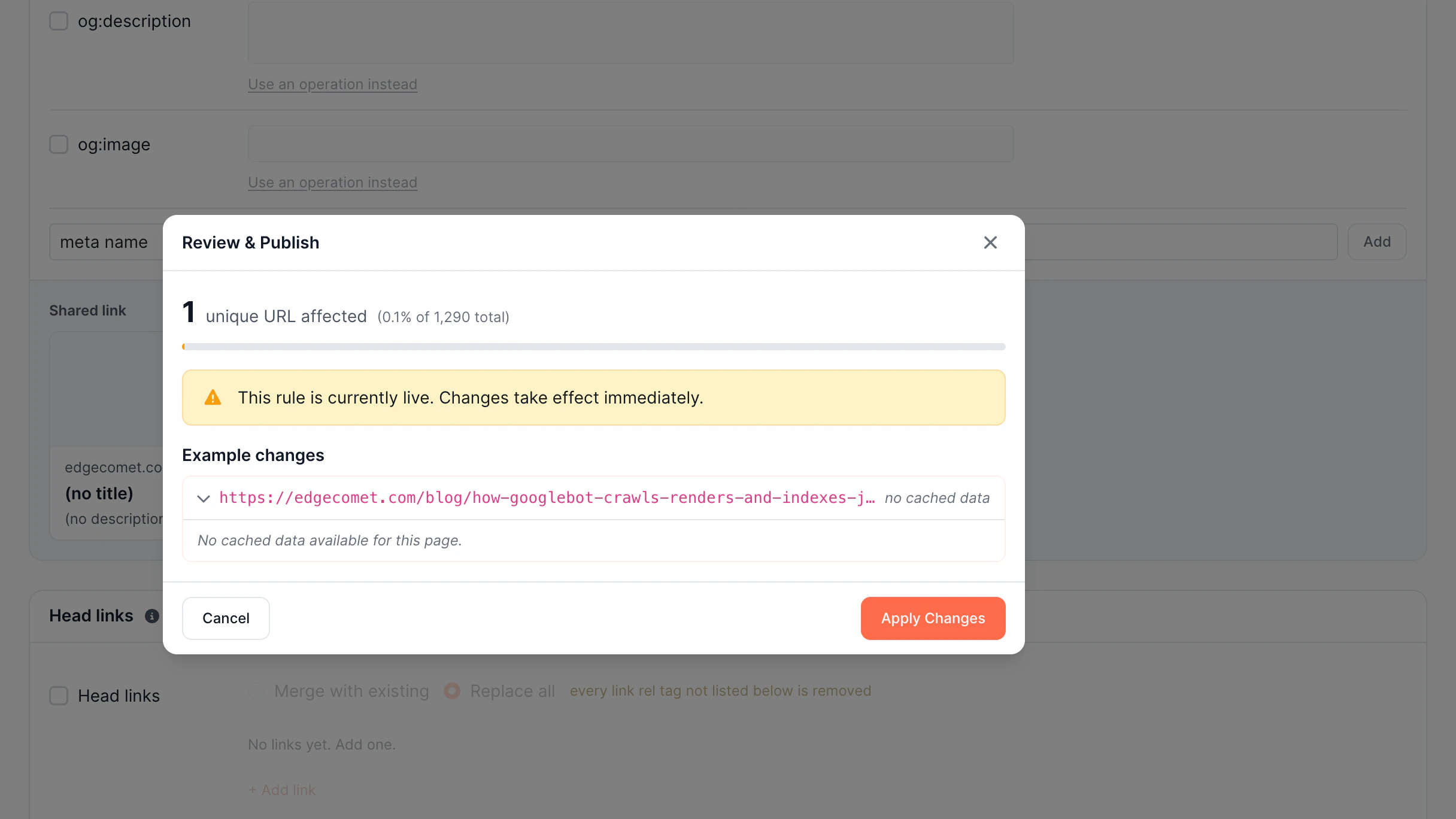
Review dialog with the number of URLs a rule changes.
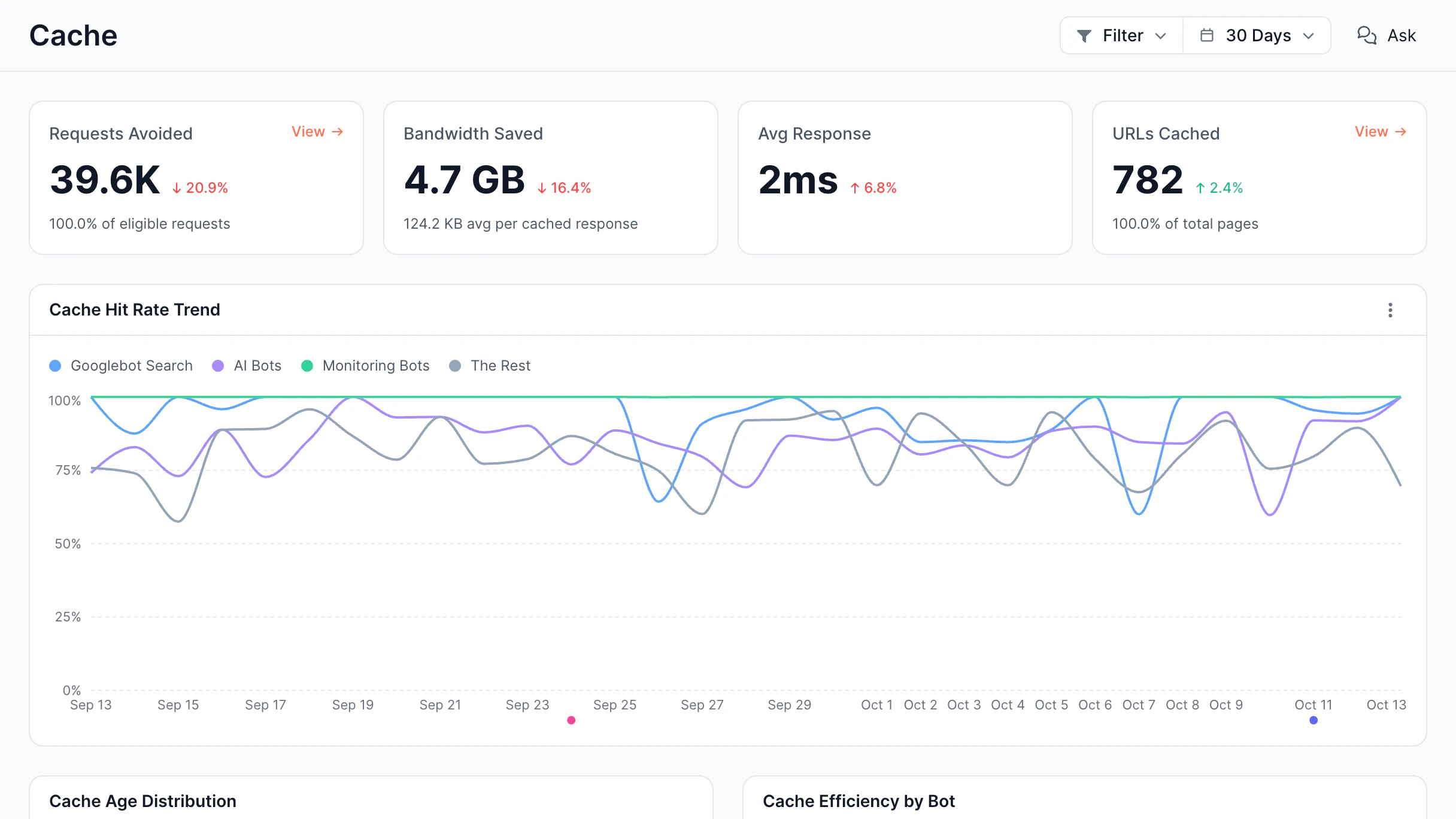
Hit rate, bandwidth saved, and cache age.
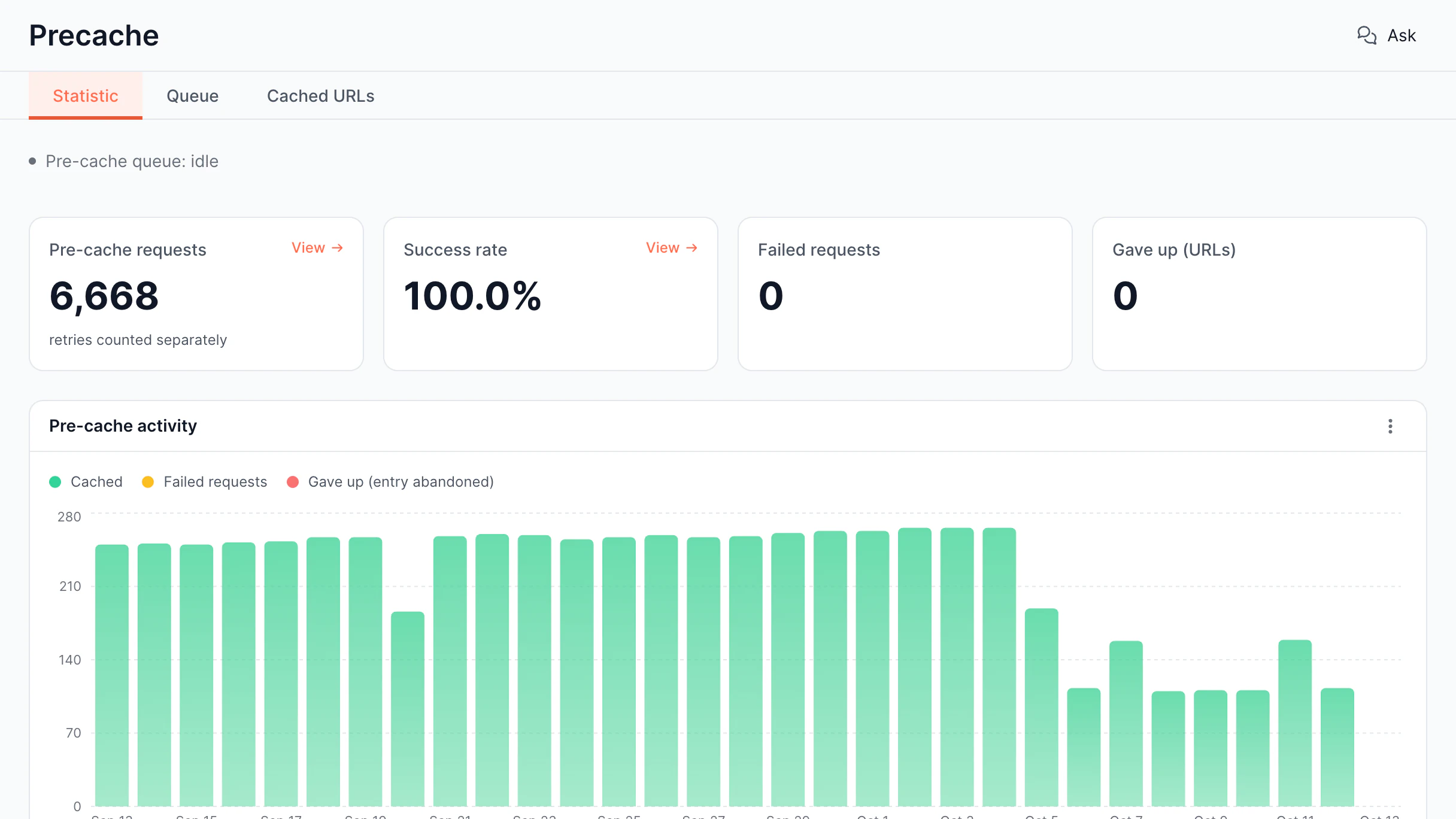
Pre-cache queue, success rate, and failures.
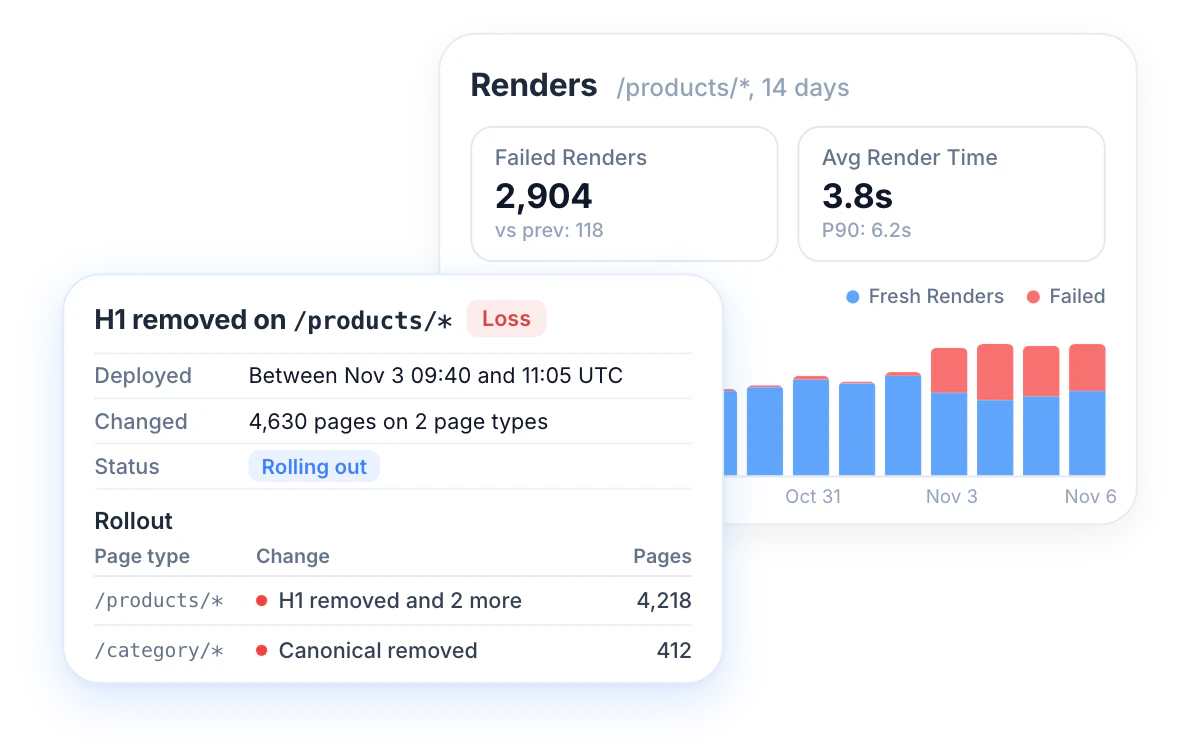
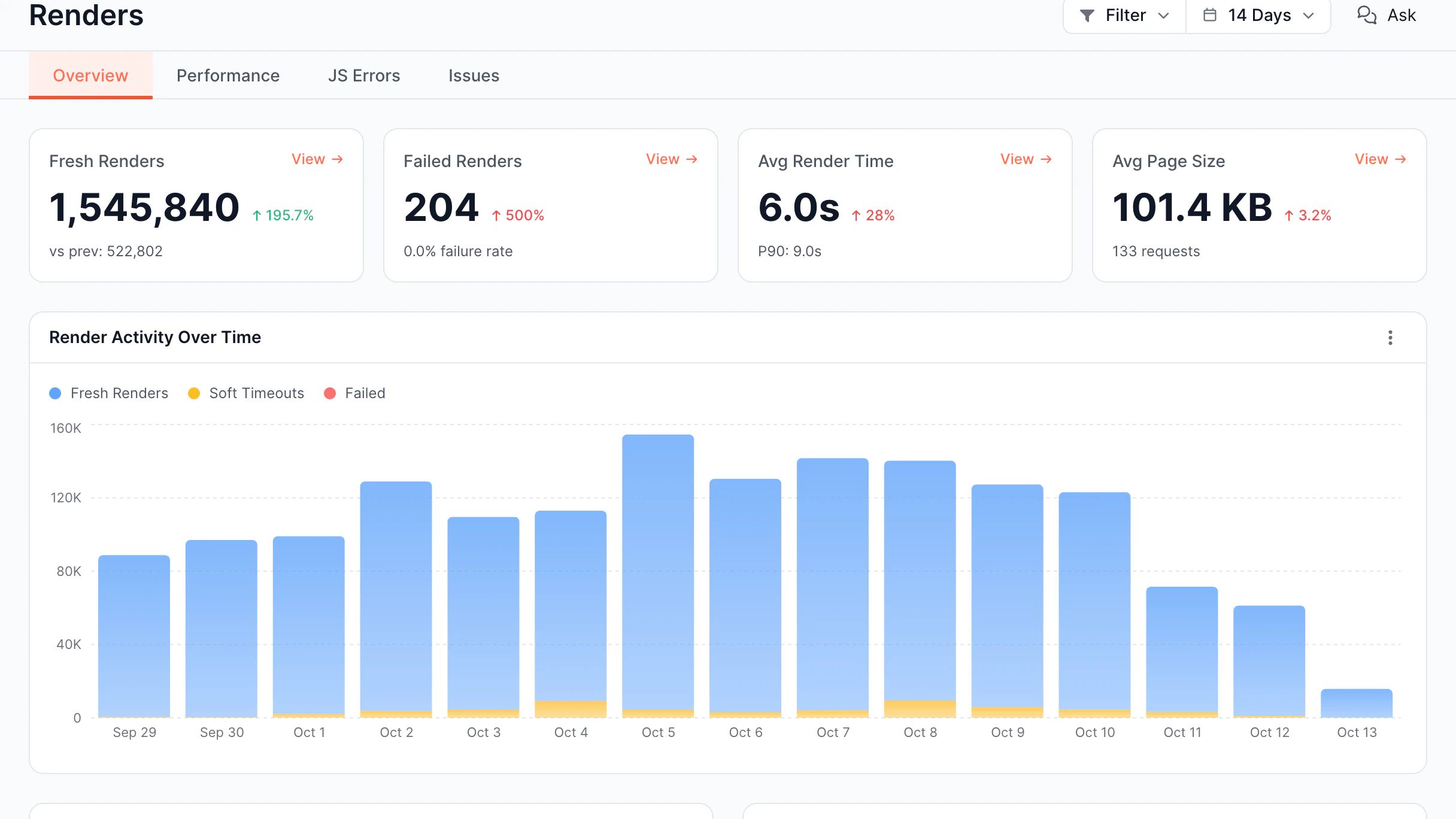
Renders per day, failures, and render time.
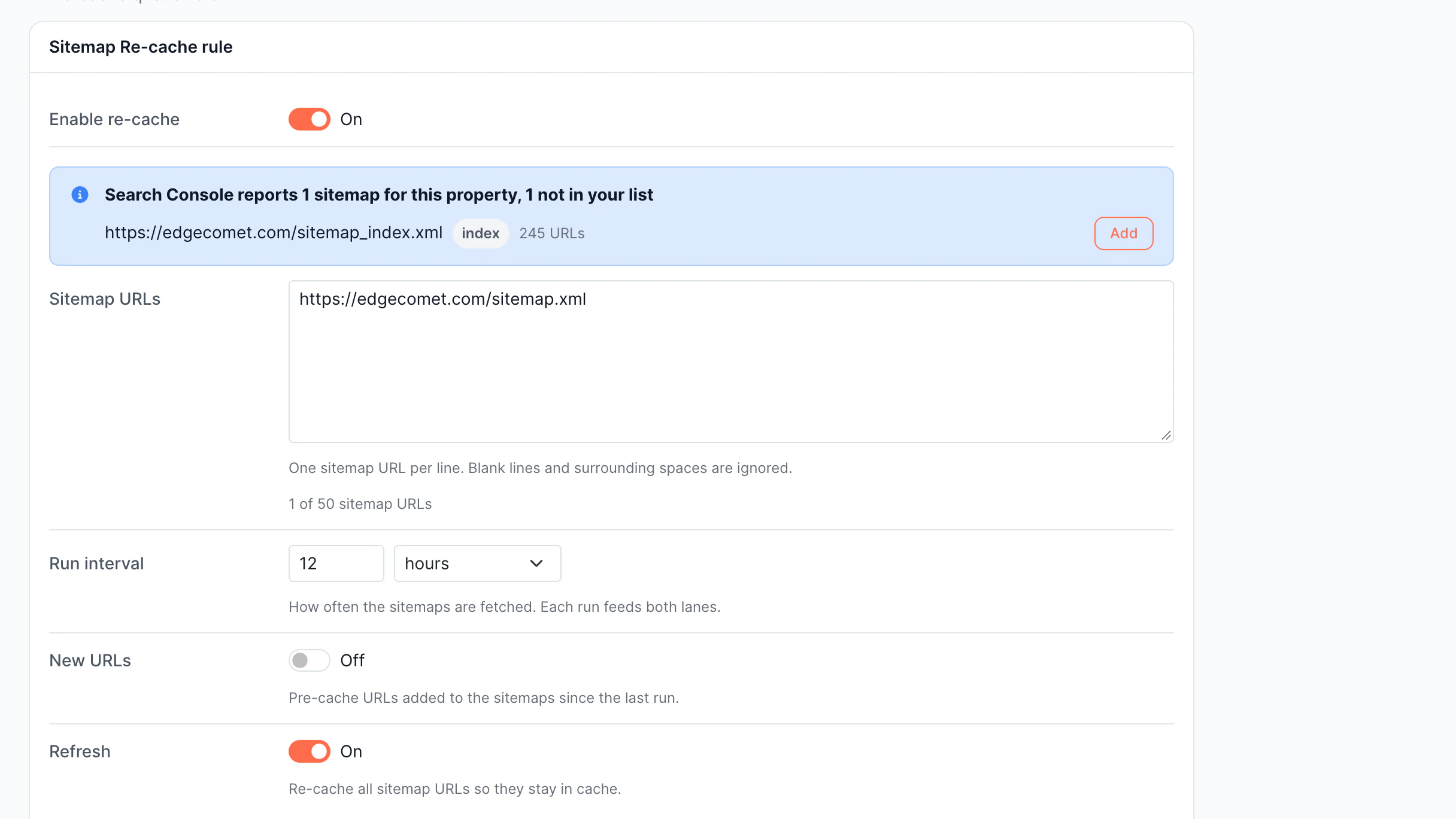
Re-cache rule for sitemap URLs on a schedule.
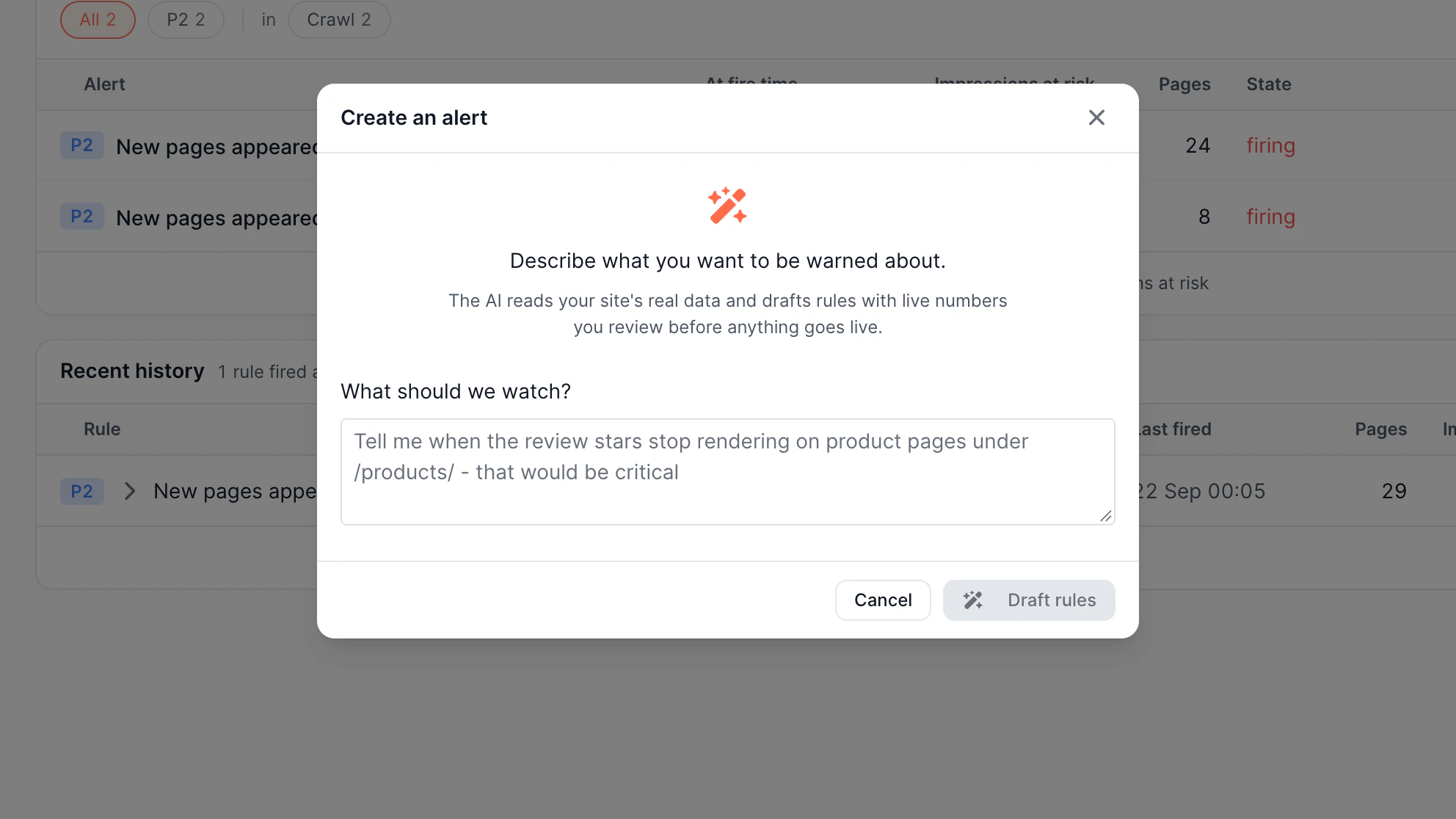
Create an alert by describing it in plain text.
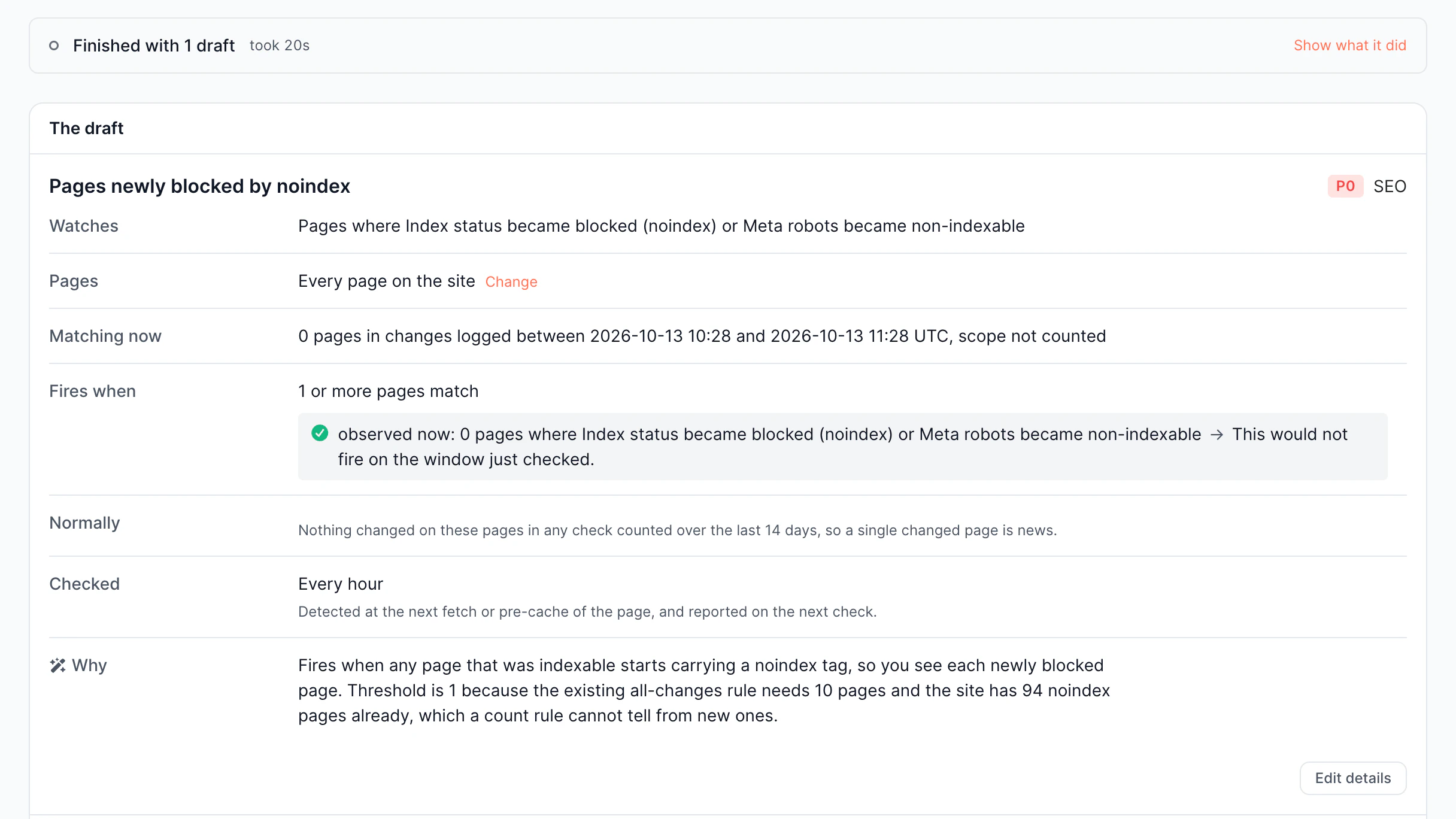
AI-drafted rule: what it watches and when it fires.
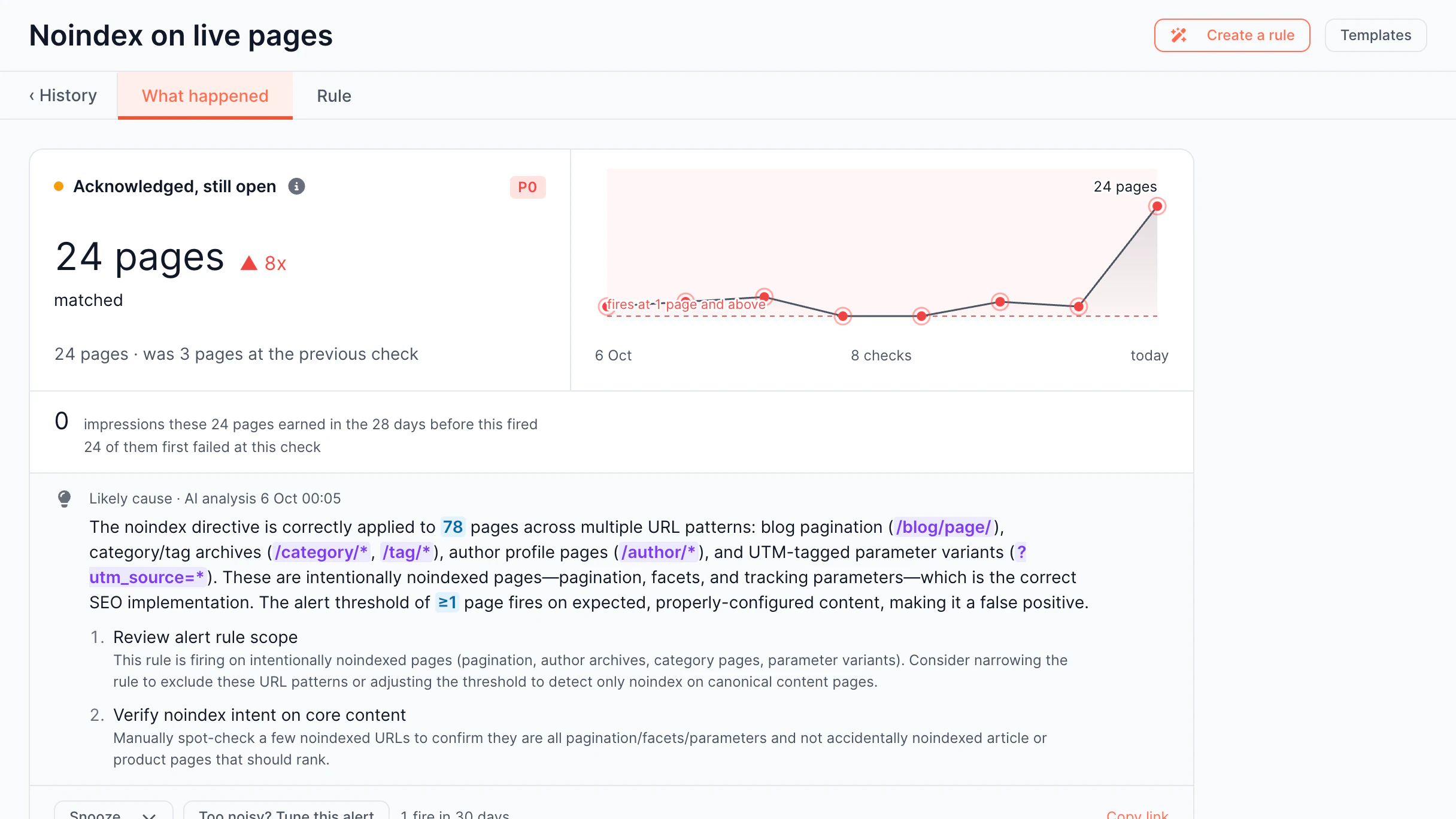
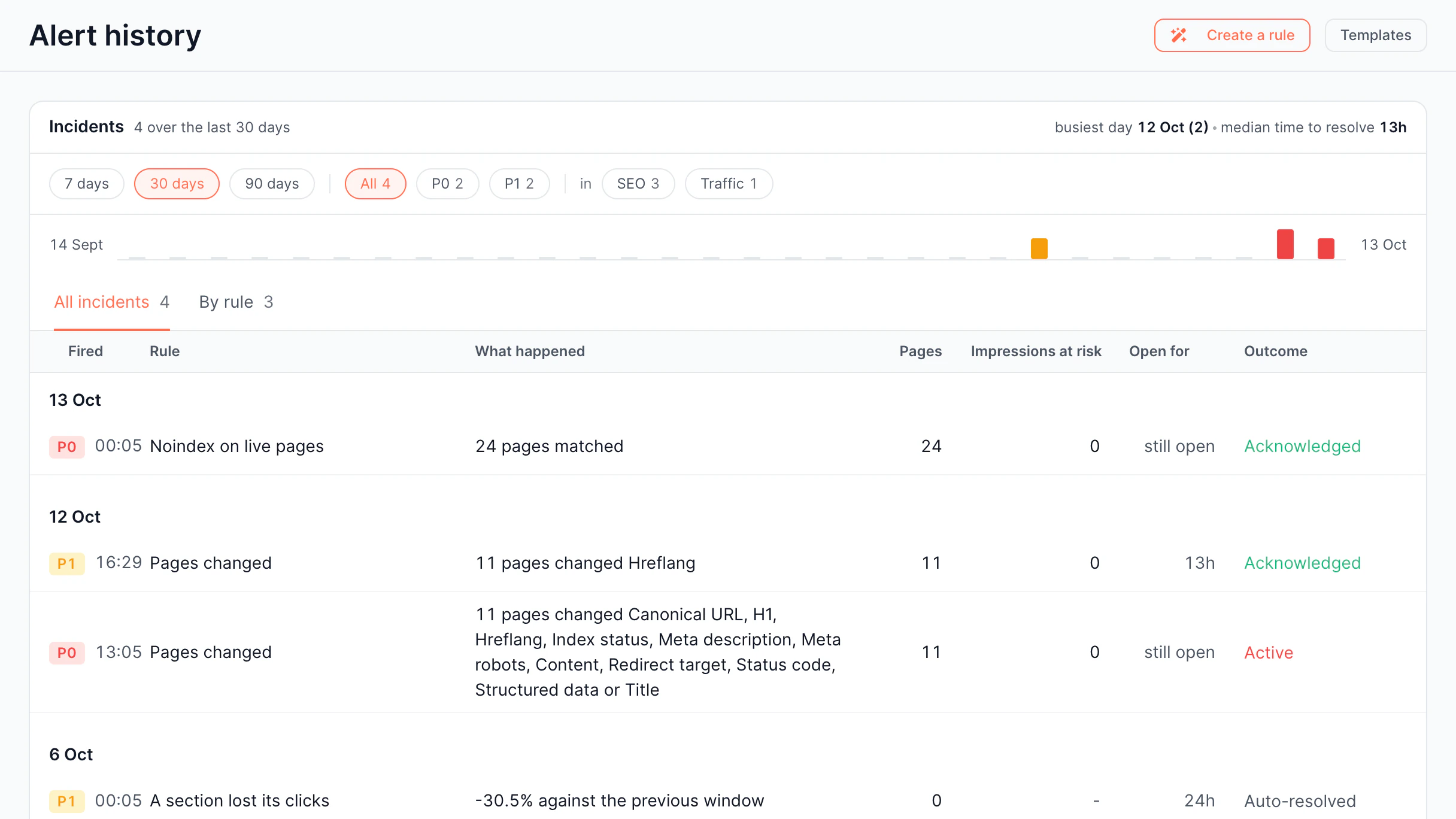
Incident page with matched pages and AI cause analysis.
Incident log with pages, impressions at risk, and outcome.
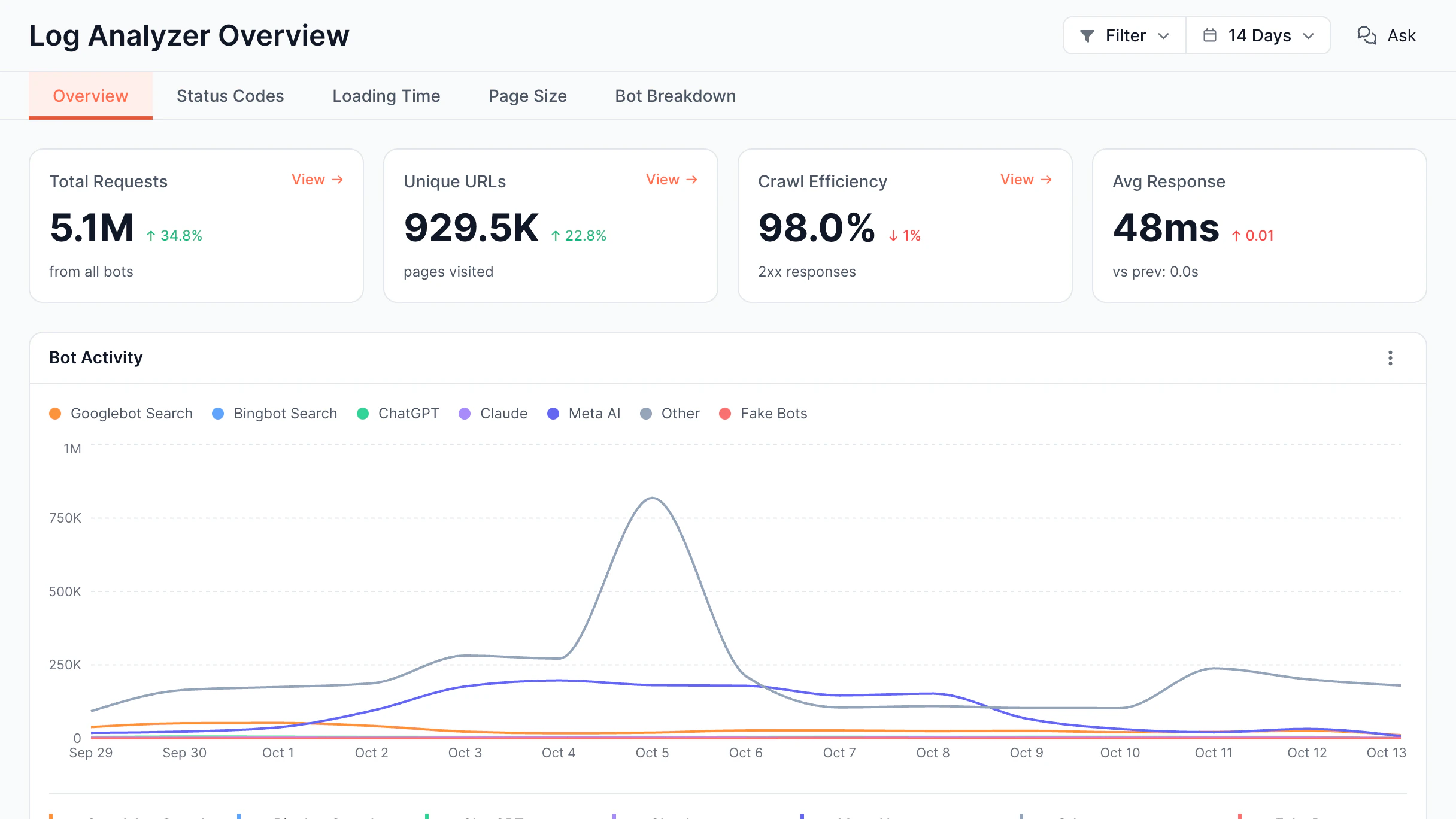
Requests per bot family, with status and response time.
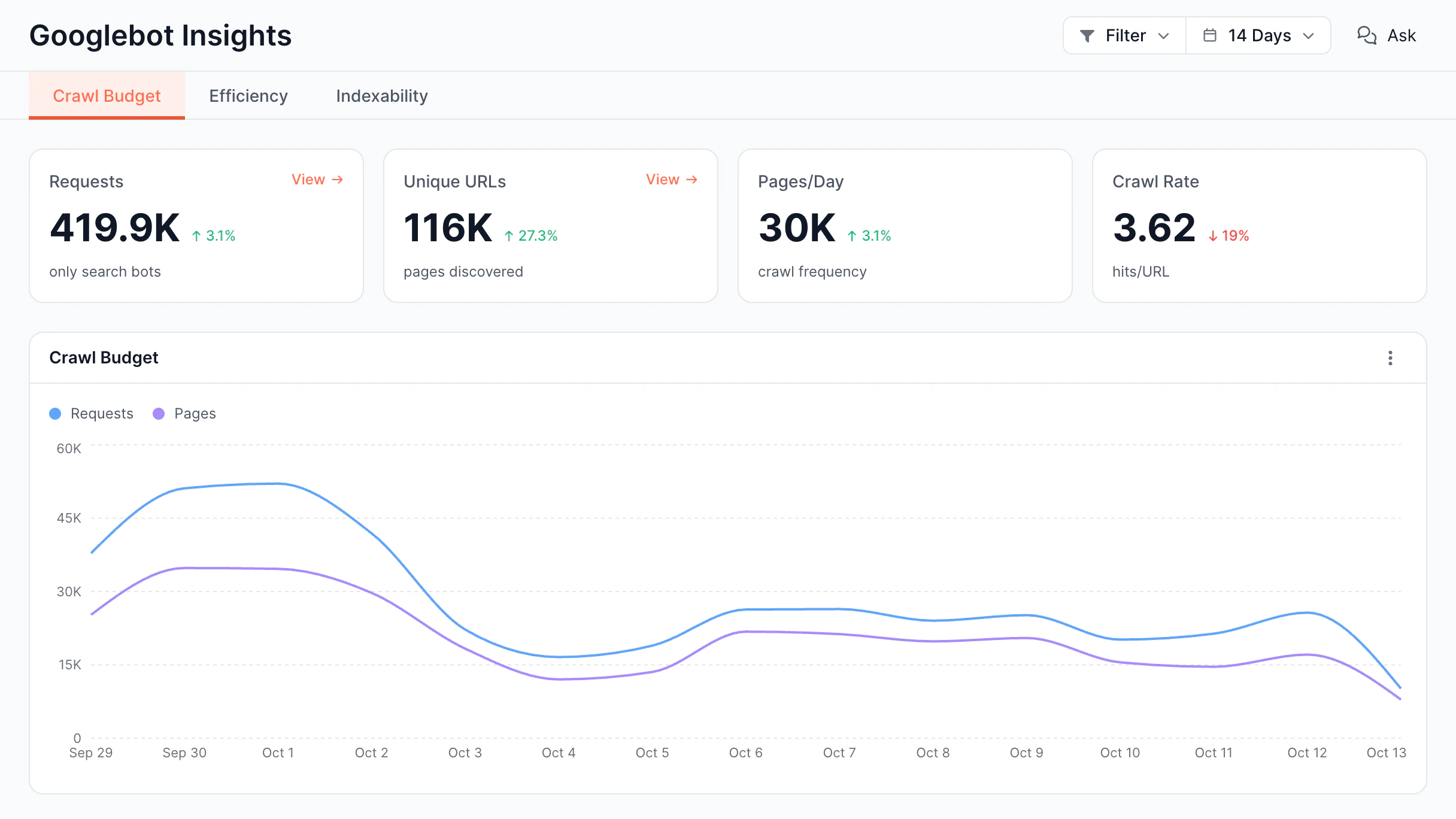
Googlebot requests, unique URLs, and crawl rate per day.
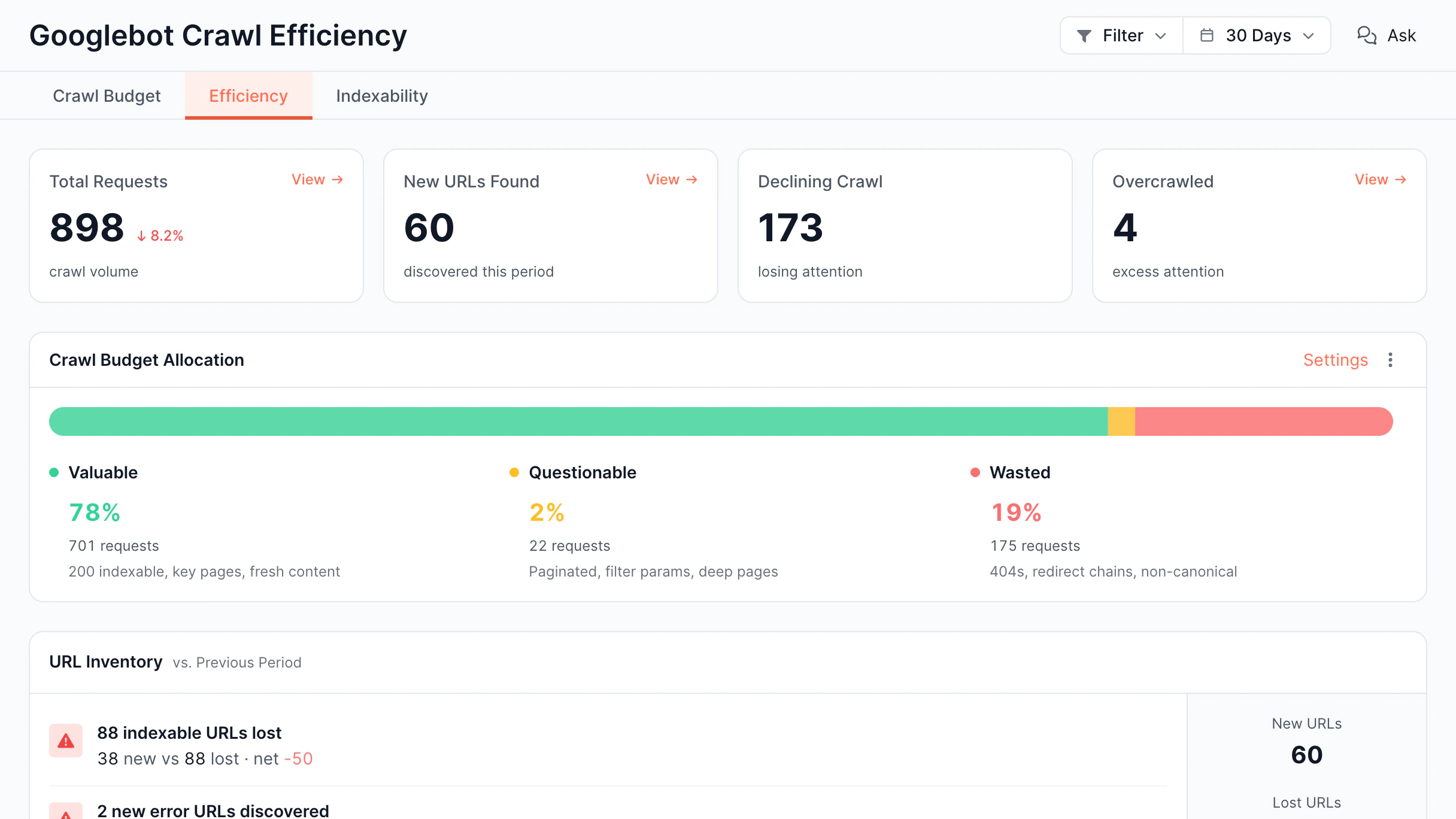
Googlebot crawl split into valuable, questionable, wasted.
Audit issues that changed since the last crawl.
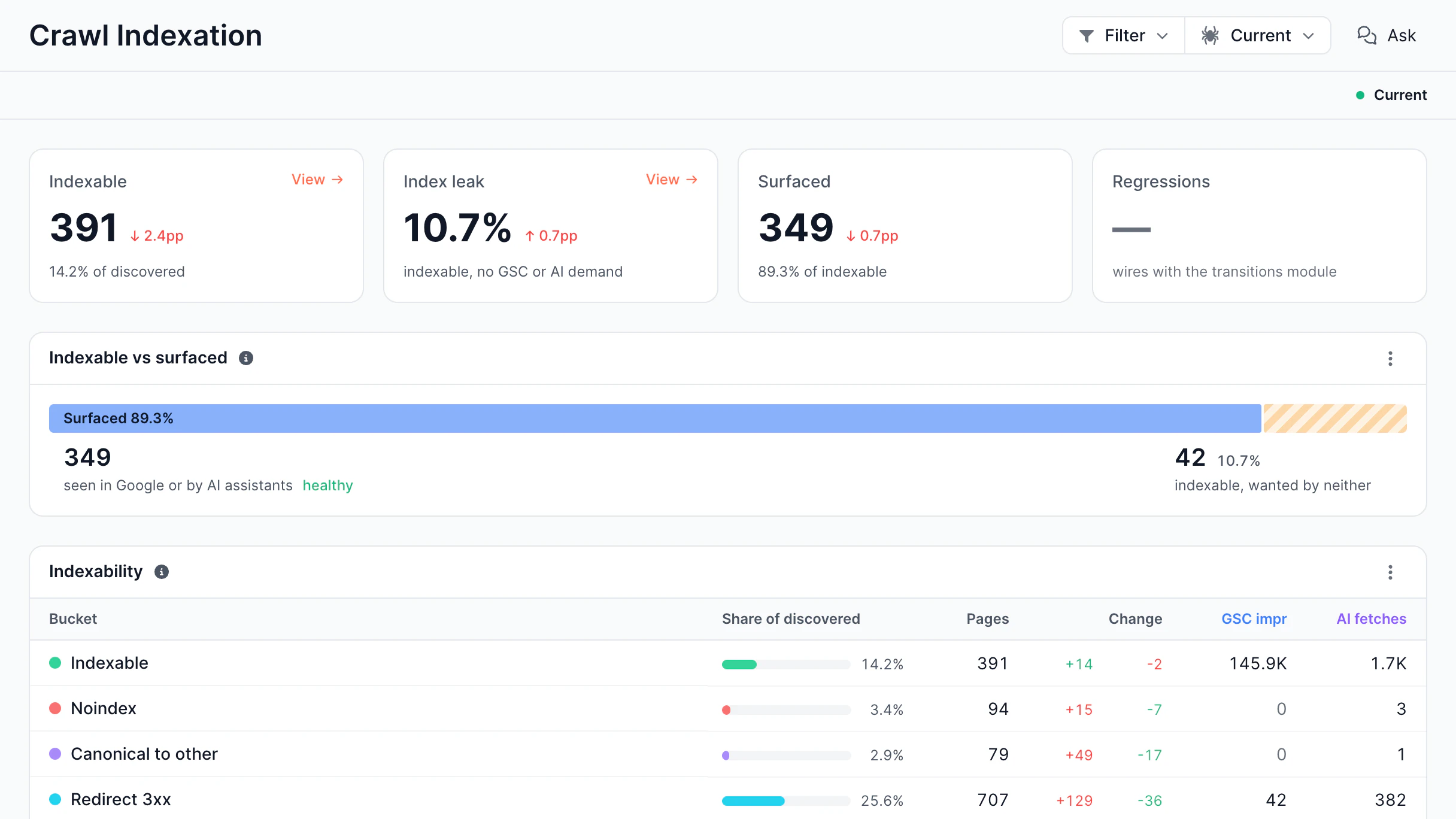
Indexable, noindex, canonicalized, and redirected pages.
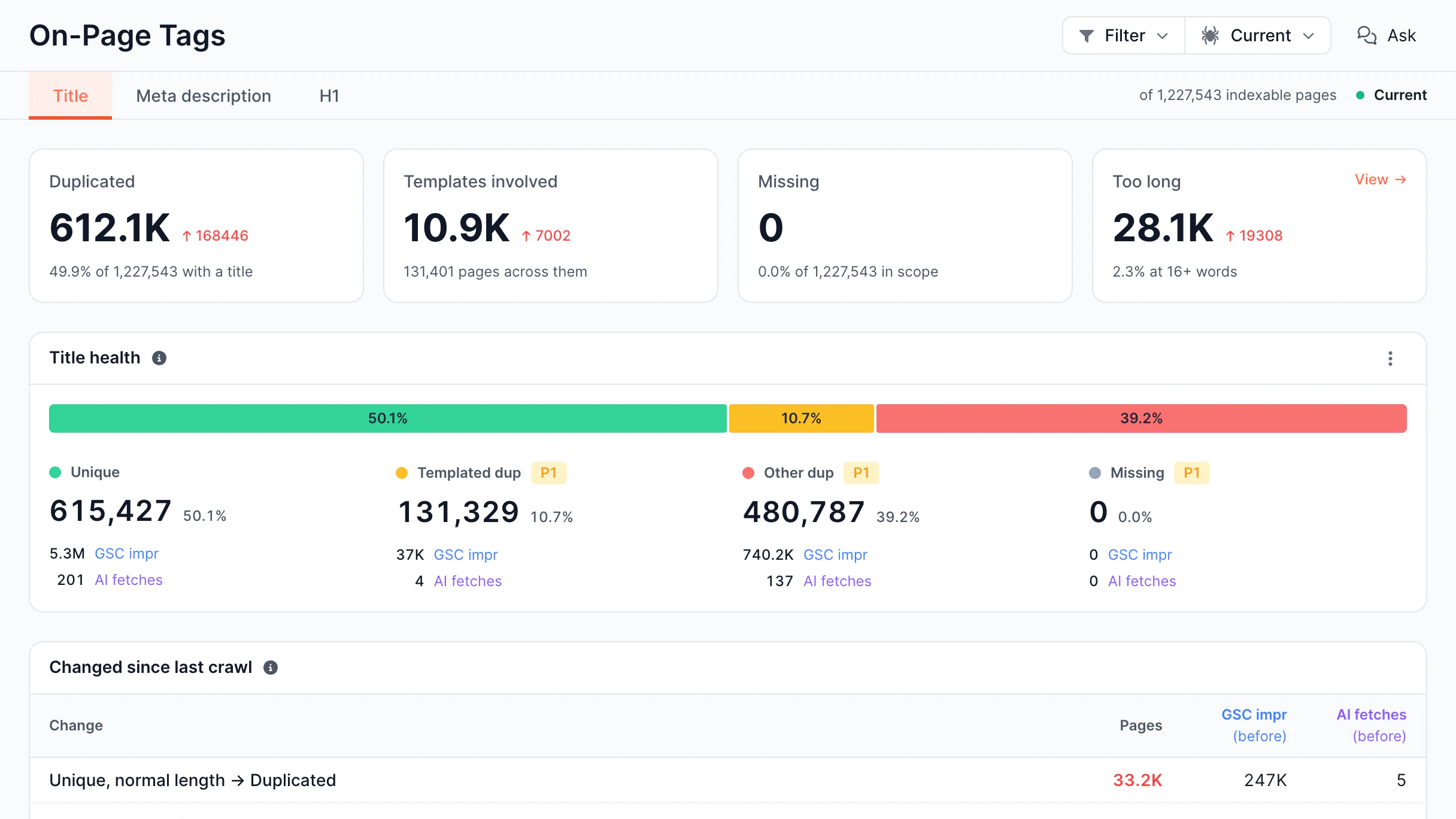
Duplicate, missing, and too-long titles.
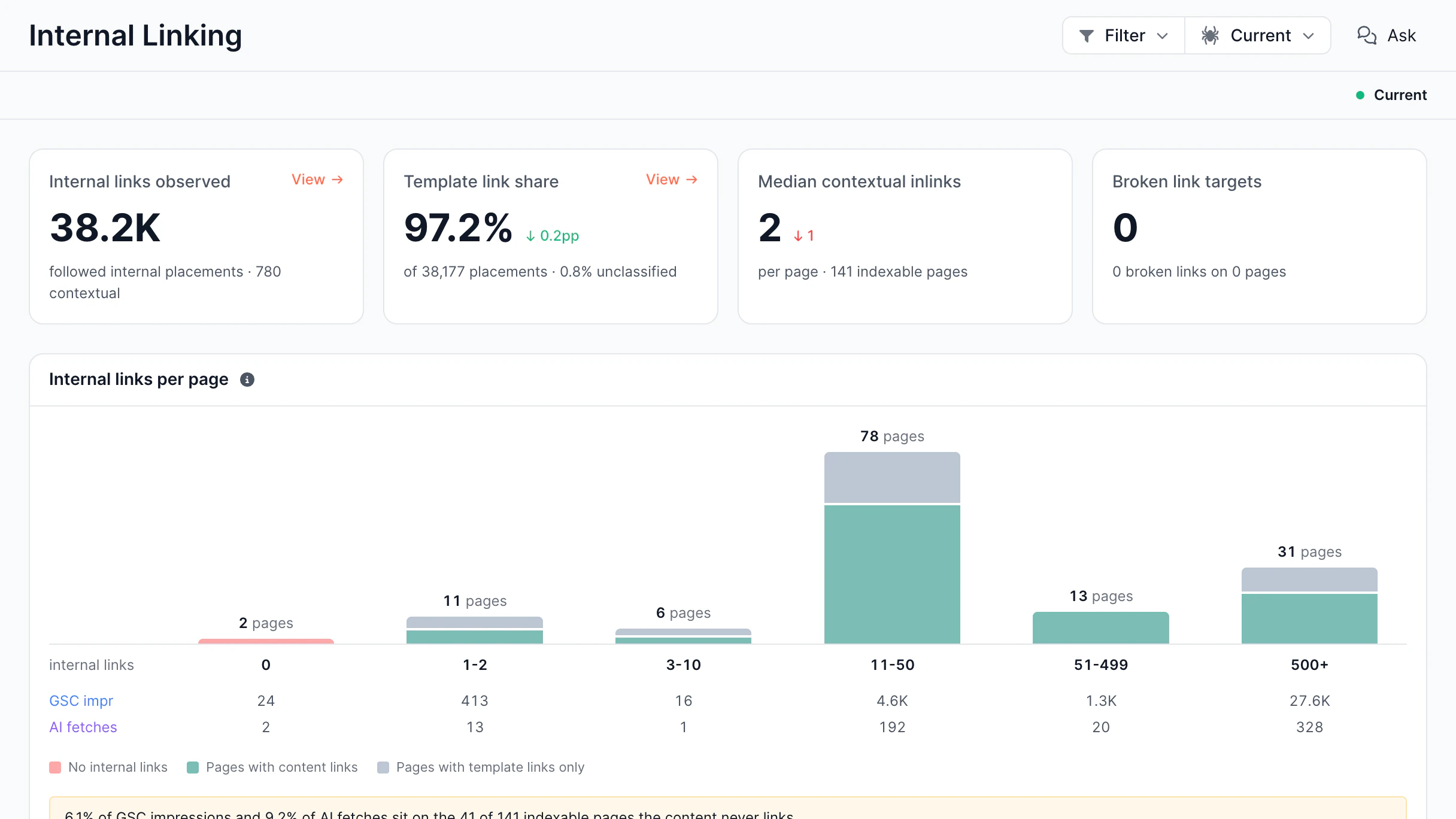
Internal links per page, content vs template.
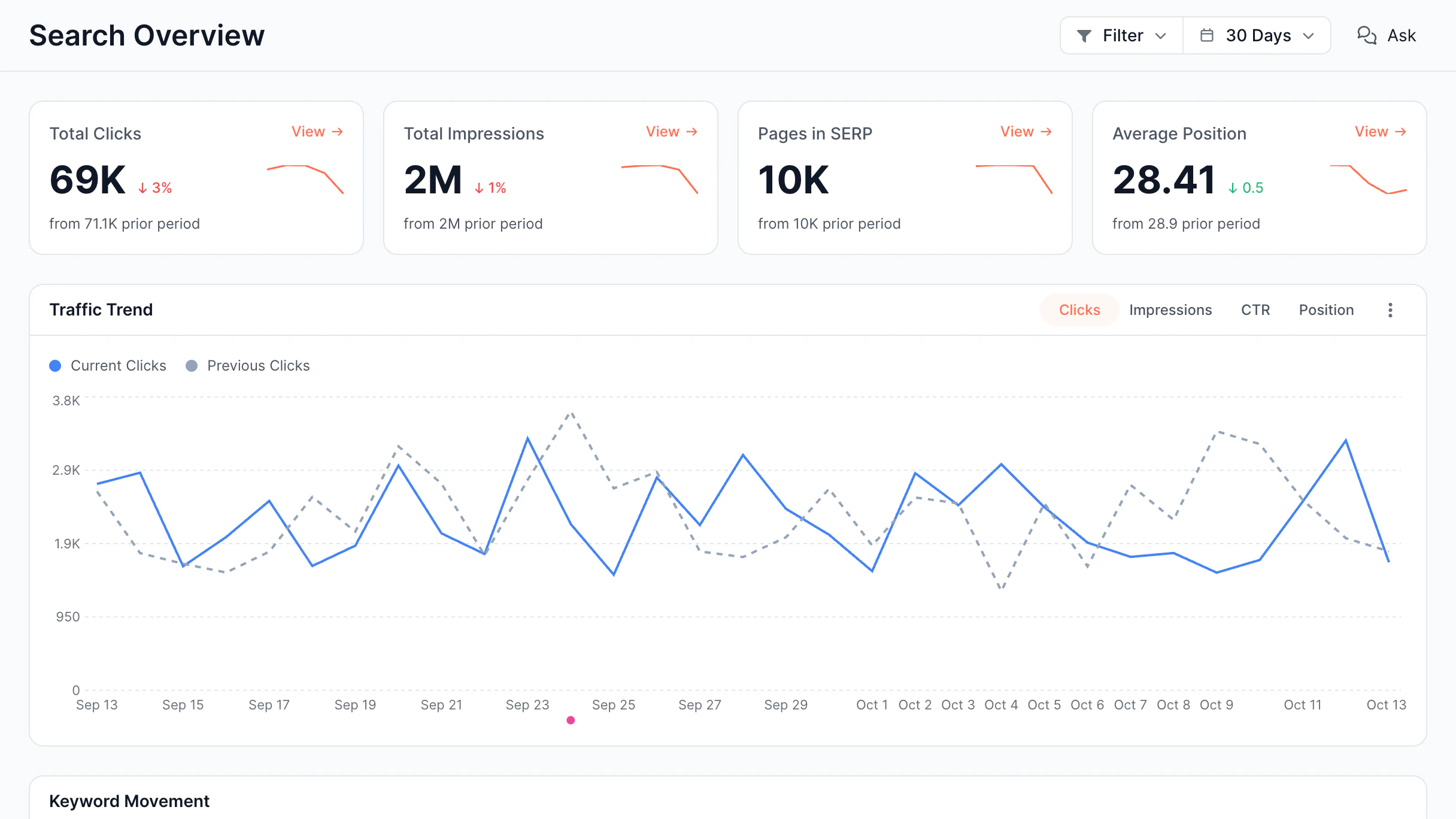
Search Console clicks, impressions, and position vs the previous period.
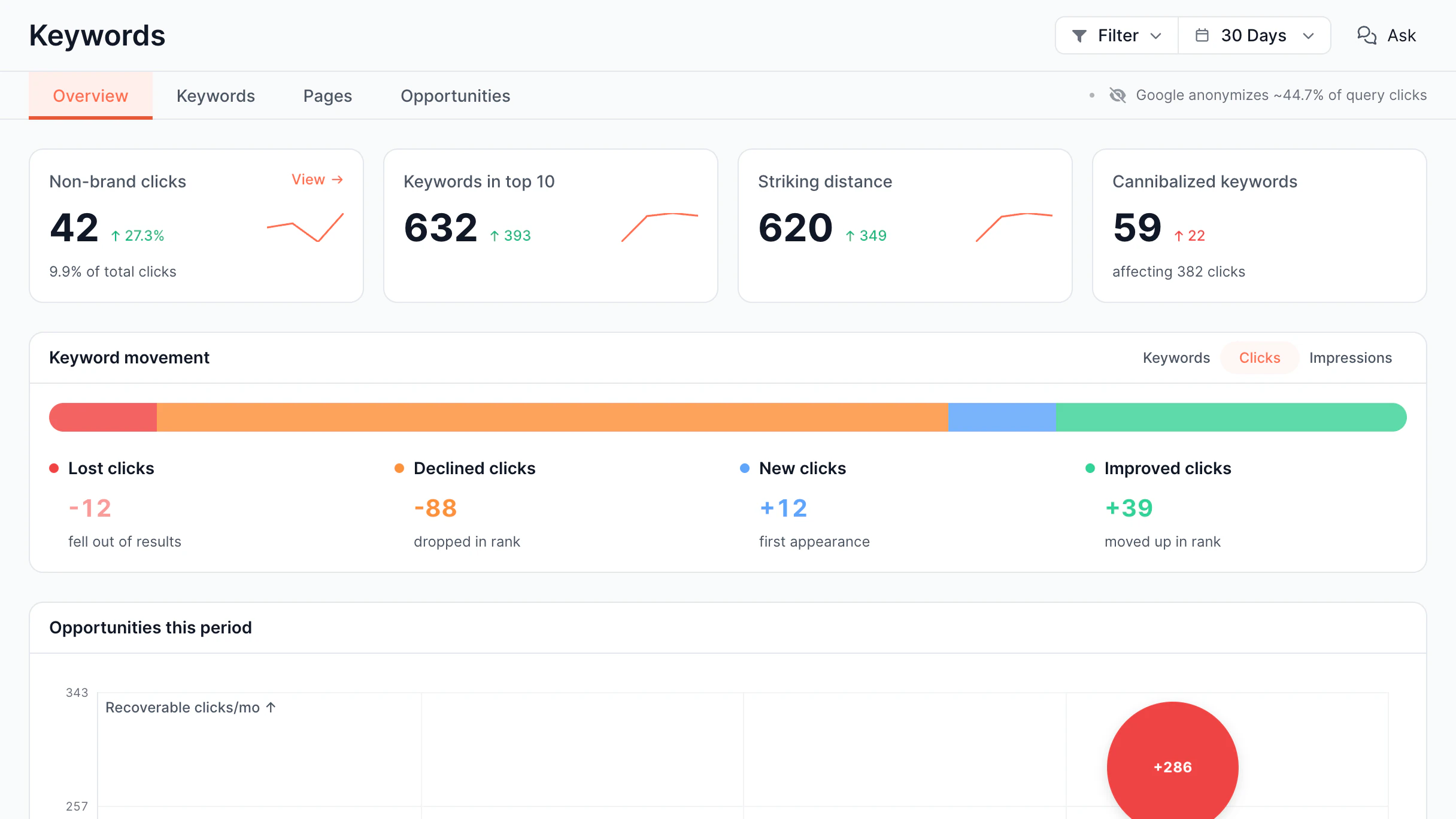
Keyword movement, top-10 counts, and striking-distance keywords.
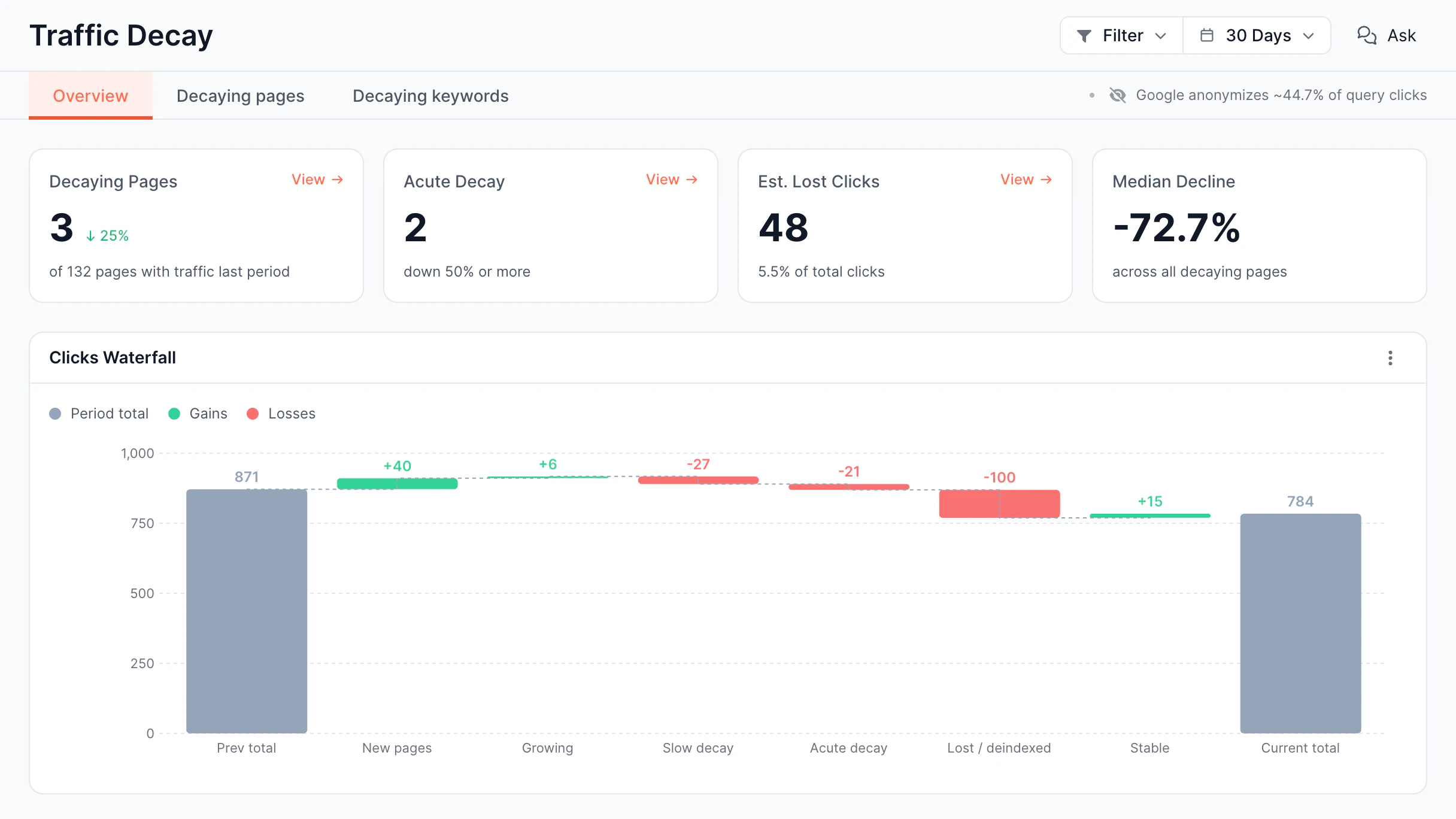
Pages losing clicks, split into slow decay, acute decay, and deindexed.
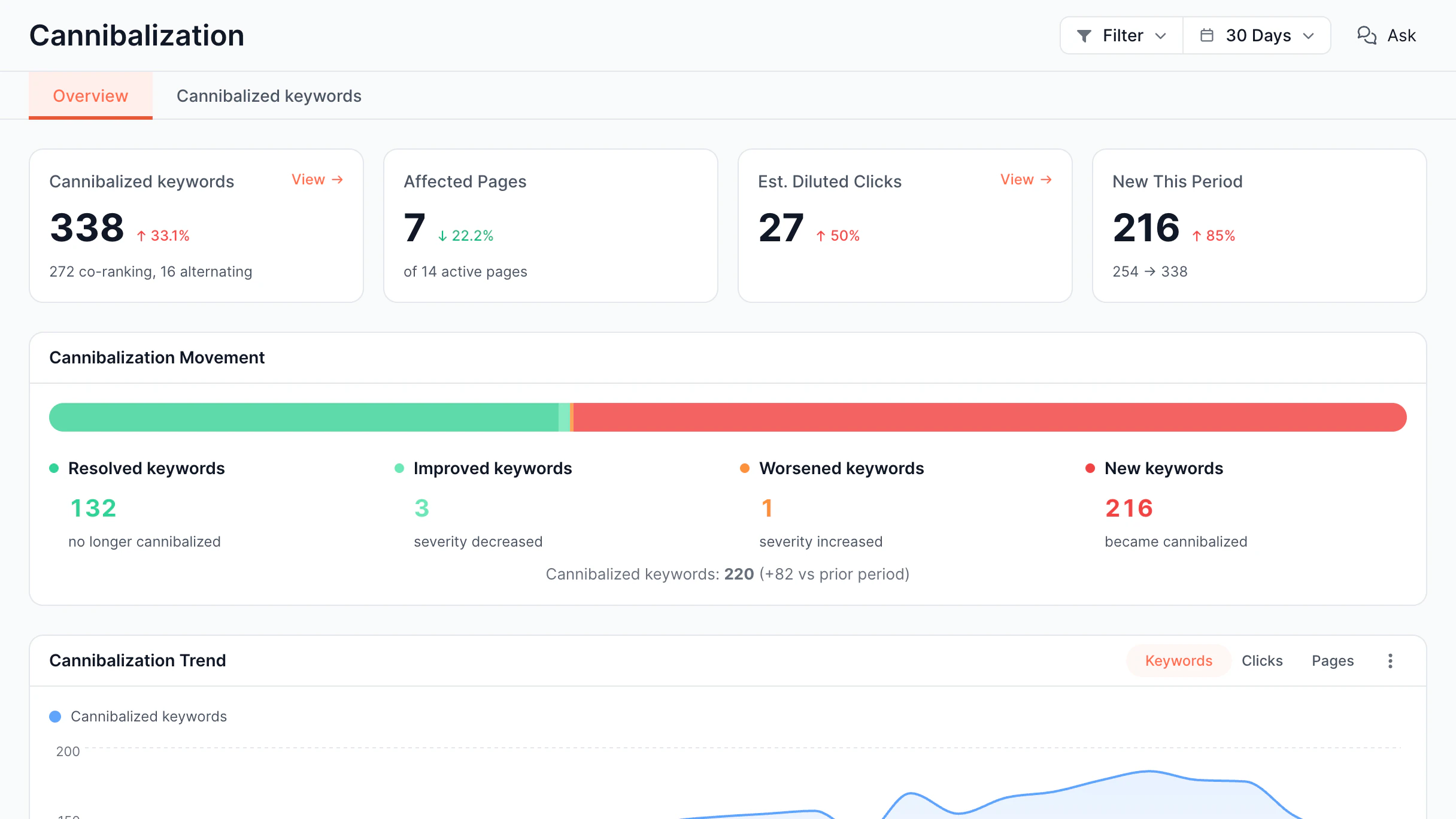
Keywords where several of your pages rank, and how that changed.
Googlebot fetches vs search and AI demand by page type.
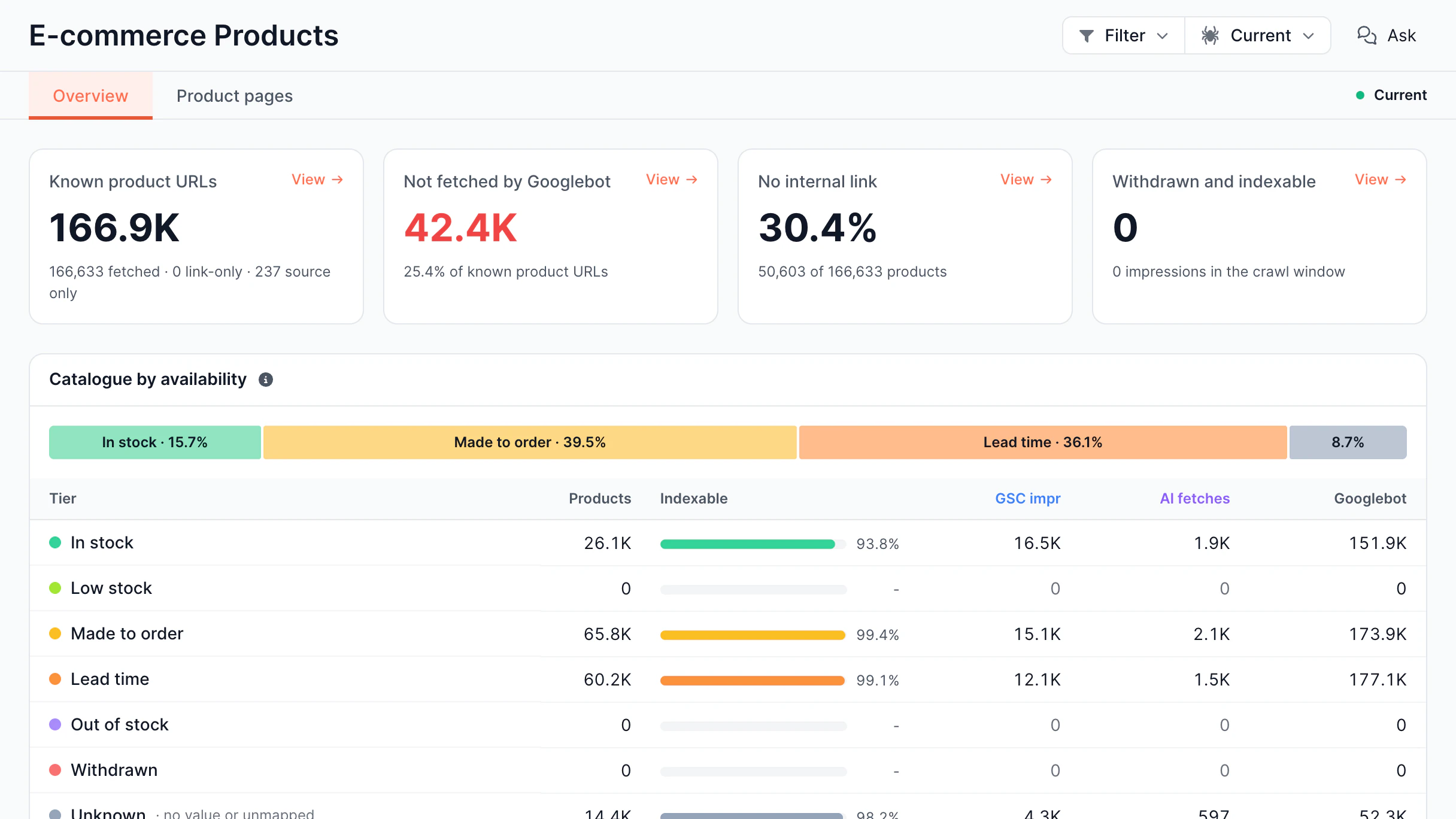
Products not fetched by Googlebot or not linked.
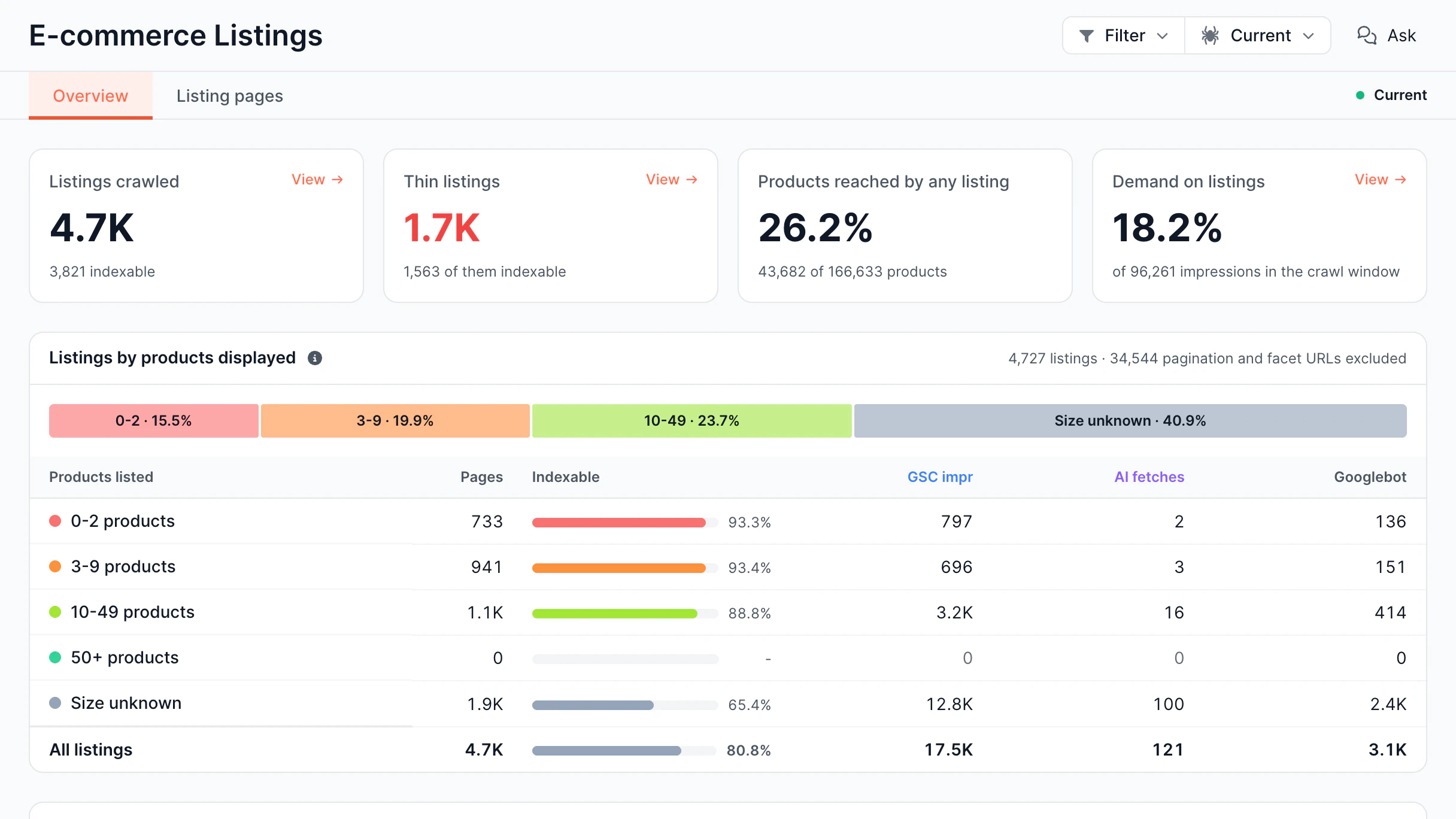
Category pages by number of products listed.
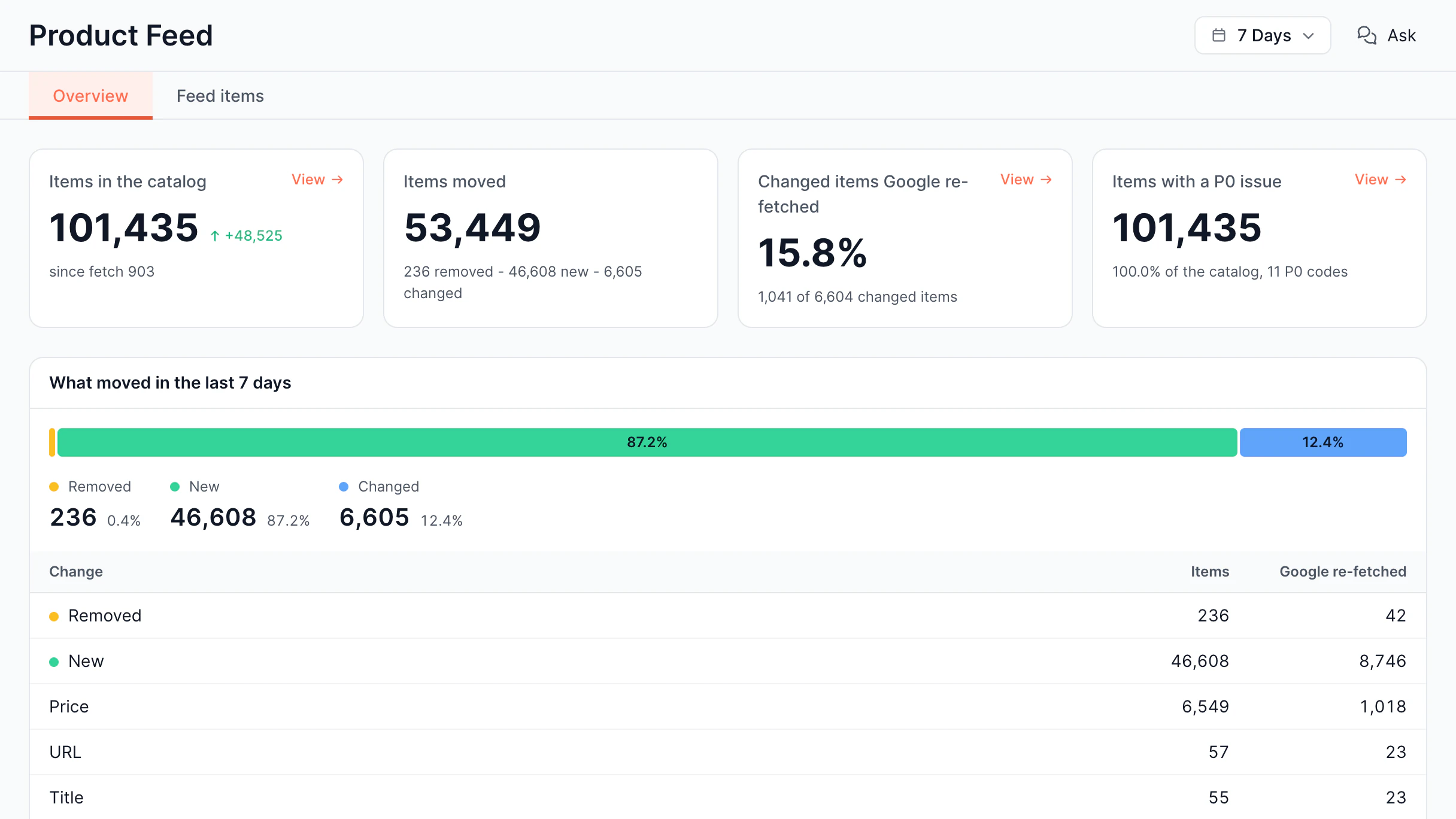
Merchant feed changes and Google re-fetches.
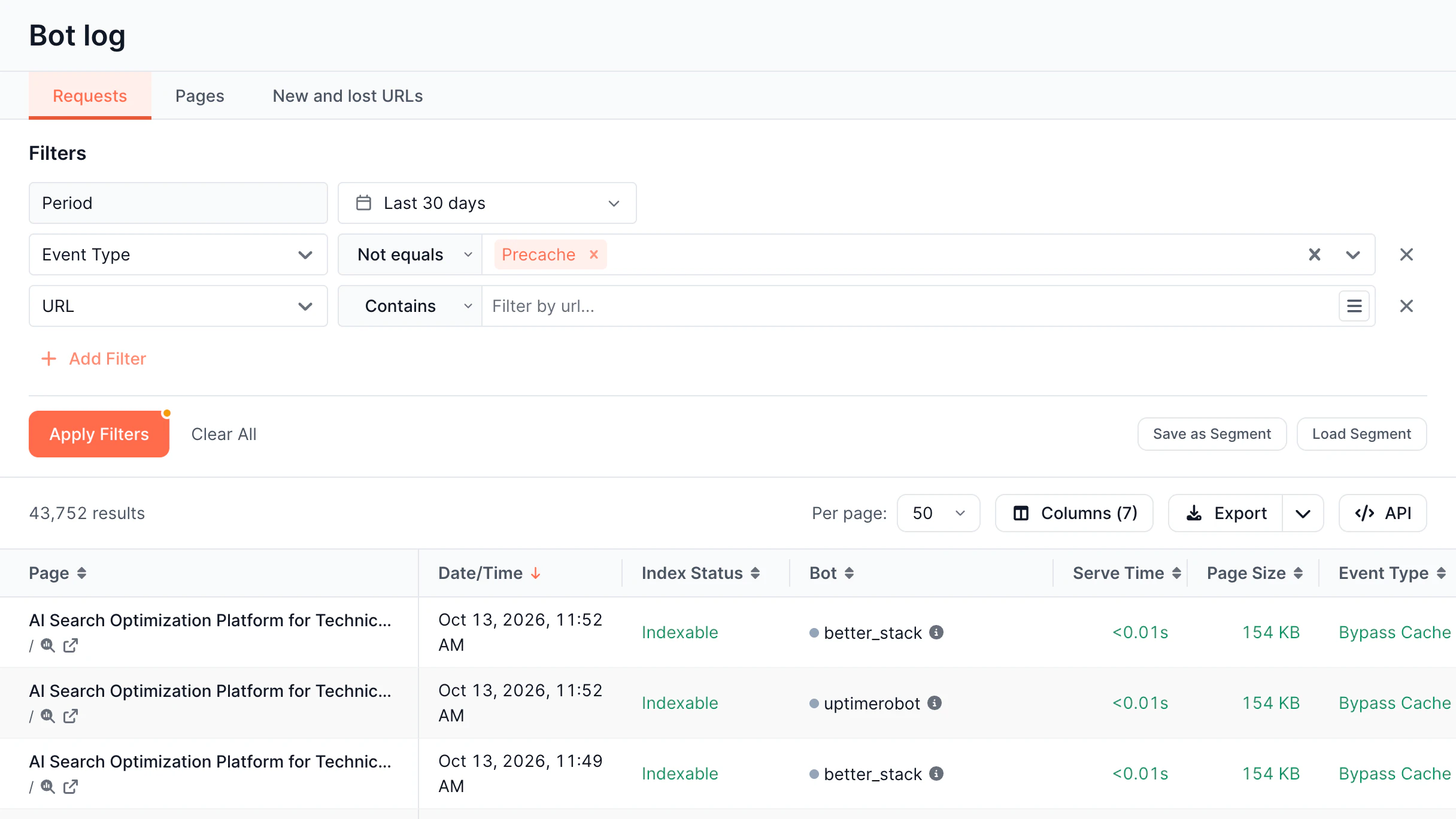
Table of every bot request with filters, segments, and export.
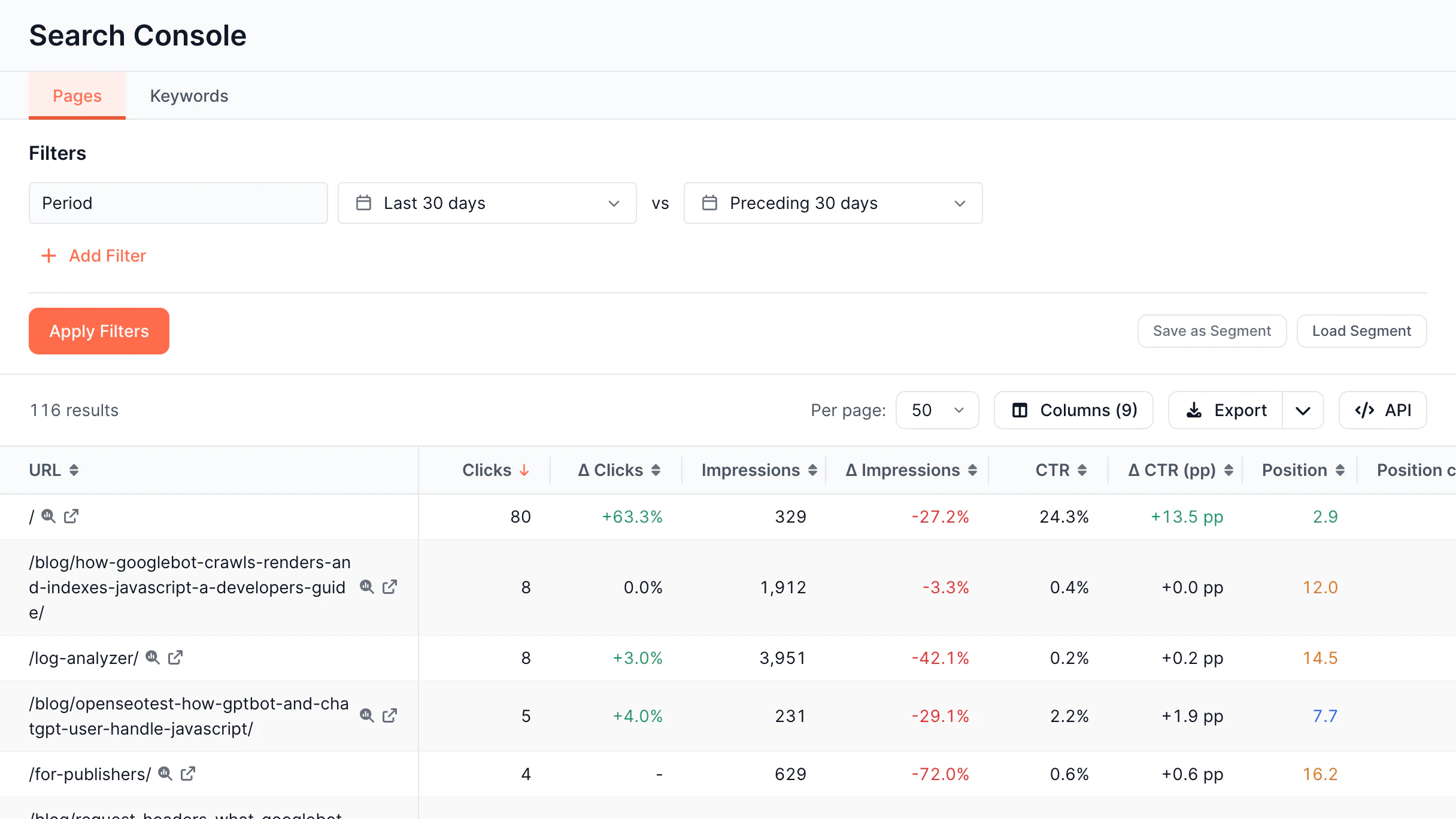
Search Console rows by page or keyword, with filters and period comparison.
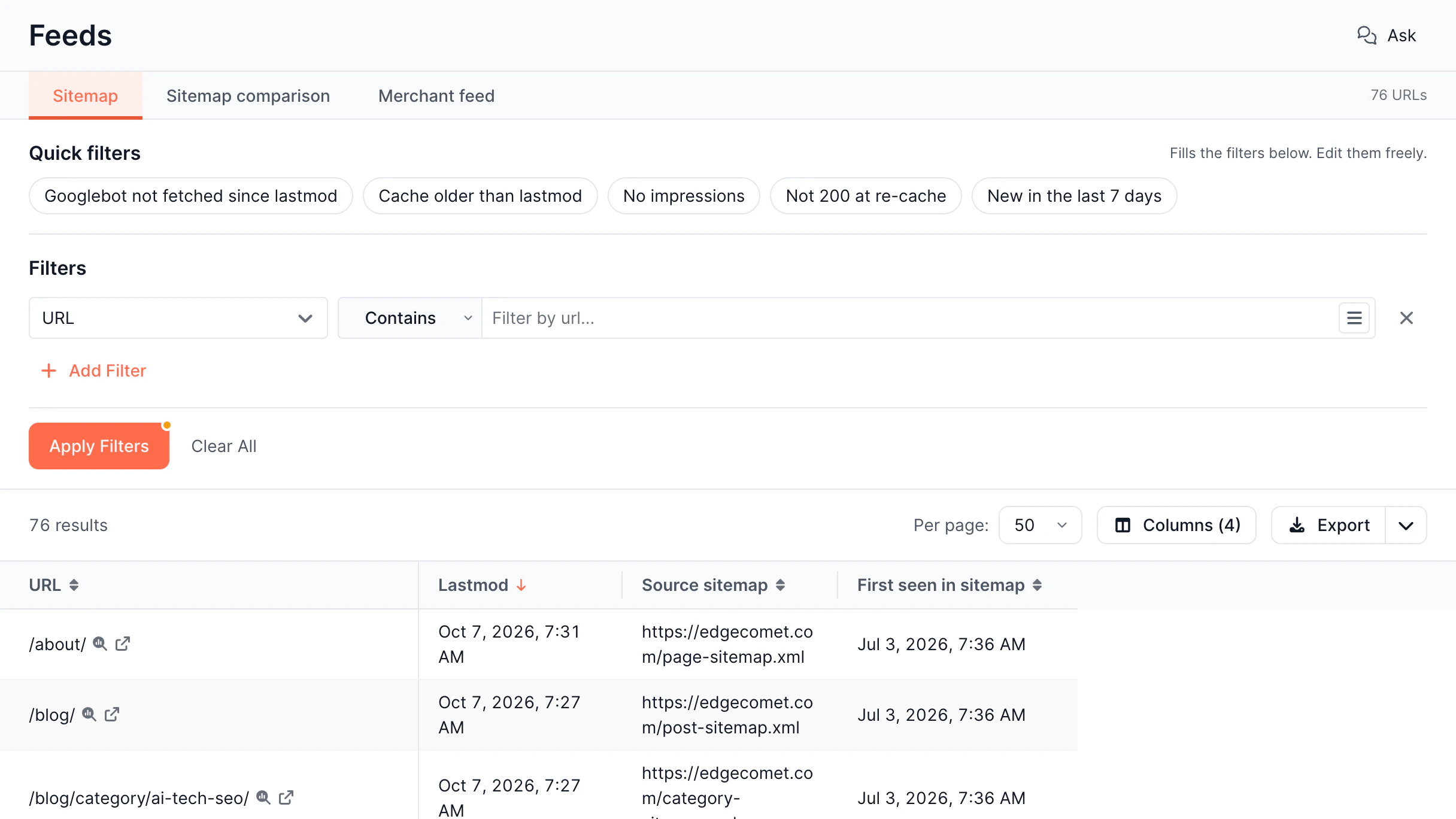
Sitemap and Merchant feed URLs with quick filters and export.
Improve indexing, visibility, and traffic from day one.
14-day free trial
E-commerce SEO is the optimization of your online store so that search bots can discover and index product pages and category pages in organic search results.
Your website may be developed on JavaScript frameworks (React or Vue), where pages load content dynamically in the browser. That may prevent Googlebot from processing content the same way users would. It means crawlers see empty pages instead of your products.
Search engine bots explore raw HTML before JavaScript runs. On JavaScript-heavy e-commerce sites built with React or Vue, product content loads dynamically in the browser, so bots see empty pages instead of actual listings. EdgeComet solves this by pre-rendering pages into static HTML before bots arrive, so crawlers see full product content every time.
Search and AI bots fetch the raw HTML, follow links, and read content before any JavaScript runs. If your product pages are loaded dynamically, bots won't see them, which is why stores using headless architecture face trouble getting their catalogs indexed.
The key challenge is JavaScript rendering. If your products load after the browser runs JS, search engines see empty pages instead. Other issues are a wasted crawl budget on filters and pagination, duplicates, and too large catalogs. Consider JavaScript e-commerce SEO provided by EdgeComet to avoid these issues.
JavaScript-rendering SEO crawlers can compare raw and rendered HTML before launch to identify missing product content, metadata, internal links, and structured data.
EdgeComet helps inspect bot-facing content and detect rendering issues in connected environments. After launch, its Log Analyzer and monitoring tools help verify what Googlebot and AI crawlers actually receive and identify regressions across product pages.
ChatGPT, Claude, and Perplexity use crawlers to explore and index web content, but most skip JavaScript. For e-commerce sites with dynamically loaded product pages, this means AI systems browse blank pages. Without readable content, your content won't appear in AI-generated recommendations. Thus, EdgeComet provides strong technical SEO support for e-commerce by pre-rendering product pages into static HTML. It makes your catalog visible and indexable across 20+ AI and search platforms.
Crawl budget optimization for e-commerce starts by measuring where verified Googlebot requests go by page type, then removing low-value URLs: sort parameters, duplicates, and filter combinations. On large catalogs, bots exhaust their crawl budget before reaching meaningful product pages. EdgeComet enhances crawl efficiency by prioritizing high-value product and category content, ensuring bots spend their visits where revenue is generated.
Rendering means how bots or browsers turn code into visible content. When search engines can't cope with that process, your listings aren’t shown to them. Websites relying on rendering often have thousands of unindexed pages.
EdgeComet works as a rendering and caching layer that sits between crawlers and your website. Whether your store runs on Shopify, Magento, or a custom headless architecture, EdgeComet intercepts bot requests and serves pre-rendered HTML instantly. Setup allows for SEO deployment without developers, making it one of the few e-commerce SEO automation solutions that work without touching your codebase.
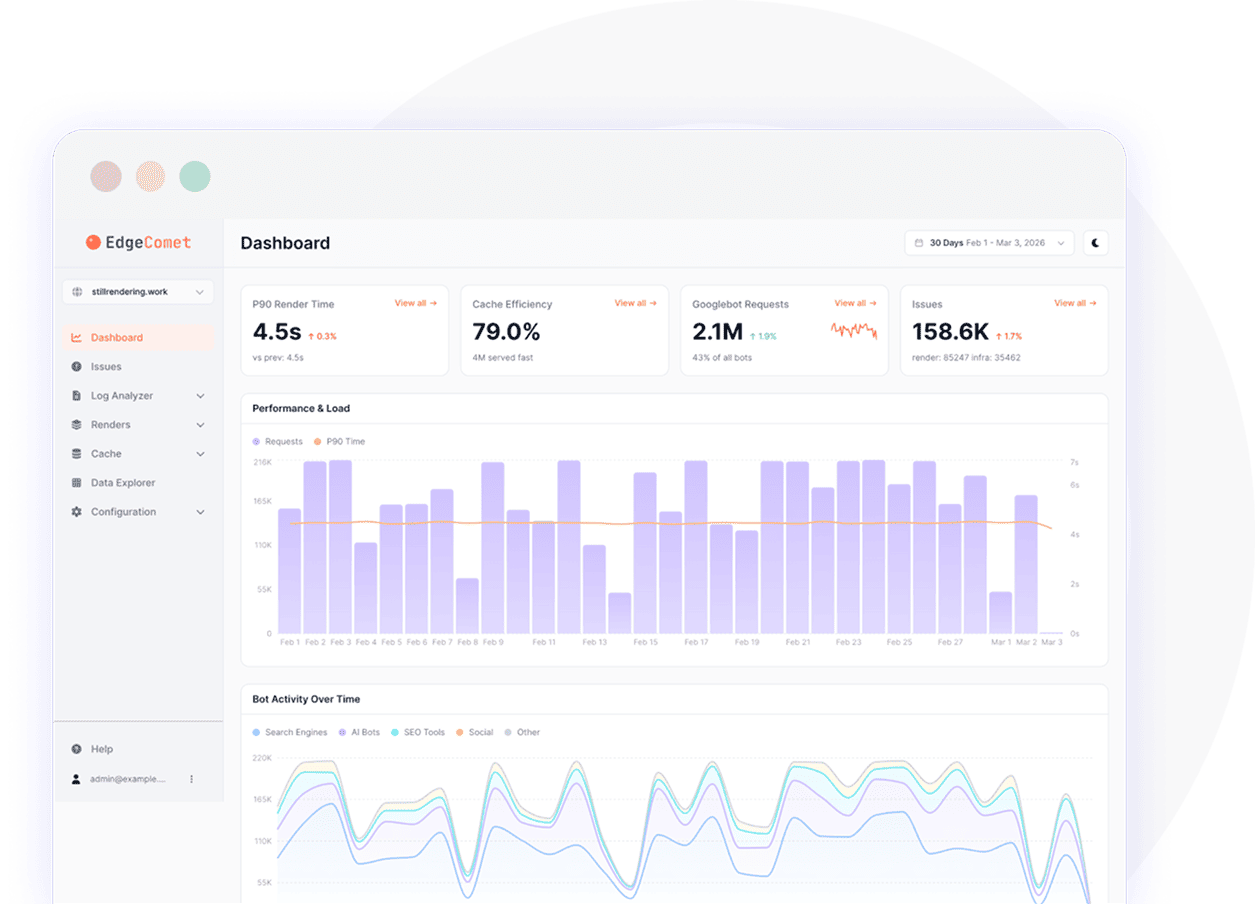
Most analytics platforms tell you nothing about what bots actually do on your site. E-commerce SEO monitoring requires visibility into crawl behavior, rendering failures, and bot activity at the page level. EdgeComet's Intelligent Log Analyzer captures every bot request in real time – tracking Googlebot, GPTBot, ClaudeBot, and PerplexityBot behavior across your catalog. Teams can find JavaScript errors during rendering, identify pages bots skip, and catch crawl issues before they impact rankings or AI visibility.
Stay ahead with expert insights on search visibility, AI optimization, and technical SEO
Faceted navigation SEO comes down to two decisions for every filter URL: may search engines crawl it, and may they...
Read Article
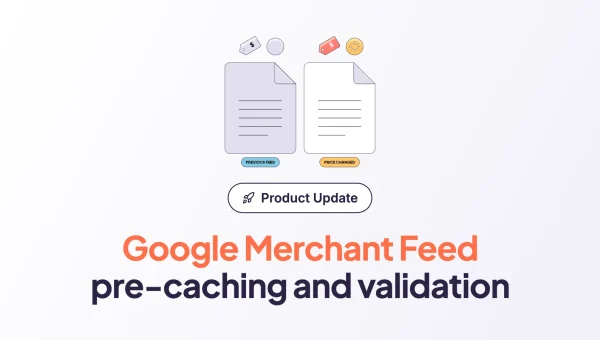
EdgeComet now reads your Google Merchant feed. Every fetch compares the feed with its previous version, re-caches the product pages...
Read Article
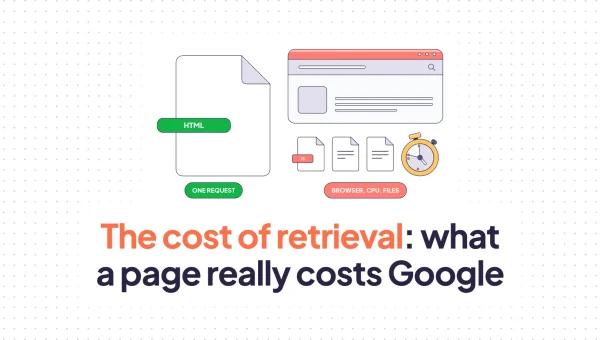
I started digging into crawl budget around 2016, and in 2018 I gave my first talk built on crawl data...
Read Article