
How to Find and Fix Orphan Pages Across Large Websites
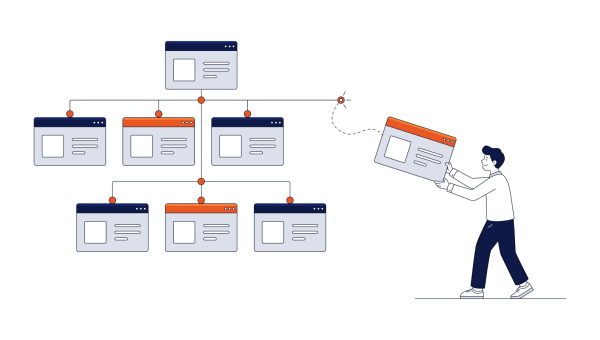
Orphan pages harm your website in many ways. They are harder to discover causing potential traffic losses, and result in...
Read ArticleEdgeComet is an SEO platform for marketplaces, classifieds, and job boards with large listing catalogs. It helps search and AI crawlers access listing content, improves crawling efficiency, and drives more organic traffic and marketplace activity.
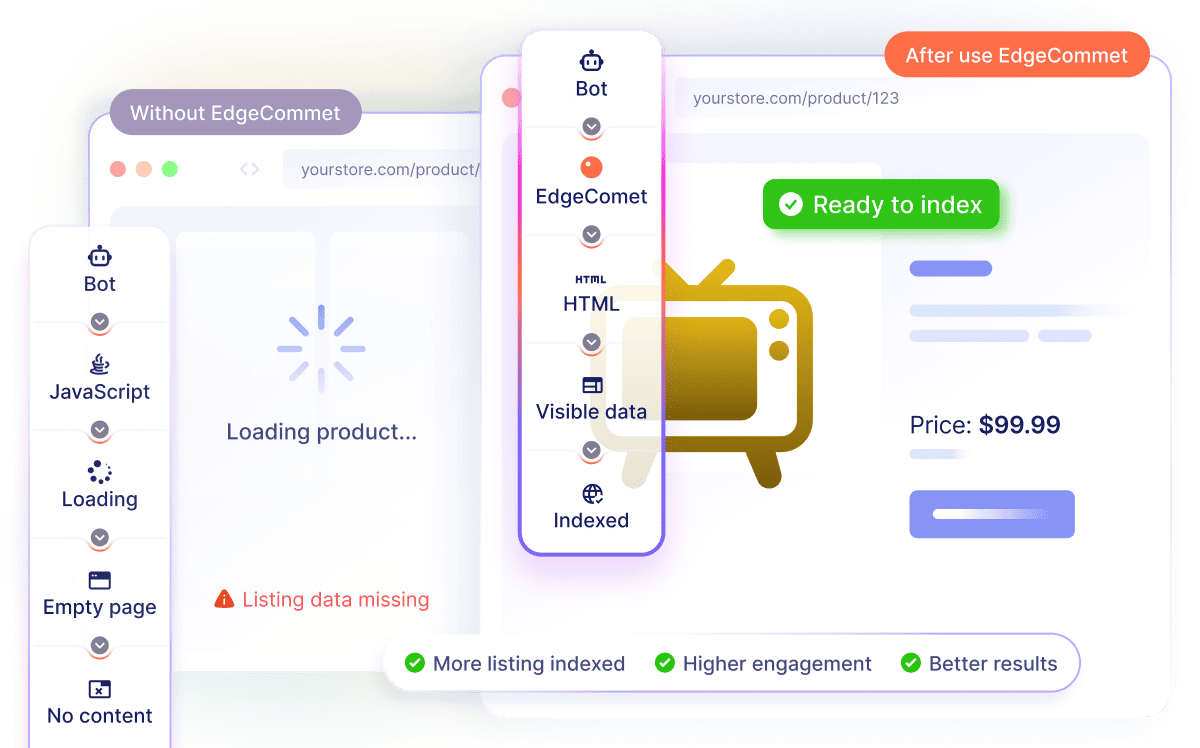
Search bots often cannot completely execute JavaScript-based sites. Such listings may be displayed as blank pages to search engines.
Classified sites contain thousands of listing pages. If each page is rendered heavily, crawlers can’t discover your inventory appropriately.
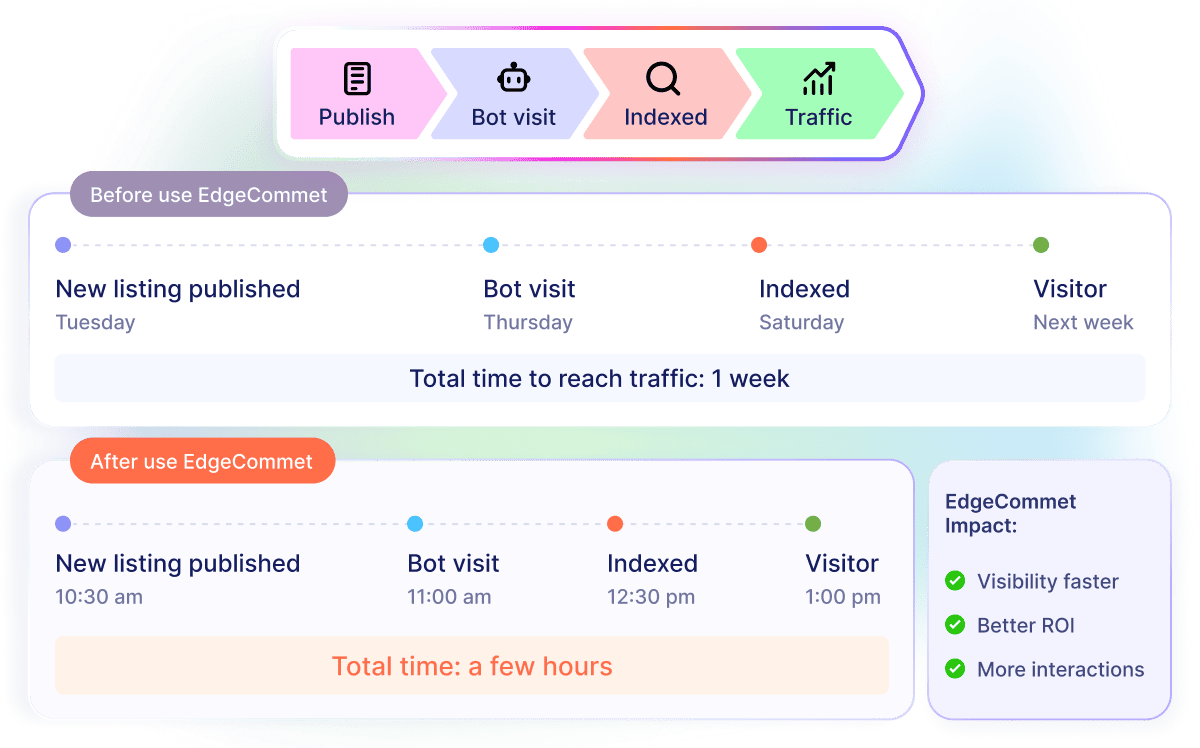
Jobs, rentals, and event tickets have short lifetimes, so listings that aren’t indexed quickly may expire before search engines show them in results. This can lead to lost leads and revenue.
If listings aren’t visible in search organically, marketplaces usually rely on paid ads. Consequently, customer acquisition cost increases.
Classifieds often rely on JS and dynamic content that search engines can’t fully process. Listing details (title, price, and seller data) may be invisible when bots first visit the page.
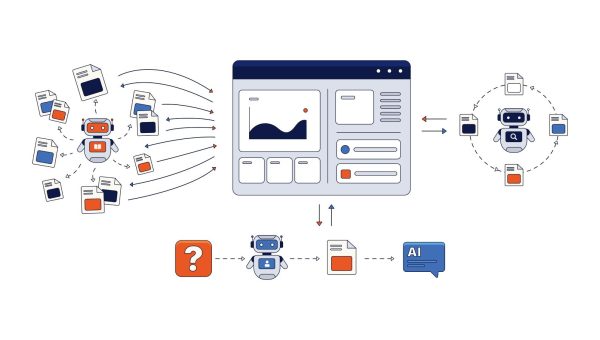
EdgeComet prepares listings so bots can access content.
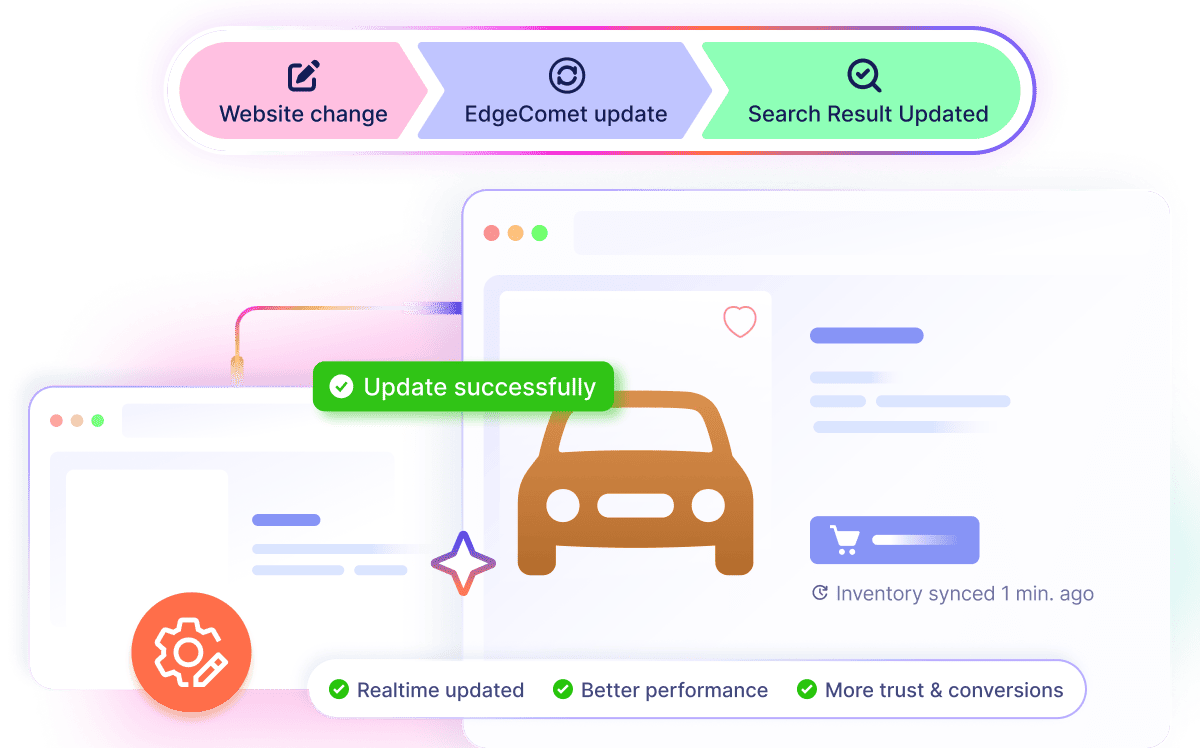
Listings change: products sold, prices updated, new offers appeared. If search engines continue seeing outdated content, new inventory may remain undiscovered.
EdgeComet keeps listing content up to date for bots and helps monitor discovery and indexation signals for time-sensitive listings, including jobs, rentals, and events.
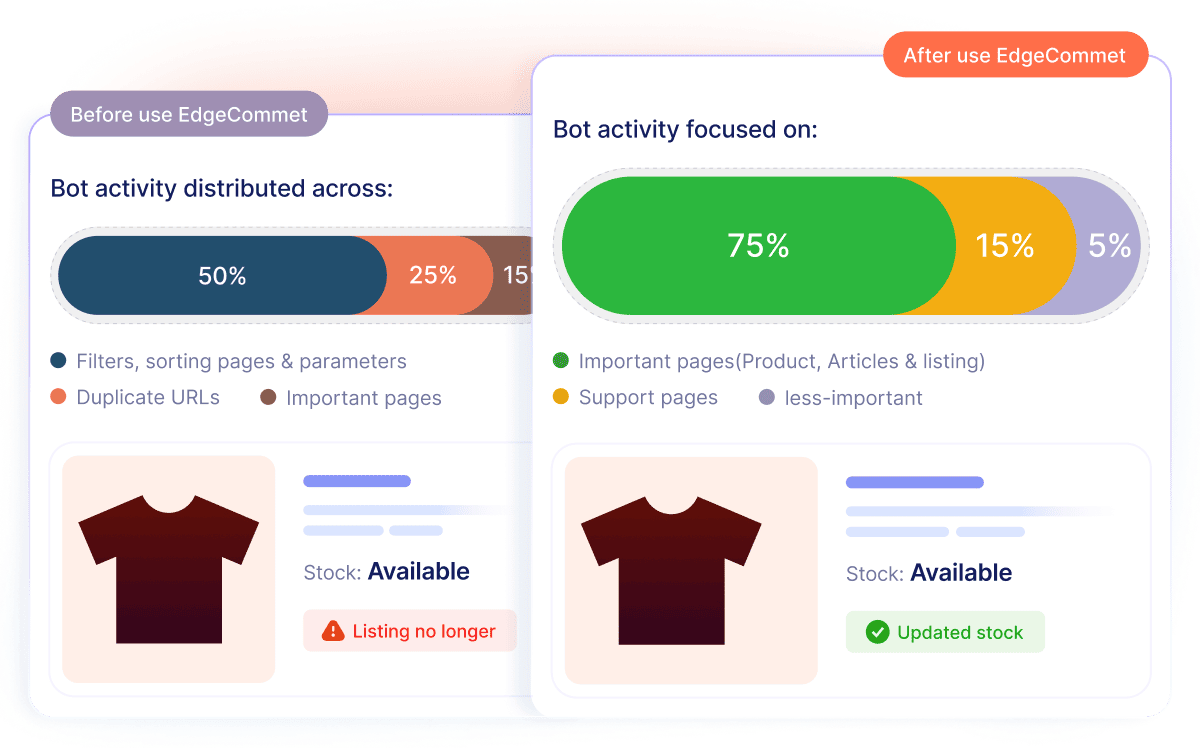
Classifieds and marketplaces, including travel and real estate, generate millions of category, location, and filter URLs.
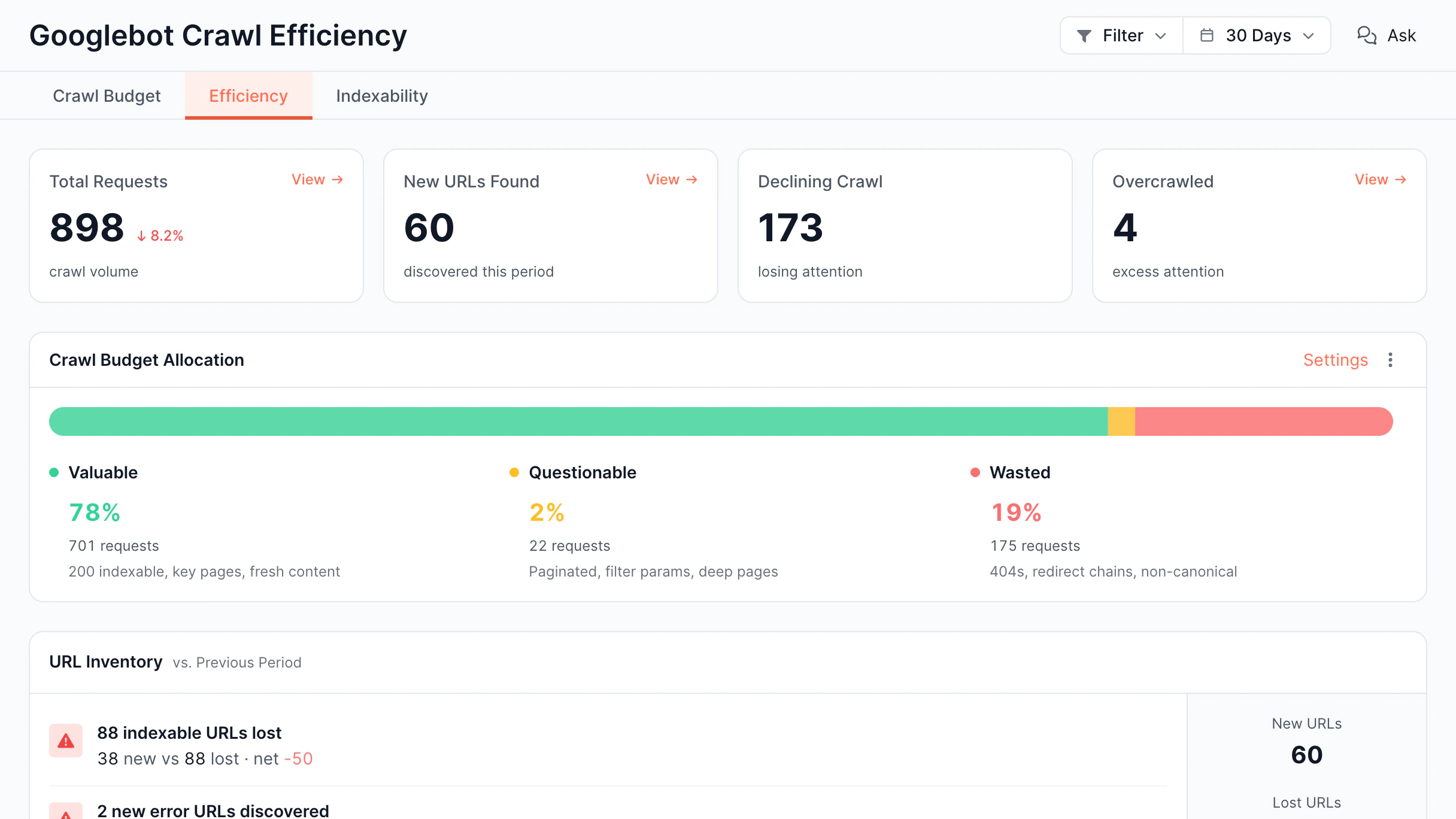
EdgeComet records every search bot request to these URLs as it is served and splits crawl into valuable, questionable, and wasted by section, so you see which combinations drain crawl budget. Alerts flag a drop in Googlebot crawling the same day.
Classifieds remove listings as items are sold or become unavailable. If search engines continue crawling outdated pages, expired listings can waste crawl budget.
EdgeComet helps manage expired and recurring event URLs with redirects, status codes, and indexability rules. Real bot data shows how much Googlebot crawl goes to expired listings, helping teams prioritize active inventory.
1 in 5 listings never appear in search results, resulting in reduced organic traffic and lost revenue. Every unindexed page is a buyer who never finds your website.
Making previously inaccessible listings crawlable creates more opportunities to attract organic traffic. Each indexed listing can become an additional entry point for buyers searching for specific products or services.
When listing content doesn't appear in search, sellers think that the platform doesn’t work and go to competitors. Visibility isn't just a growth facilitator – it's a retention tool.
69% of AI crawlers can’t execute JavaScript, which means that dynamically loaded content is never seen. So, AI traffic goes to your competitors instead.
When a buyer looks for a particular item in AI, it doesn't display a list of links.
AI replies with recommendations on listings from the platform it could read. Classifieds with JavaScript frontends show empty pages to AI bots.
Today, the real value is the website AI picks when buyers search for specific items, jobs, or services.
AI bots explore your listings the same way Googlebot does, and they all face the same problem – JavaScript that can’t be rendered.
Classified inventories change by the minute. Bots don't wait for your content to be rendered – they read raw HTML and move on further.
If a listing is invisible the moment it goes live, it will never be recommended by AI.
EdgeComet makes your listings instantly discoverable across search and AI engines
Because EdgeComet is directly in the rendering path, it captures exactly what Googlebot, GPTBot, PerplexityBot, ClaudeBot, or other bots actually receive.
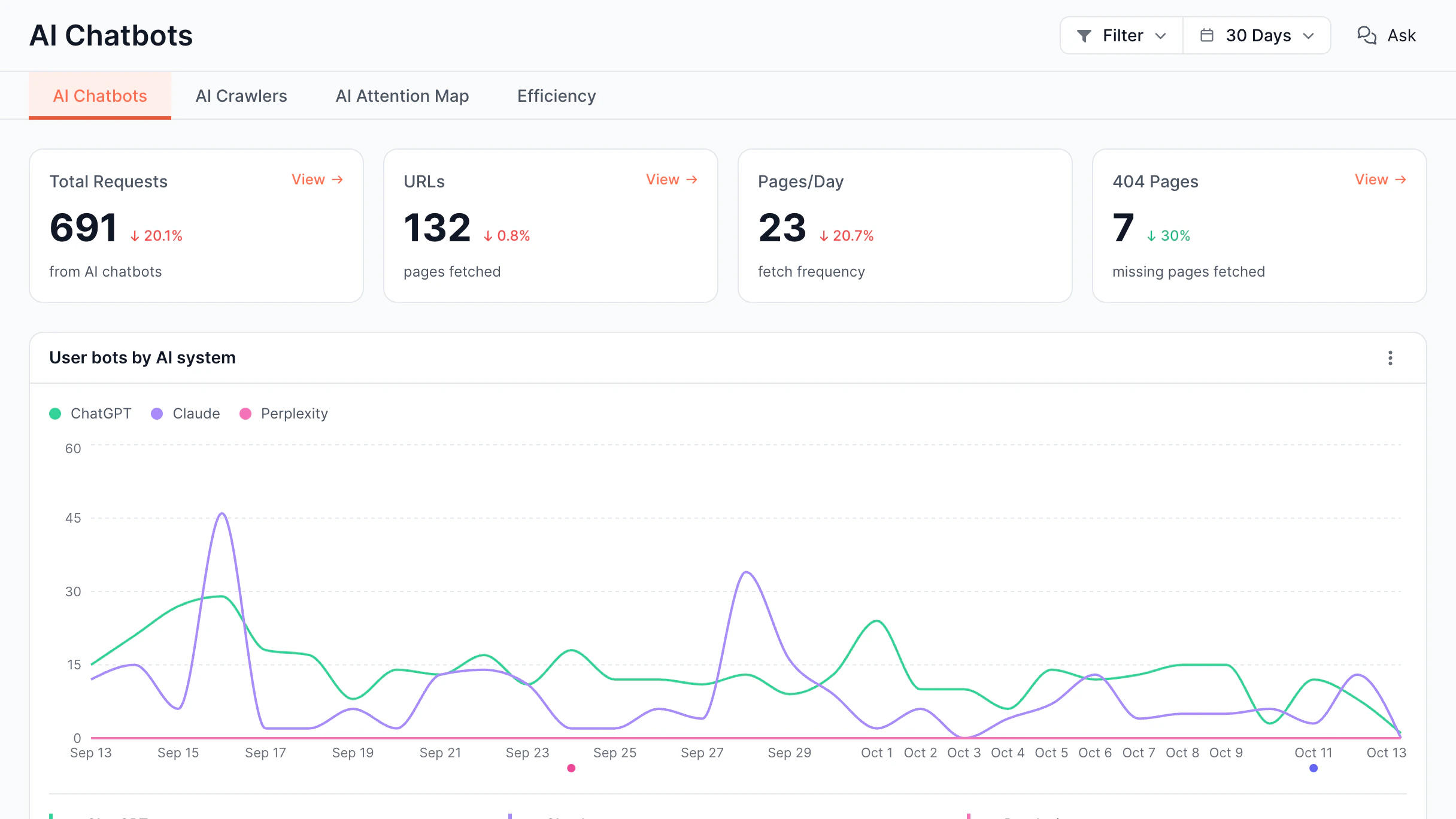
Pages ChatGPT, Claude, and Perplexity fetch while answering users, by day.
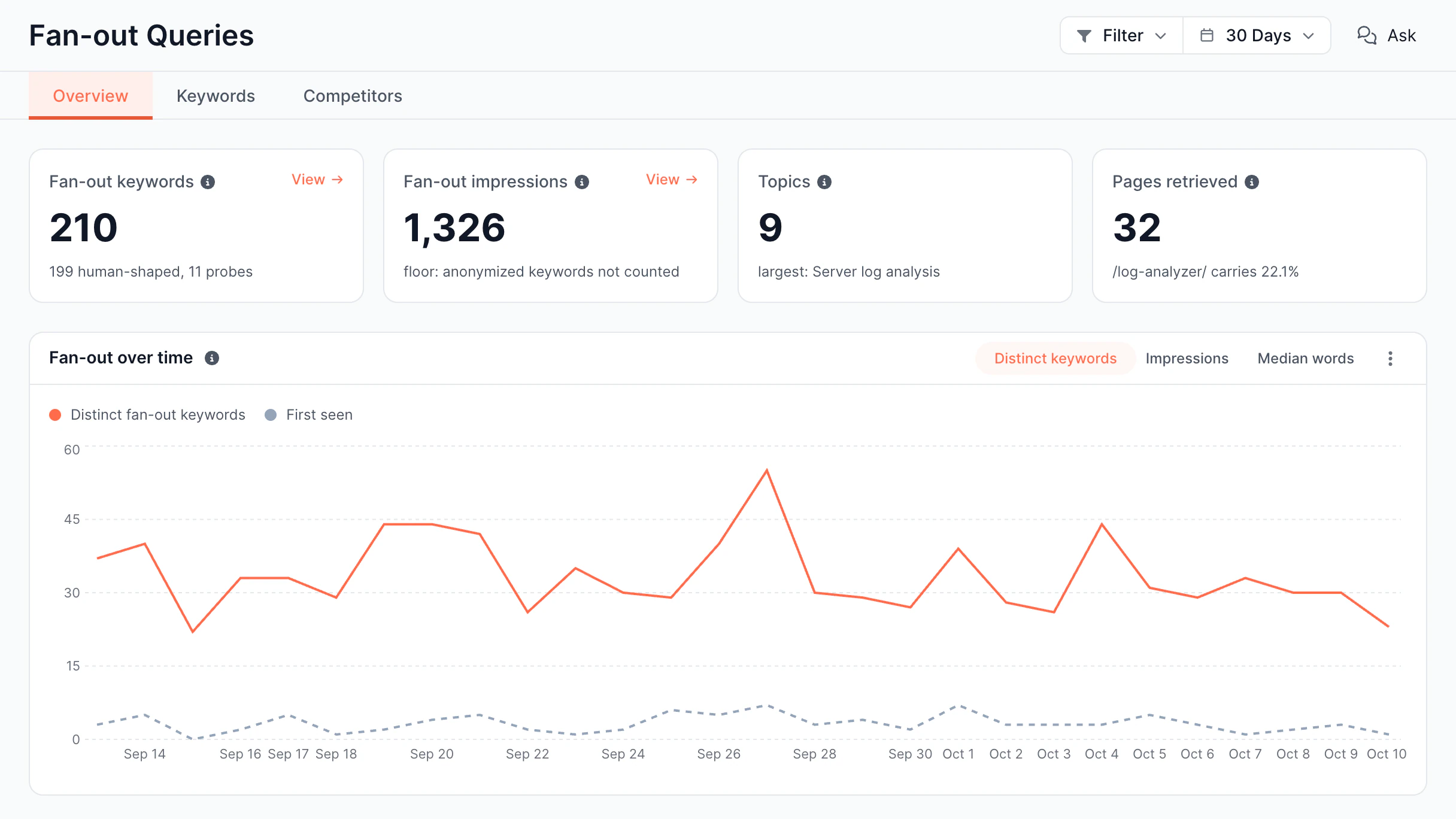
Fan-out keywords from Search Console, grouped into topics, with impressions.
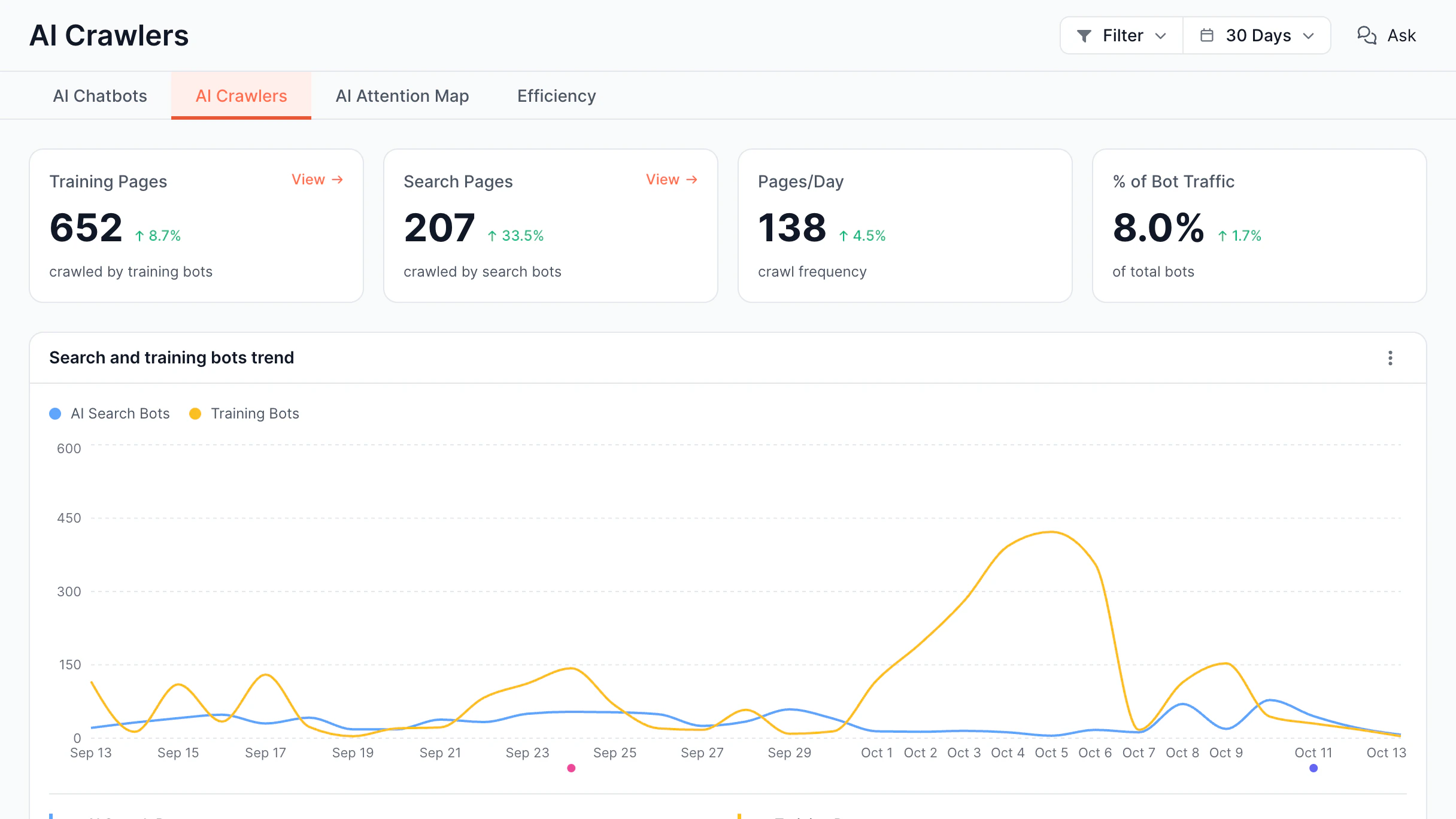
AI training and search bots: pages crawled, pages per day, share of traffic.
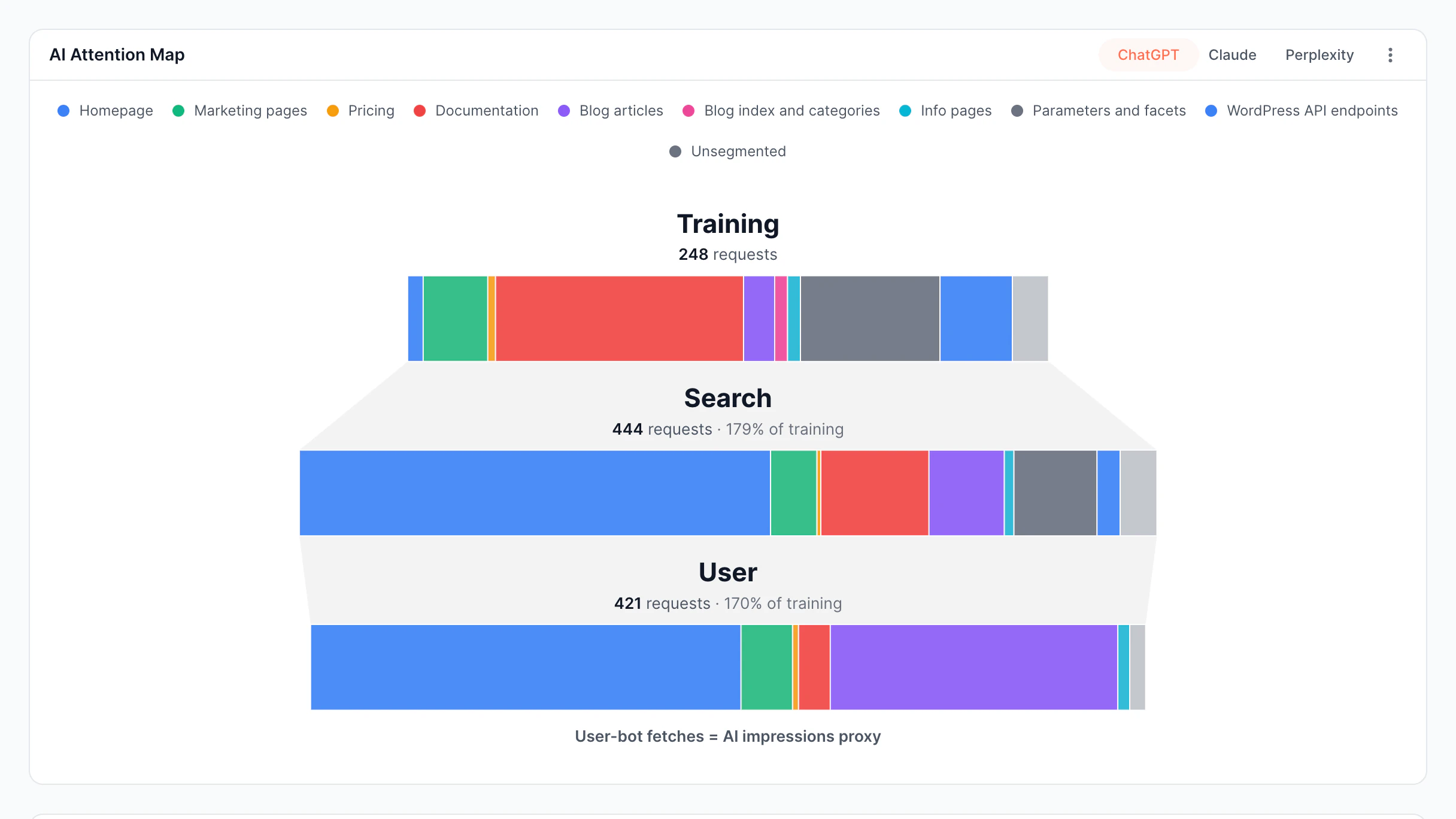
Training, search, and user bot requests by page type, for each AI provider.
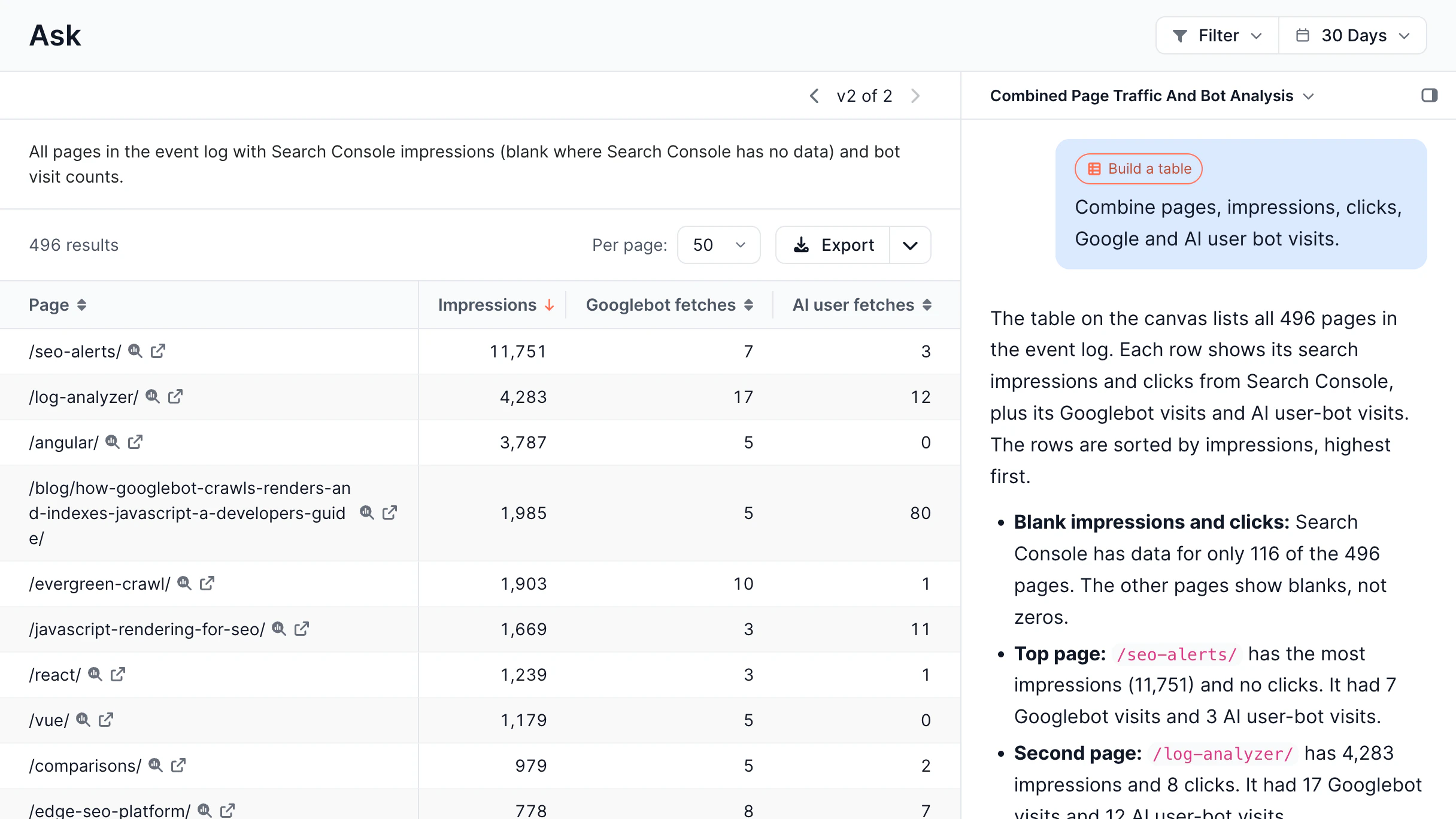
Chat that answers with sortable tables you can export to CSV or Google Sheets.
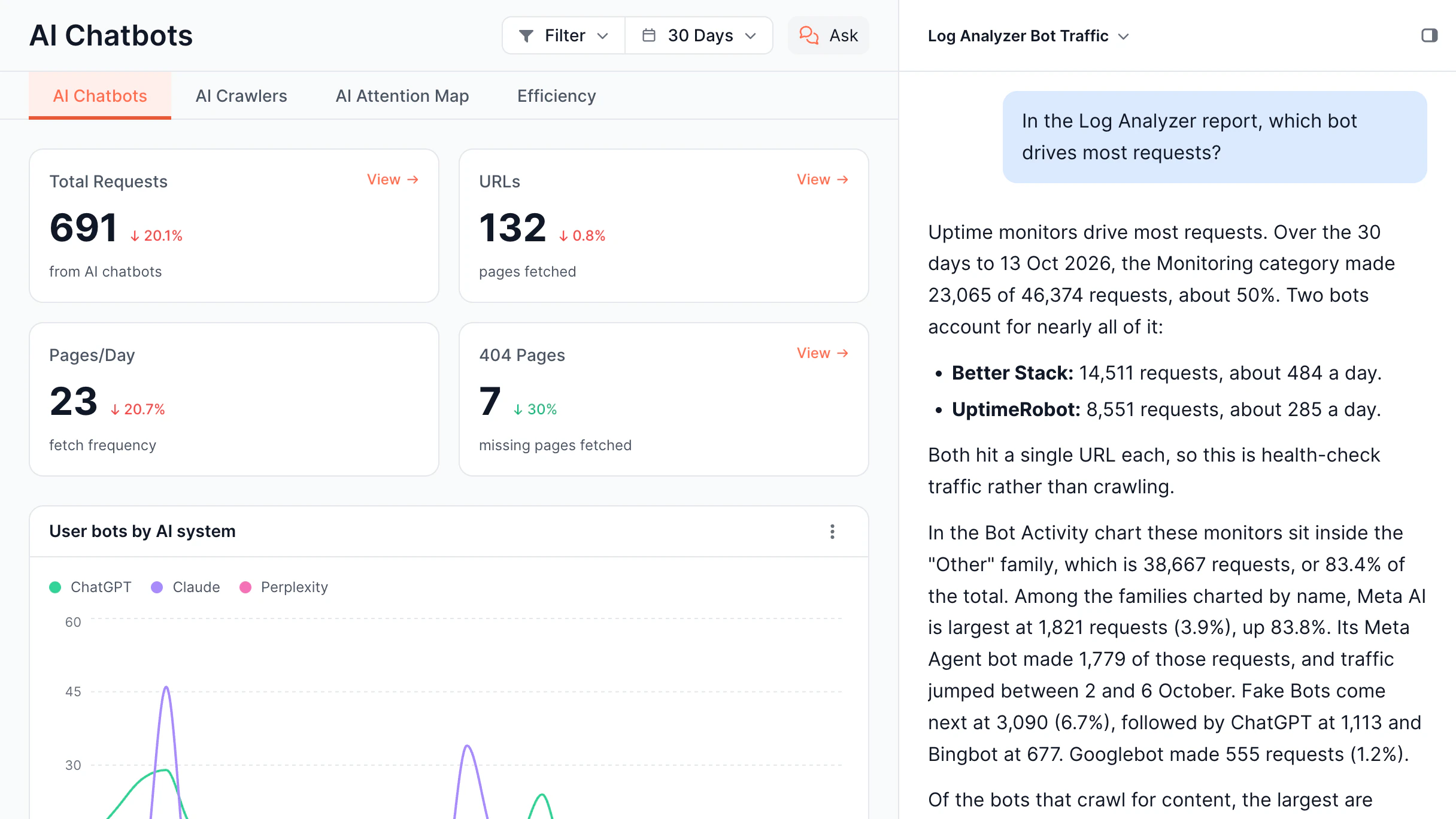
Chat panel next to any report that answers questions about its data.
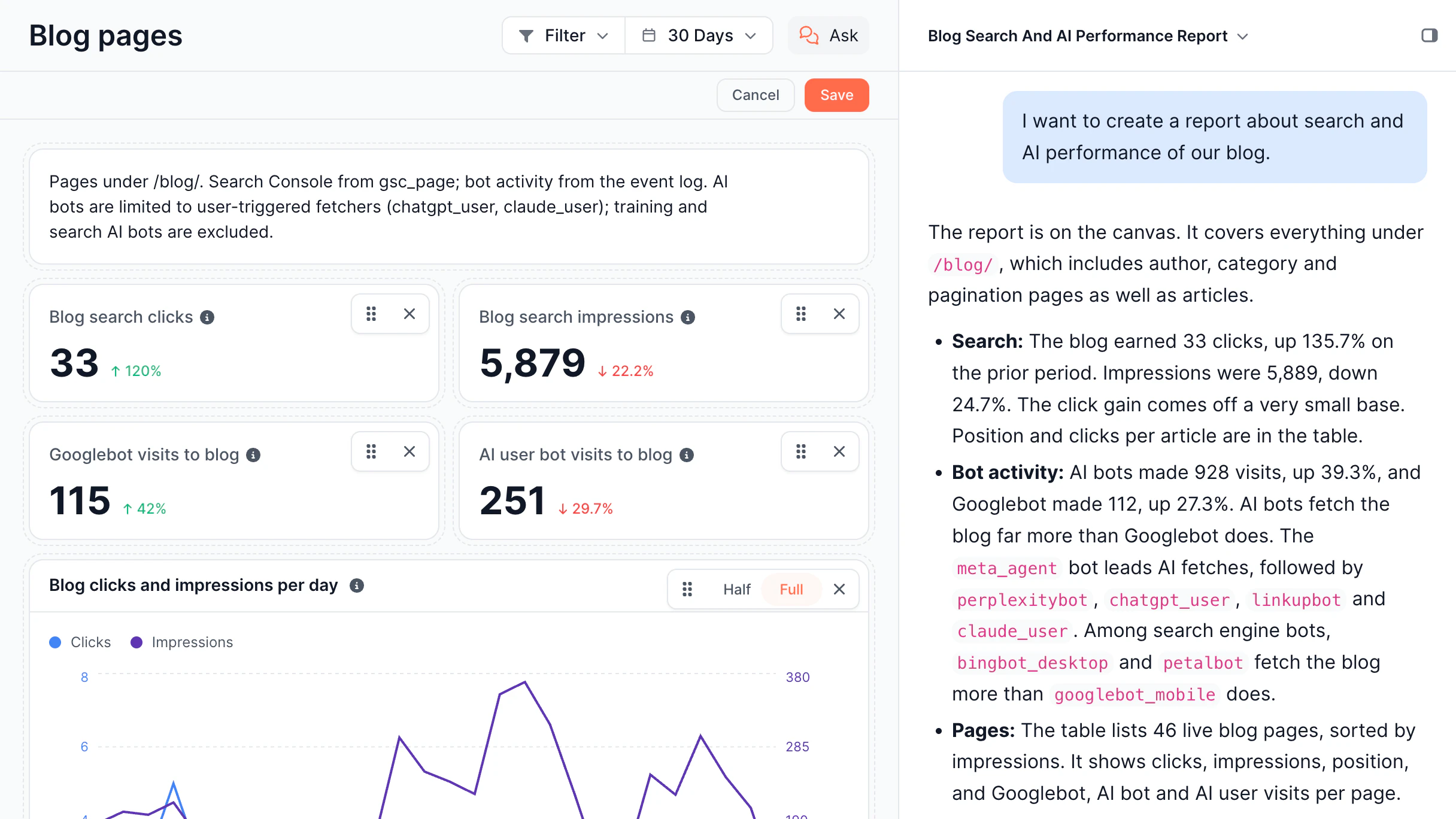
Custom reports built from a chat request, with widgets you can edit and save.
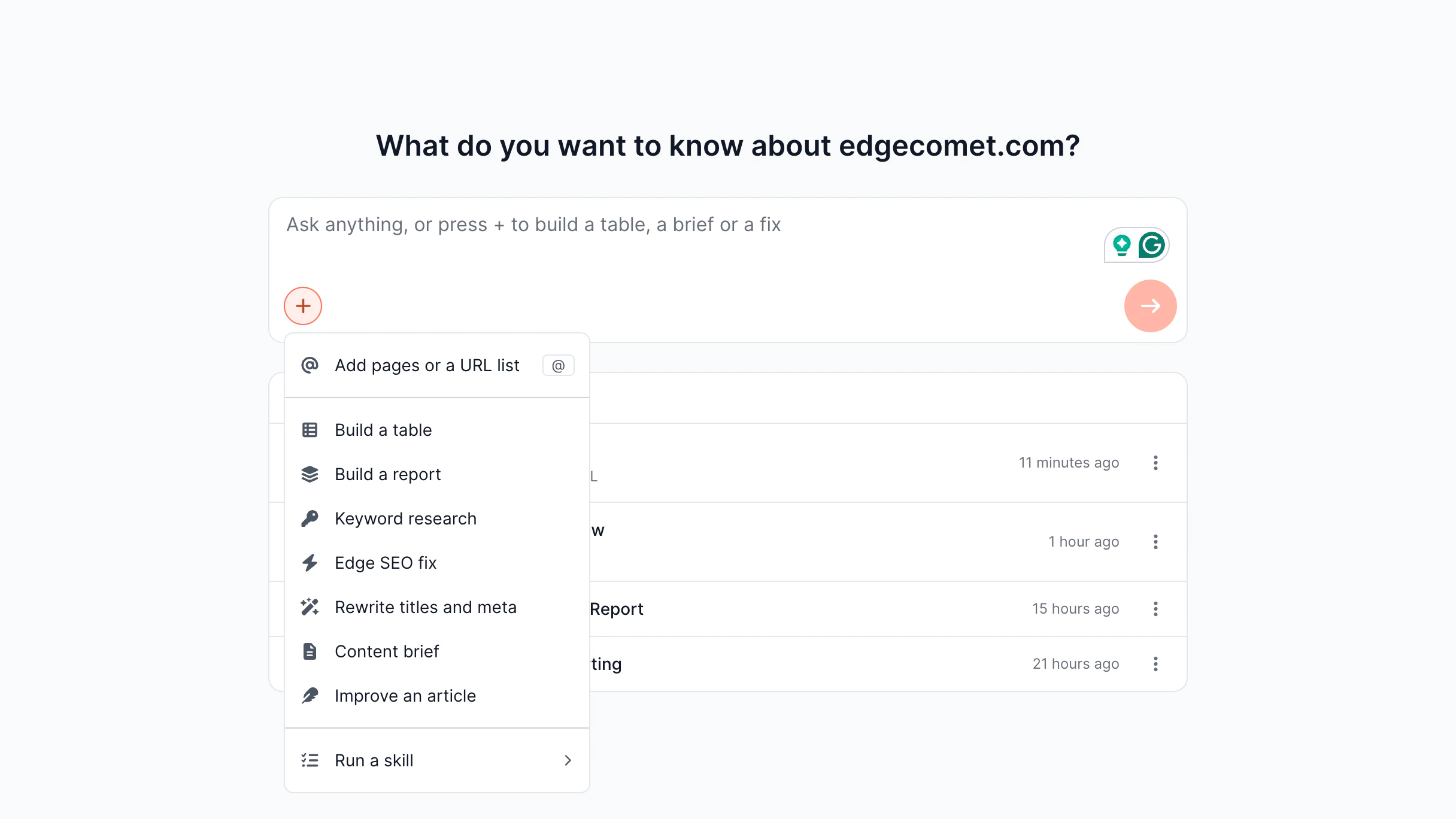
Skills menu: keyword research, content briefs, article and meta rewrites.
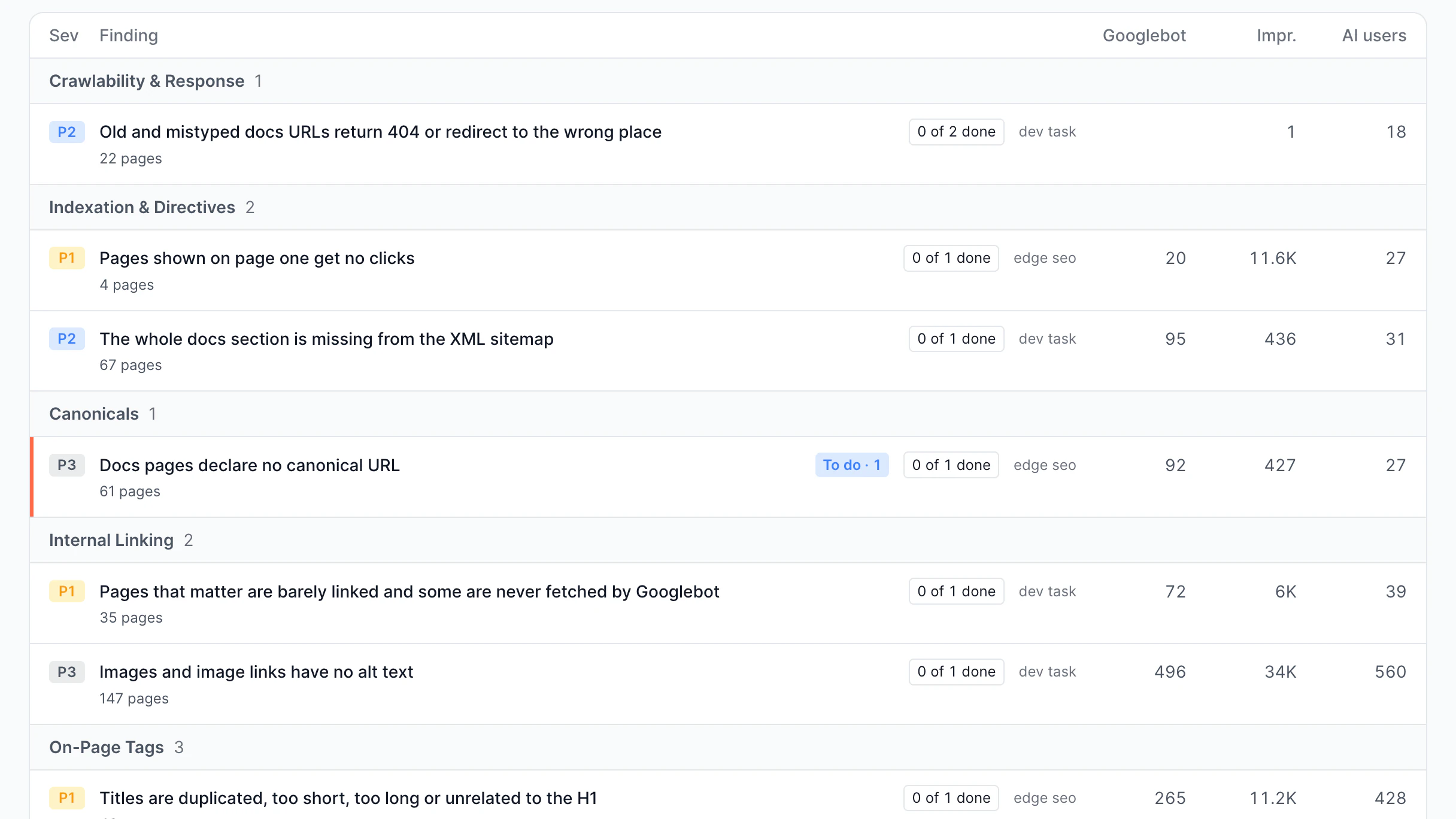
Findings by type and severity, with traffic per issue.
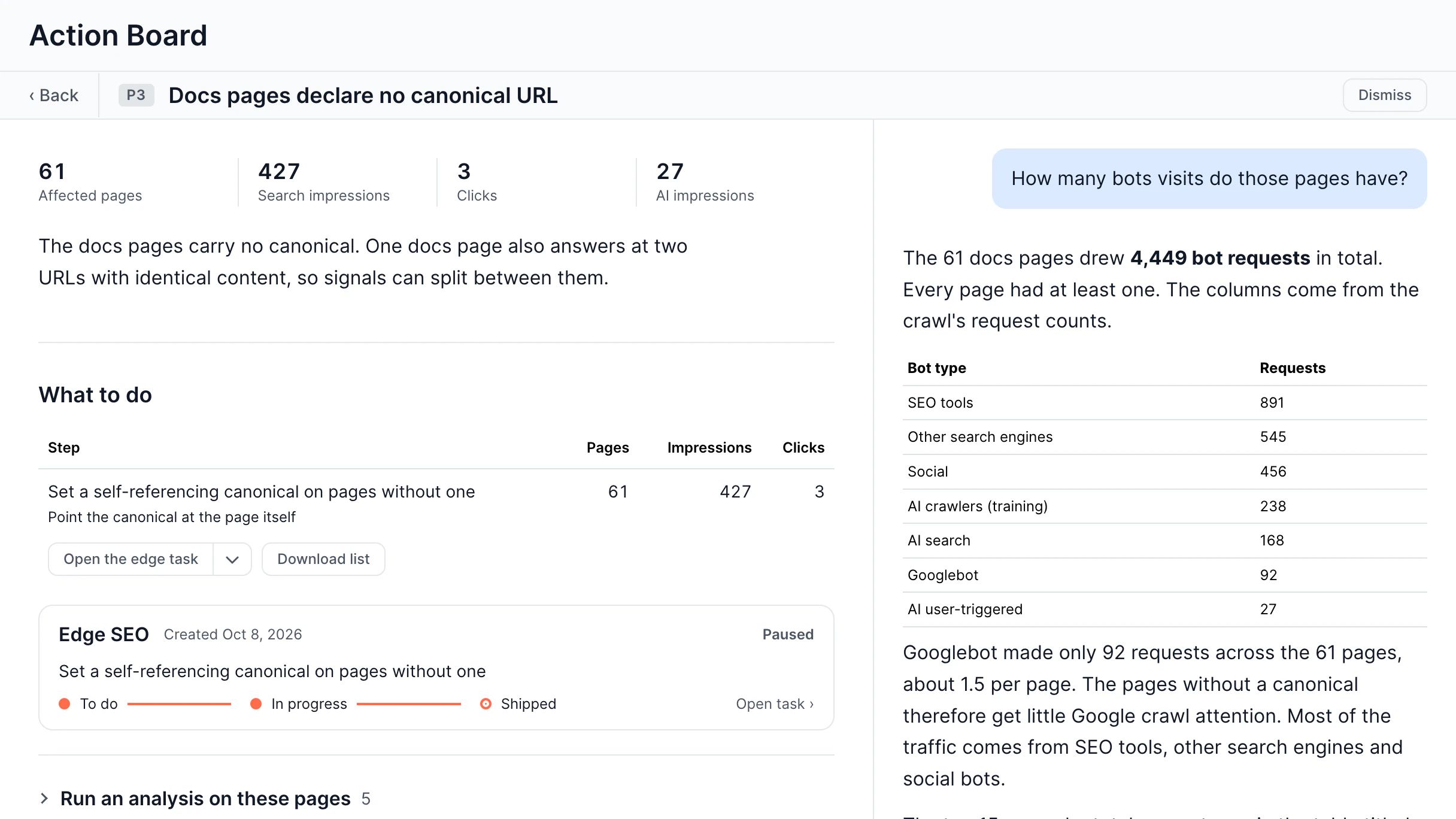
One finding: affected pages, fix steps, task status.
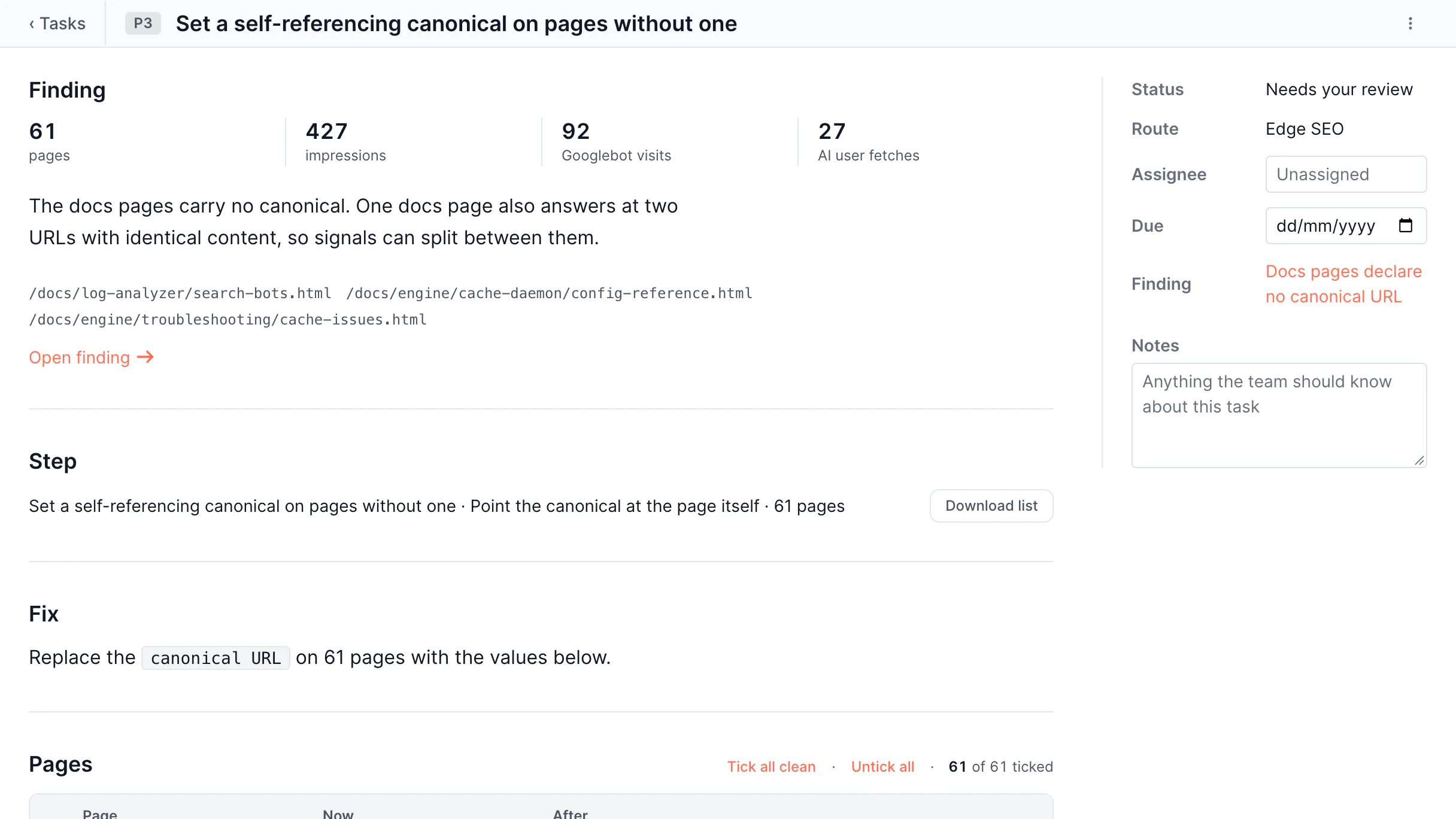
Task page with status, assignee, due date, and notes.
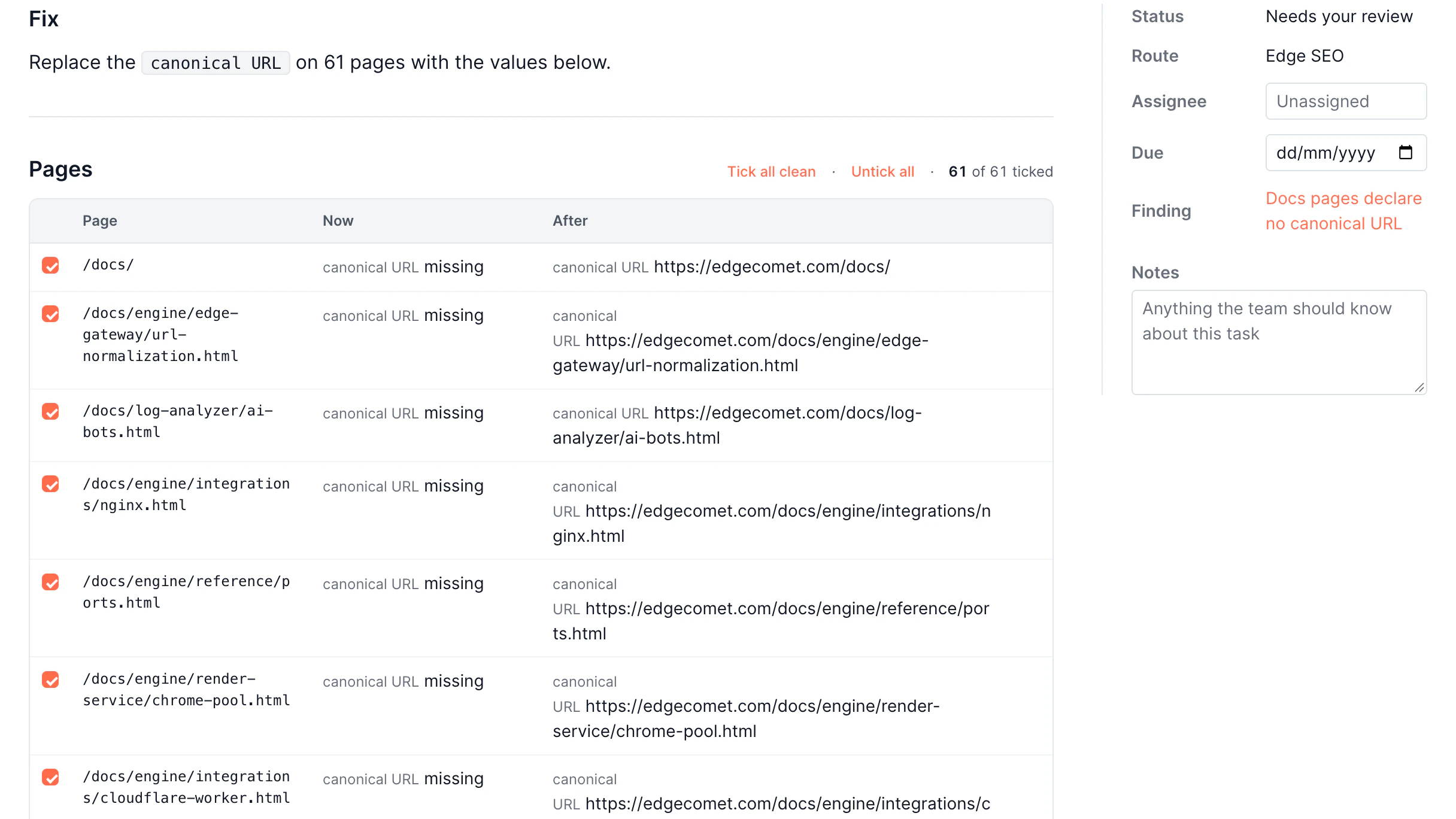
Before and after values per page, with edge deploy.
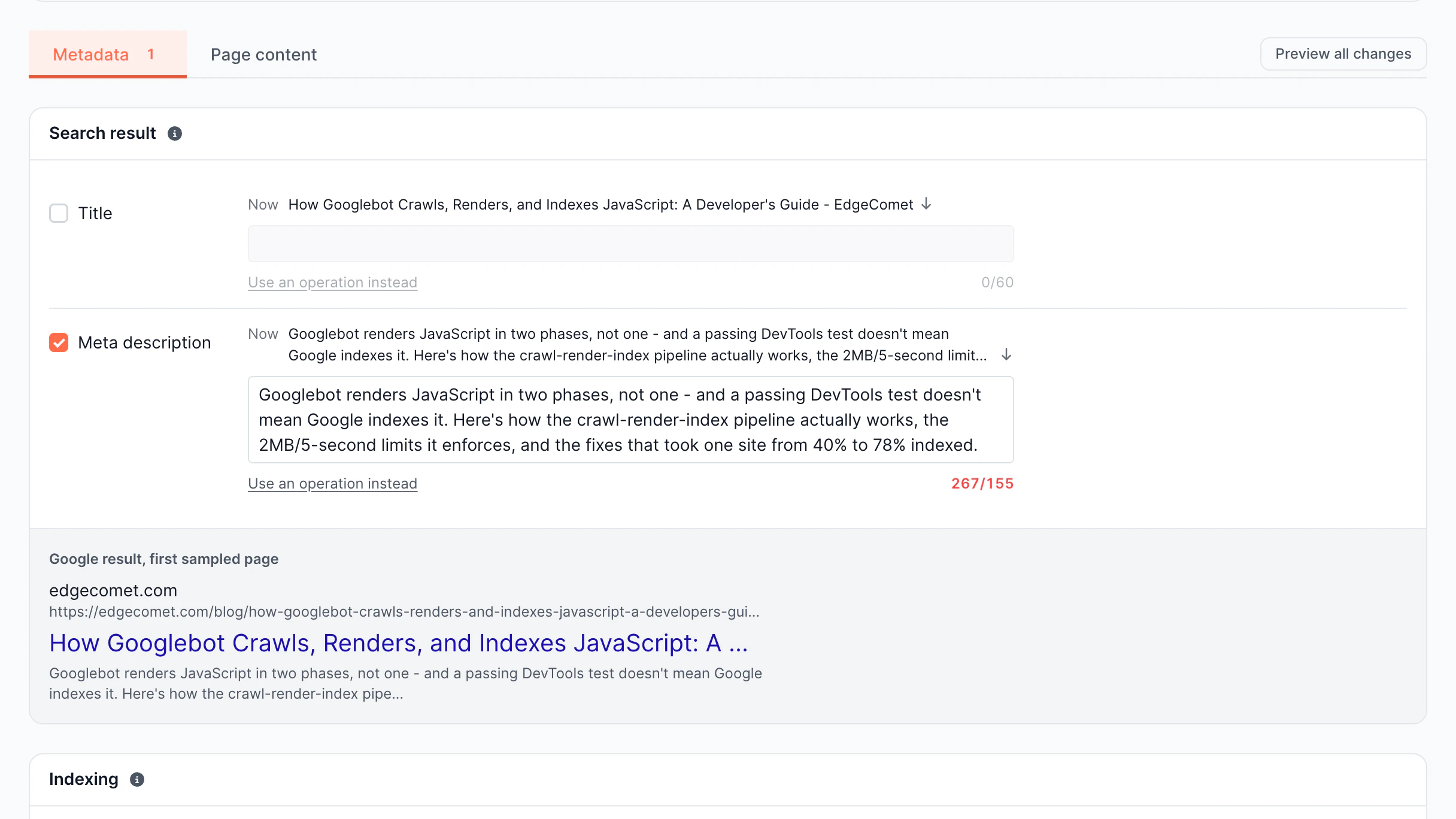
Title and meta overrides with a Google result preview.
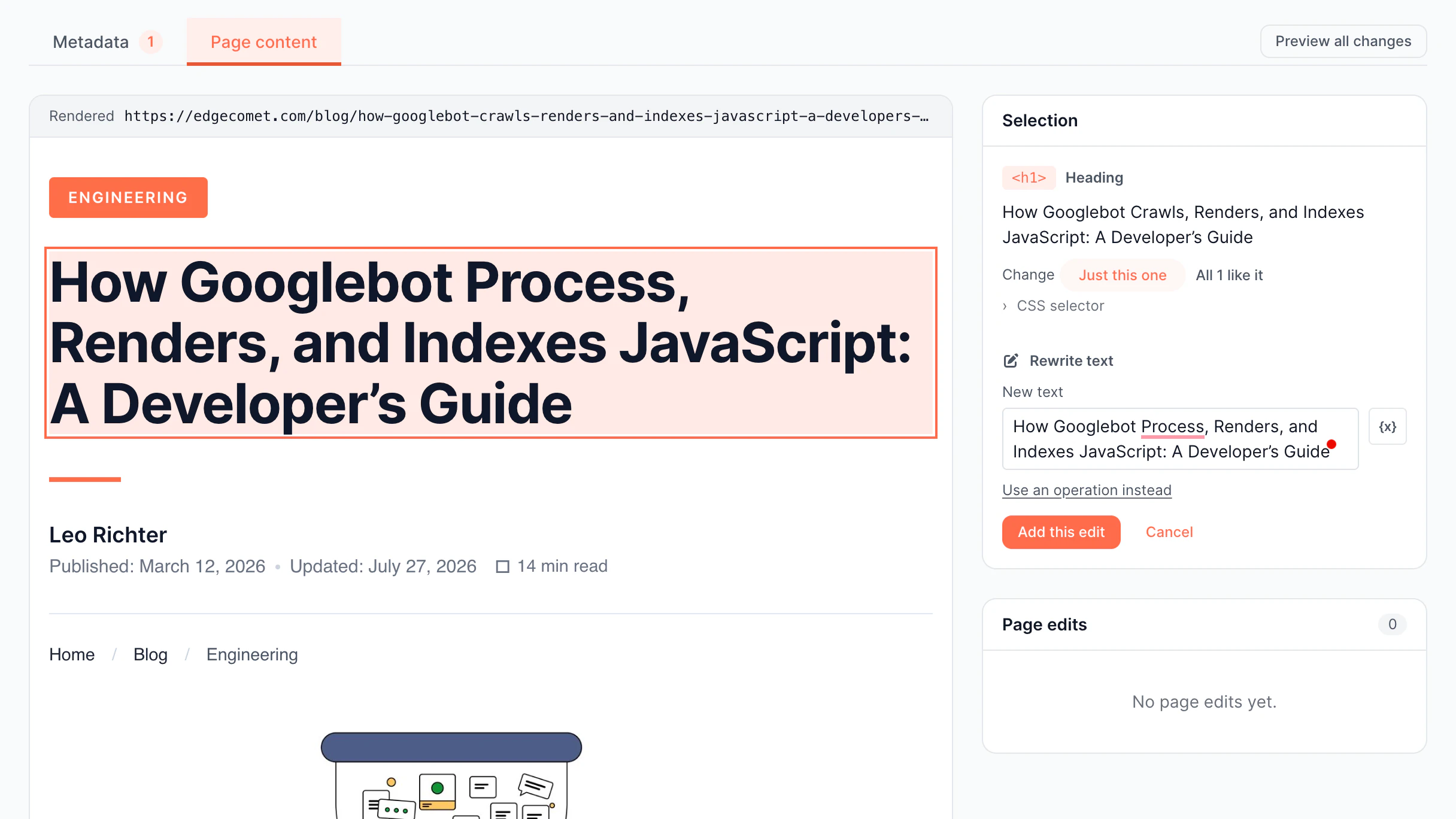
Select an element on the rendered page and edit its text.
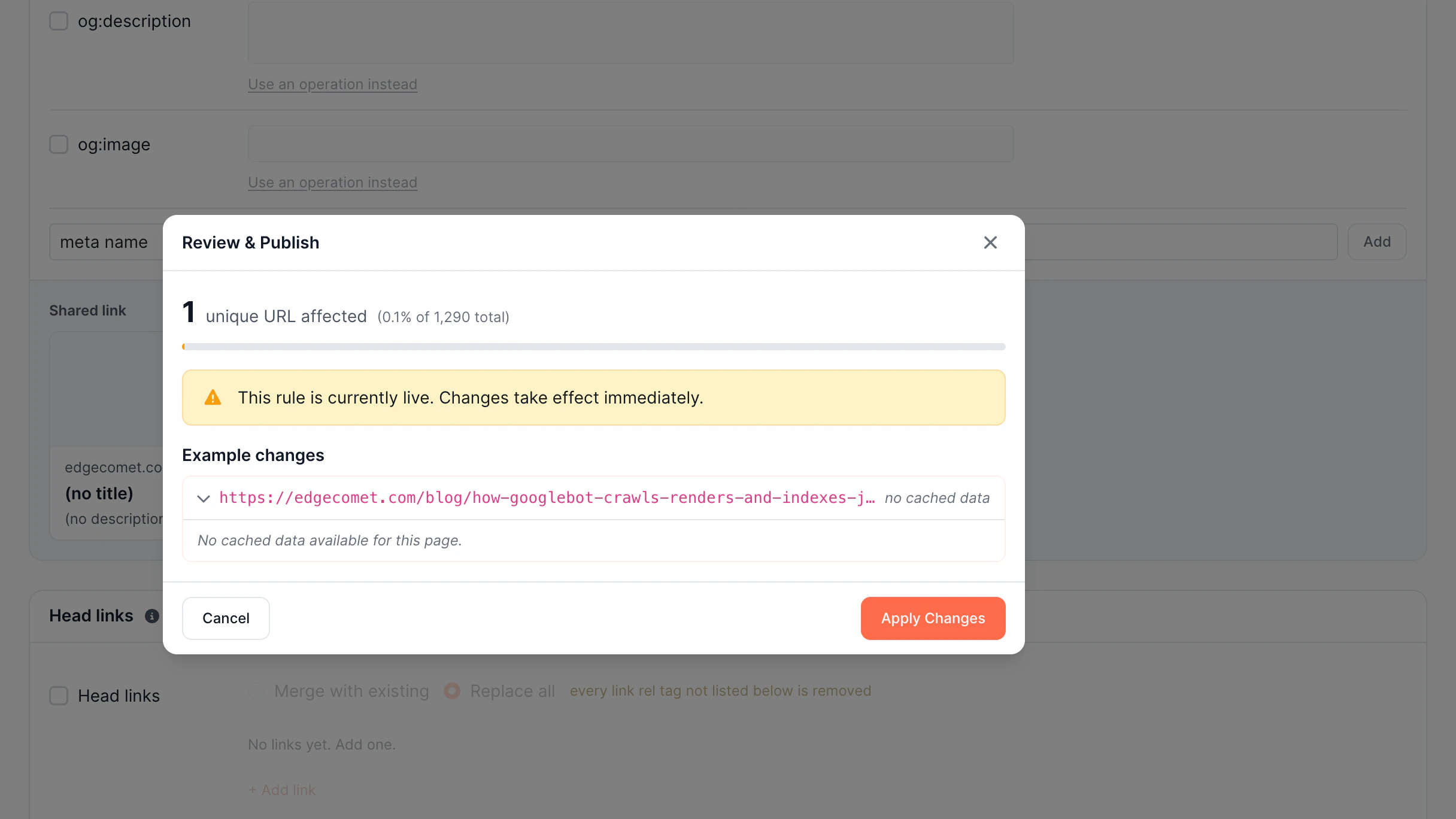
Review dialog with the number of URLs a rule changes.
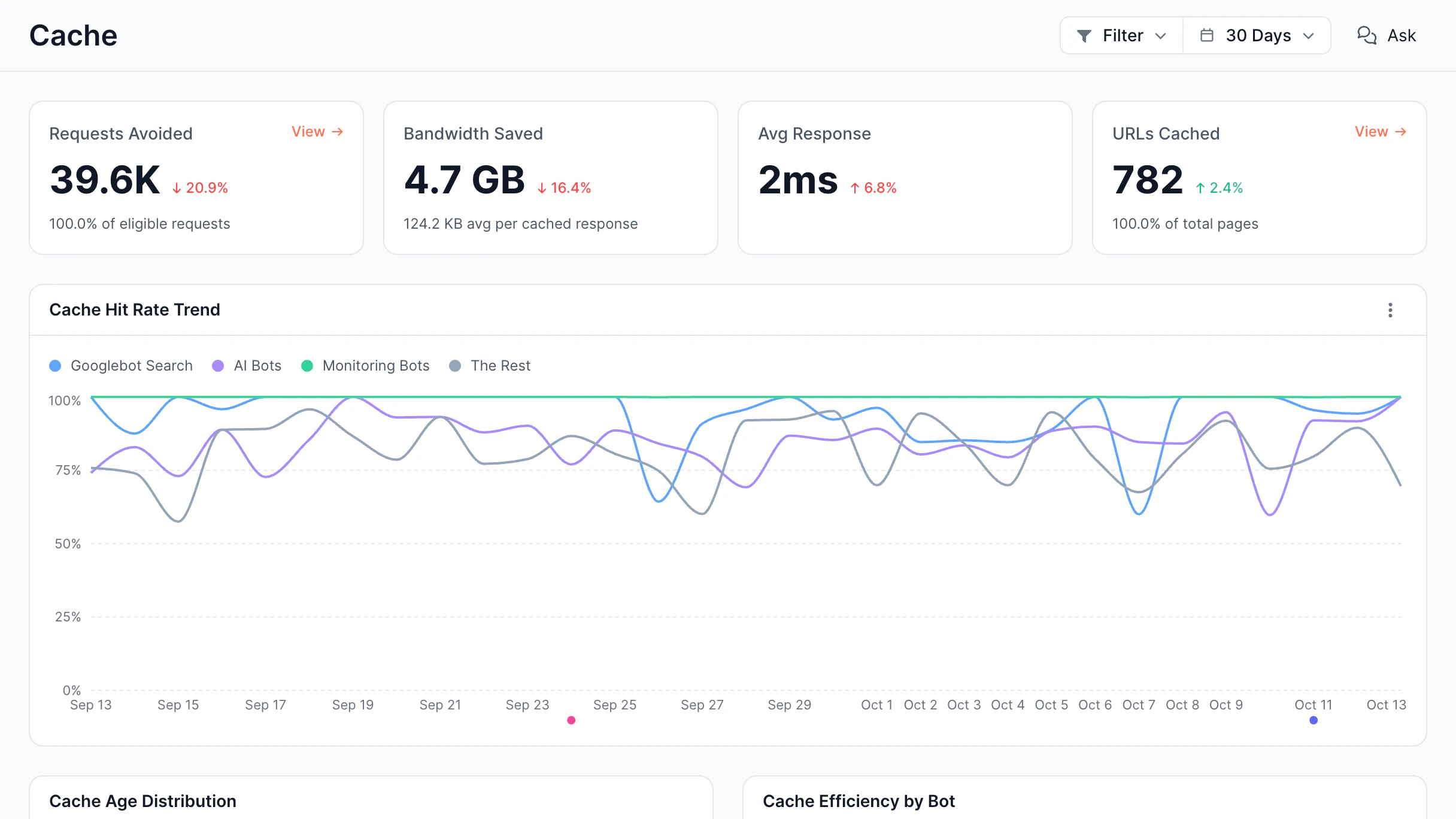
Hit rate, bandwidth saved, and cache age.
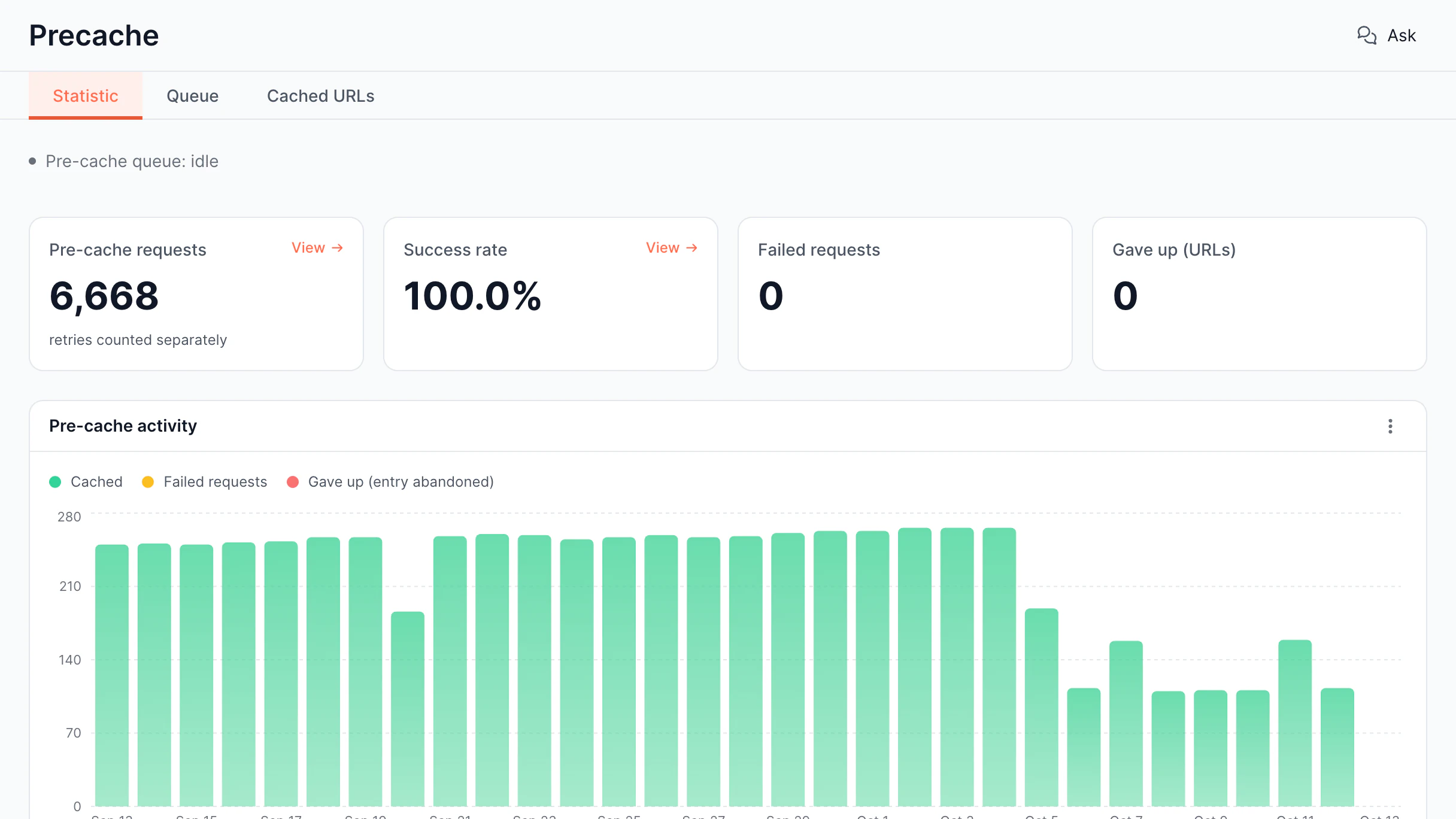
Pre-cache queue, success rate, and failures.
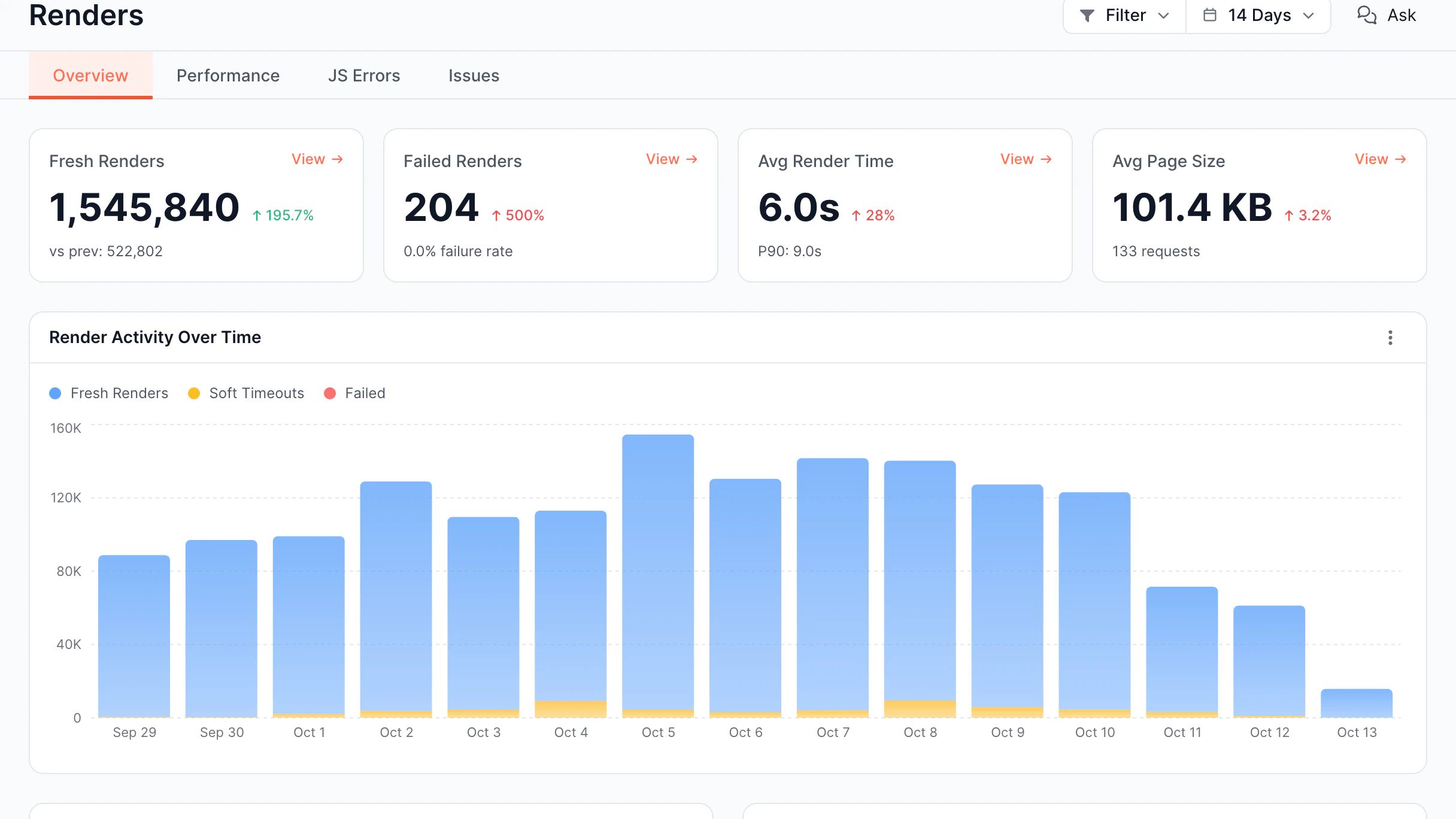
Renders per day, failures, and render time.
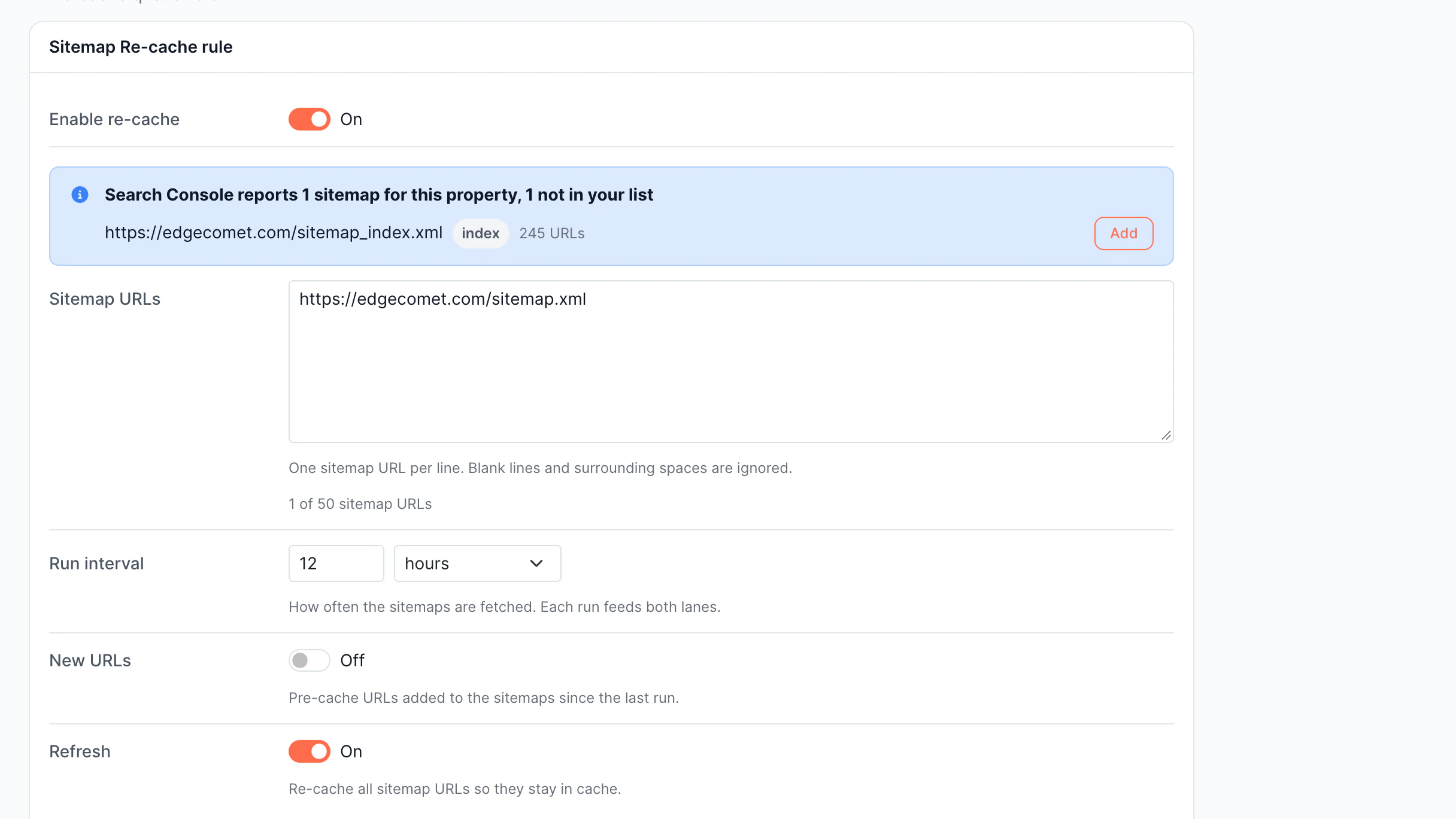
Re-cache rule for sitemap URLs on a schedule.
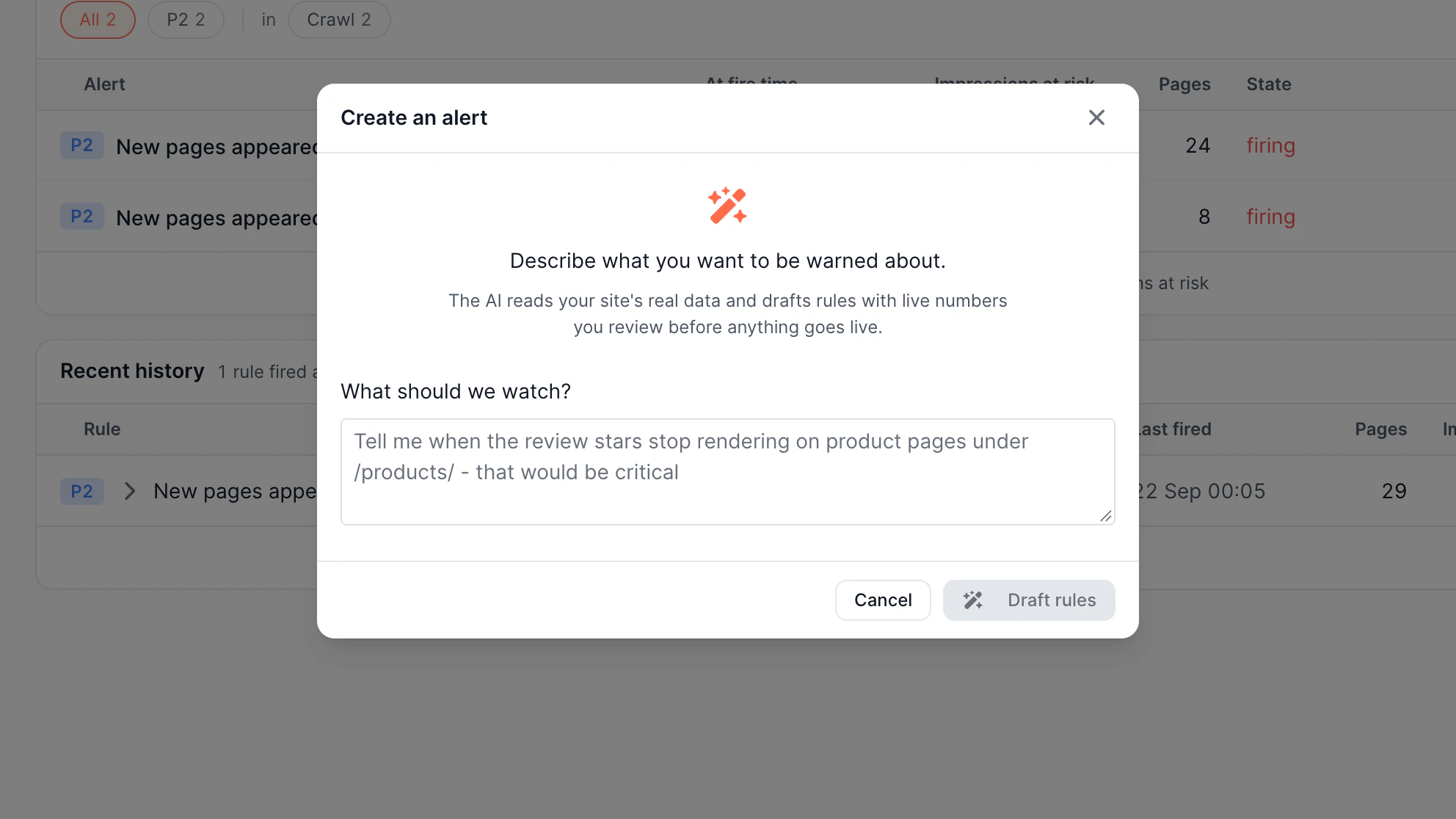
Create an alert by describing it in plain text.
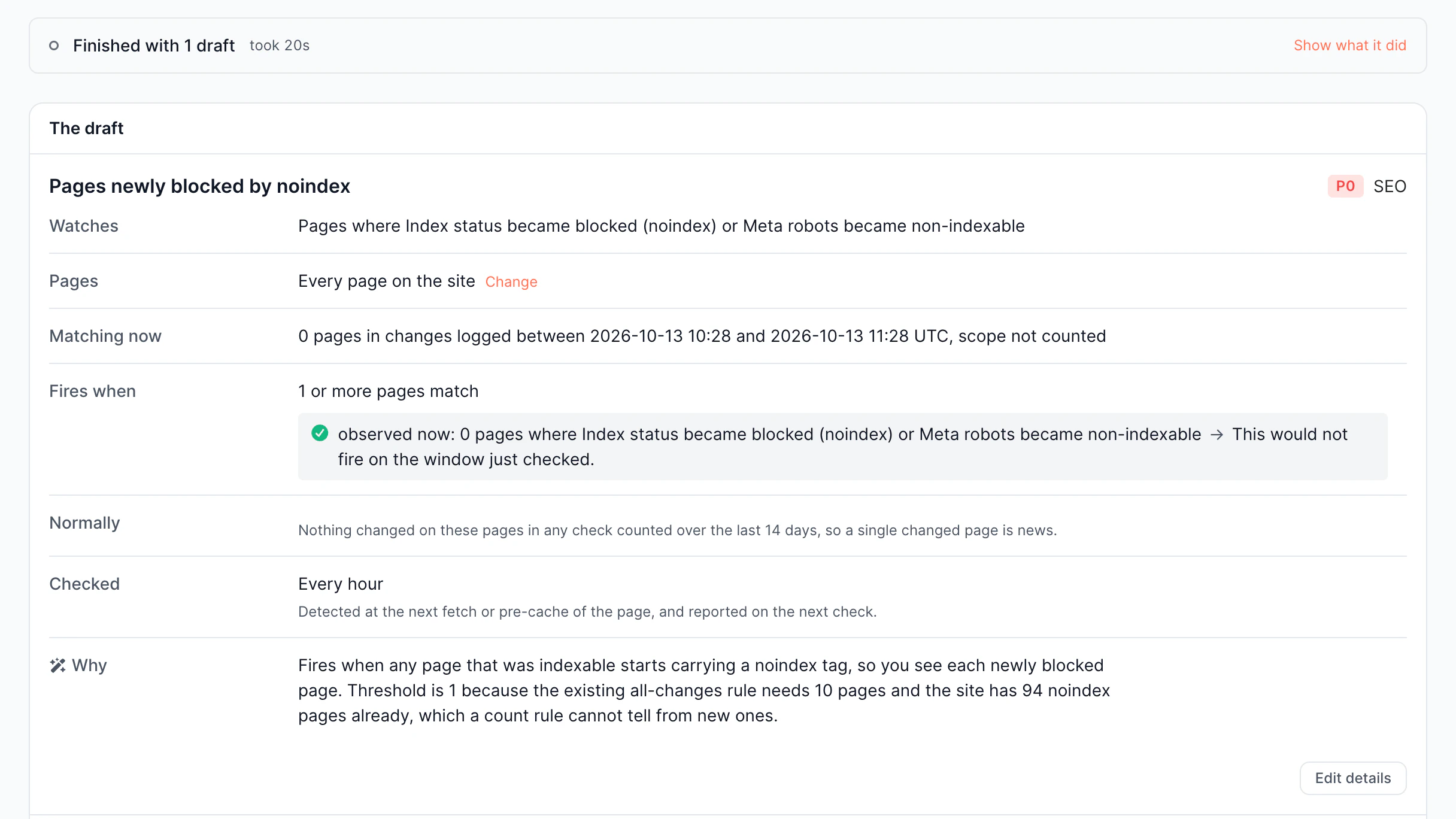
AI-drafted rule: what it watches and when it fires.
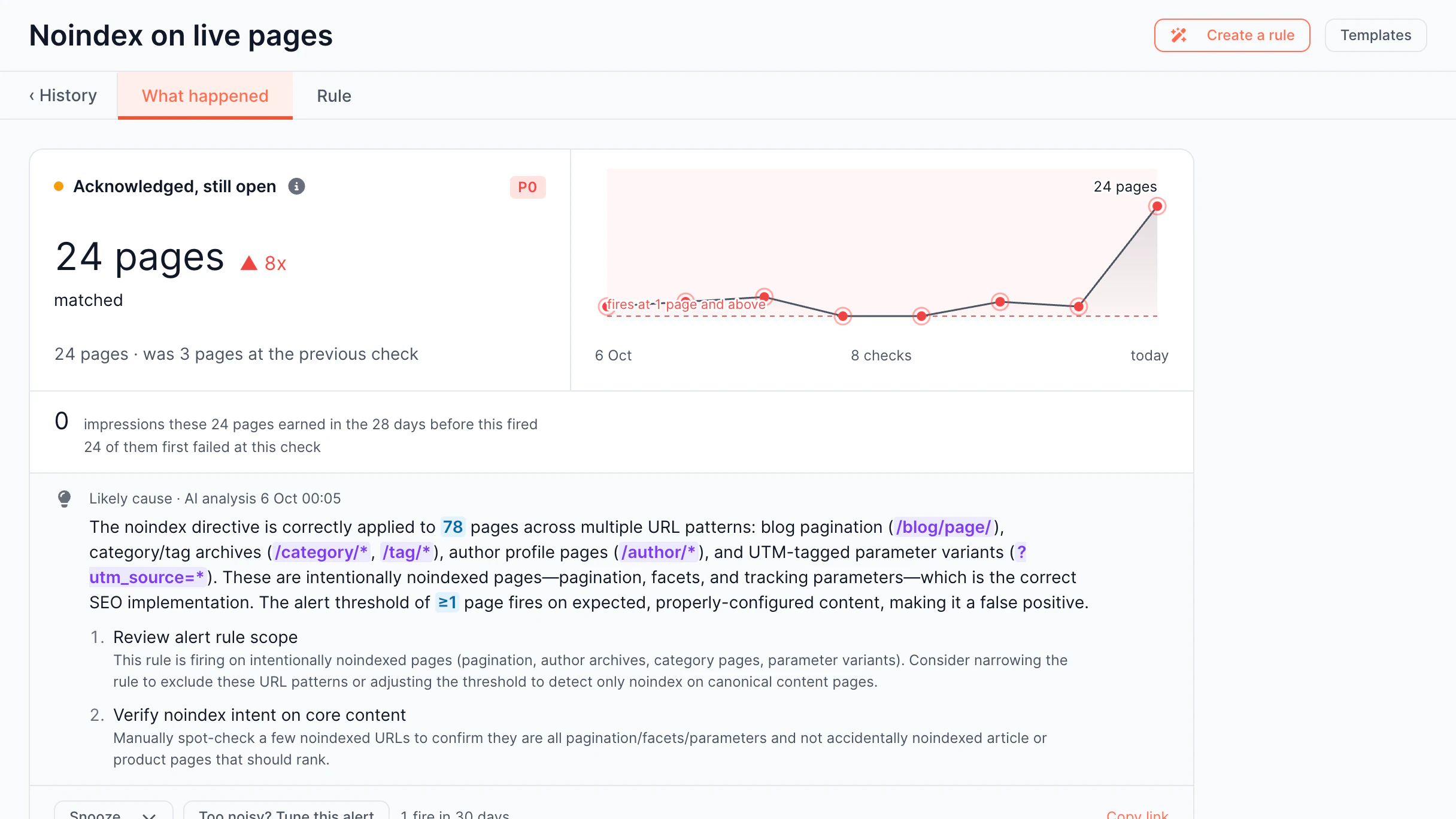
Incident page with matched pages and AI cause analysis.
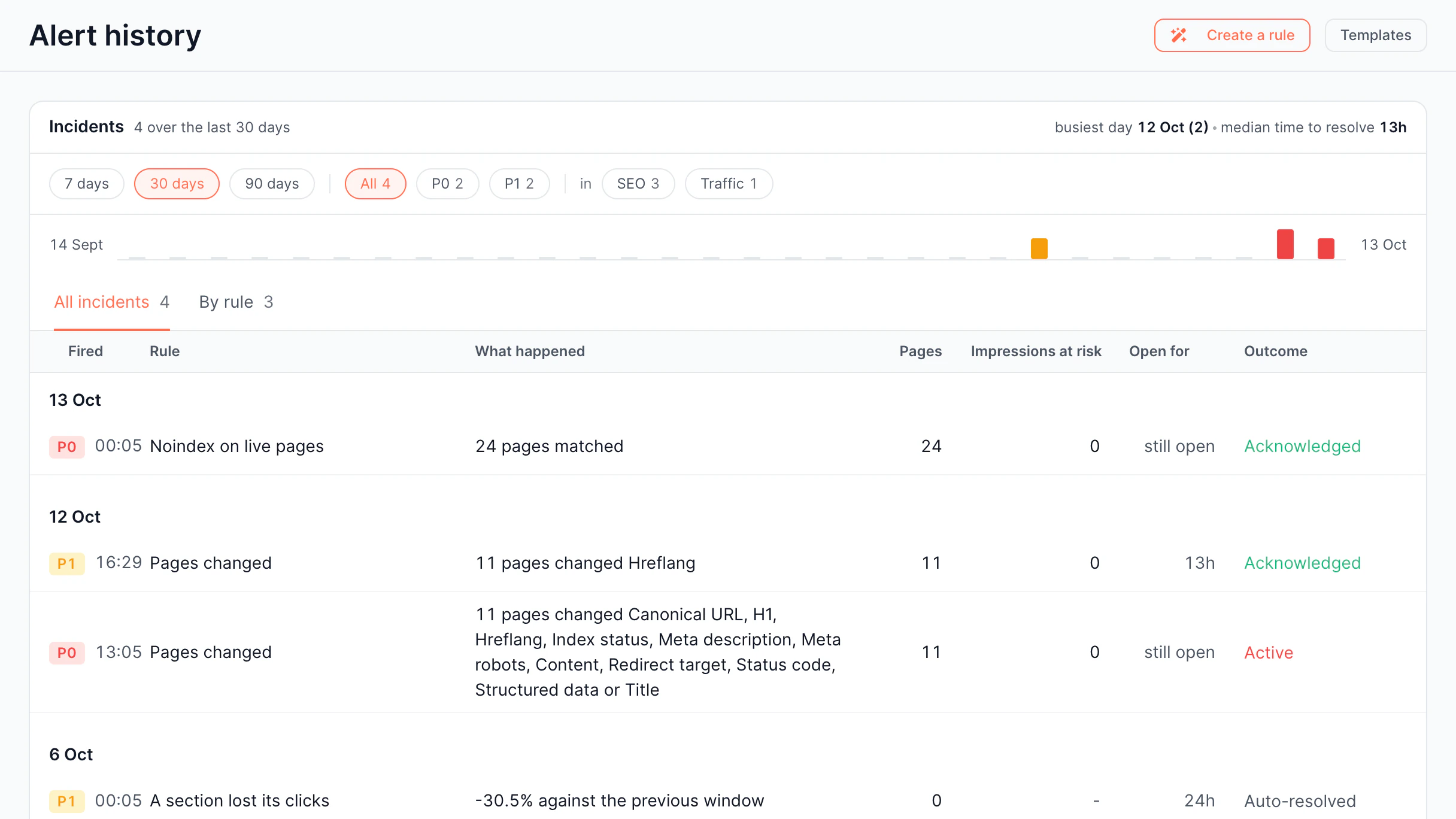
Incident log with pages, impressions at risk, and outcome.
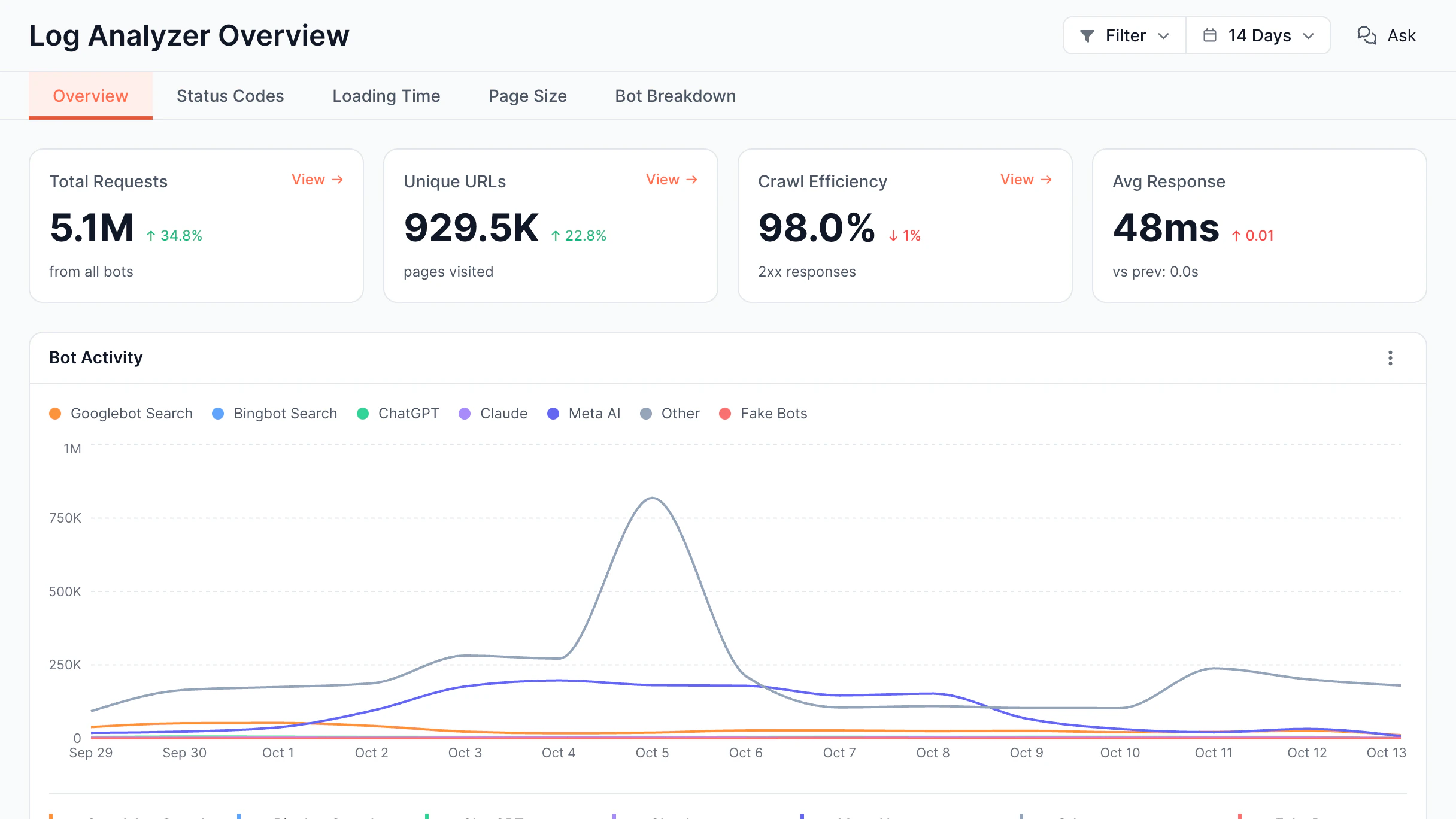
Requests per bot family, with status and response time.
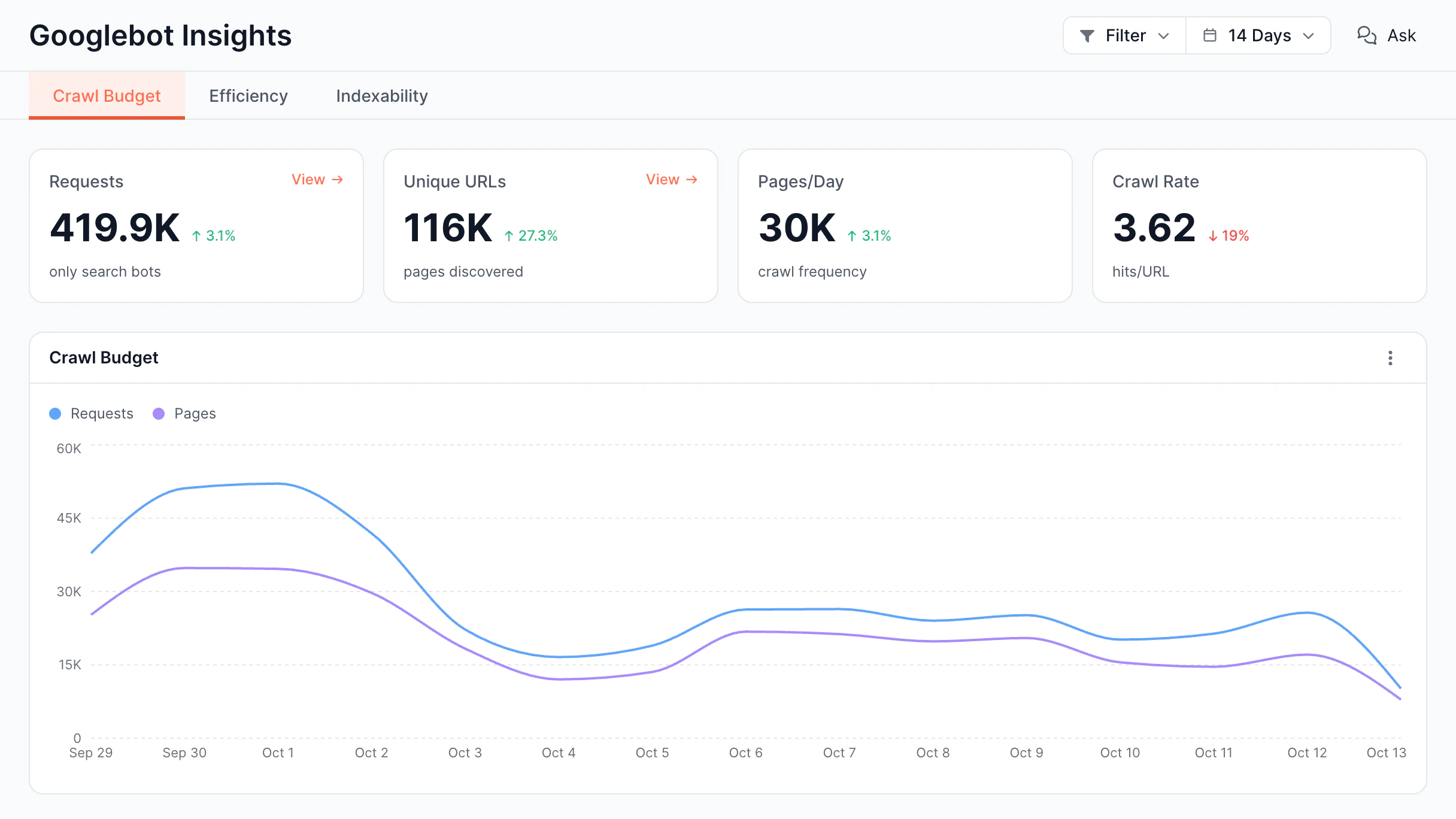
Googlebot requests, unique URLs, and crawl rate per day.
Googlebot crawl split into valuable, questionable, wasted.
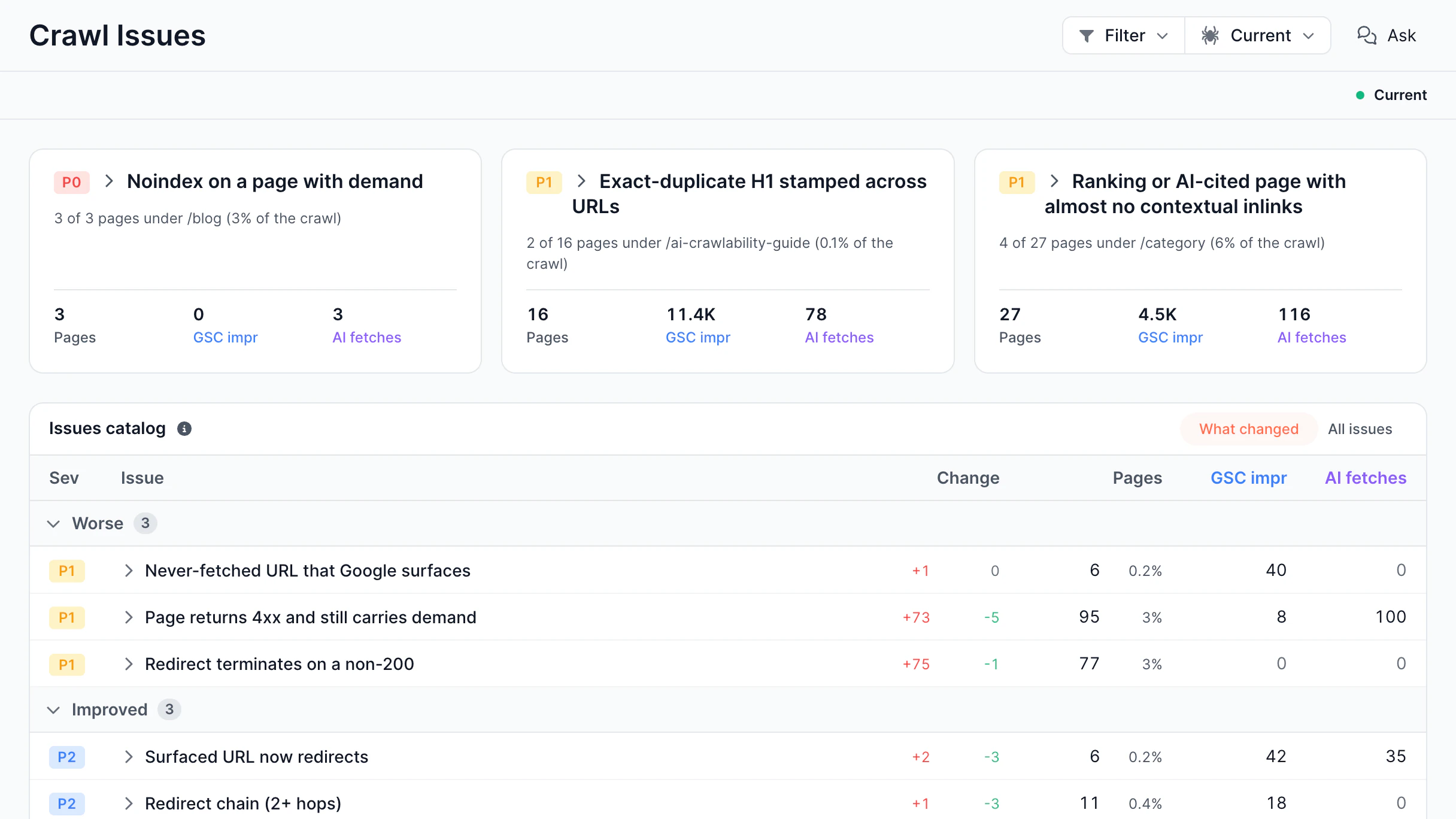
Audit issues that changed since the last crawl.
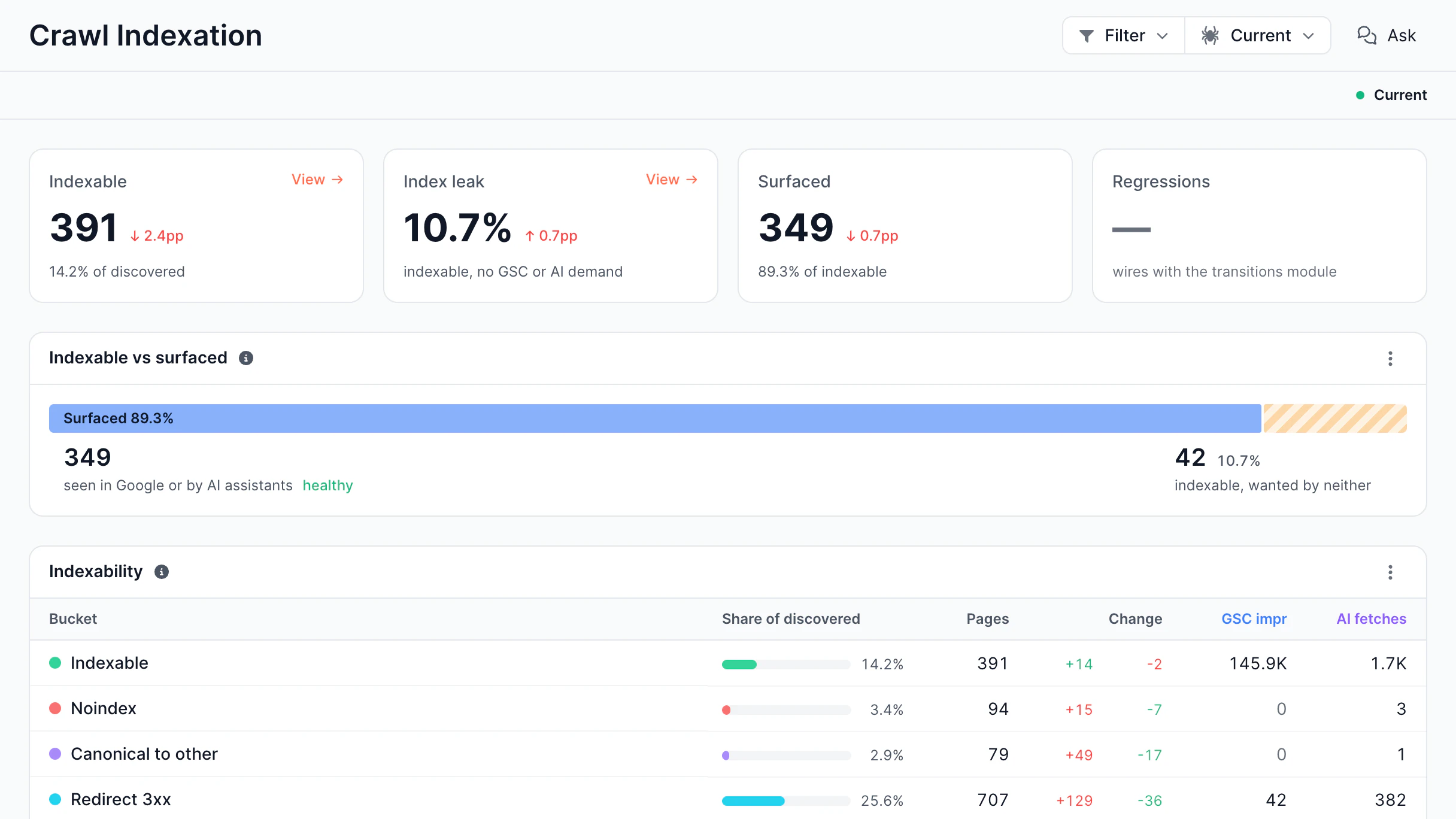
Indexable, noindex, canonicalized, and redirected pages.
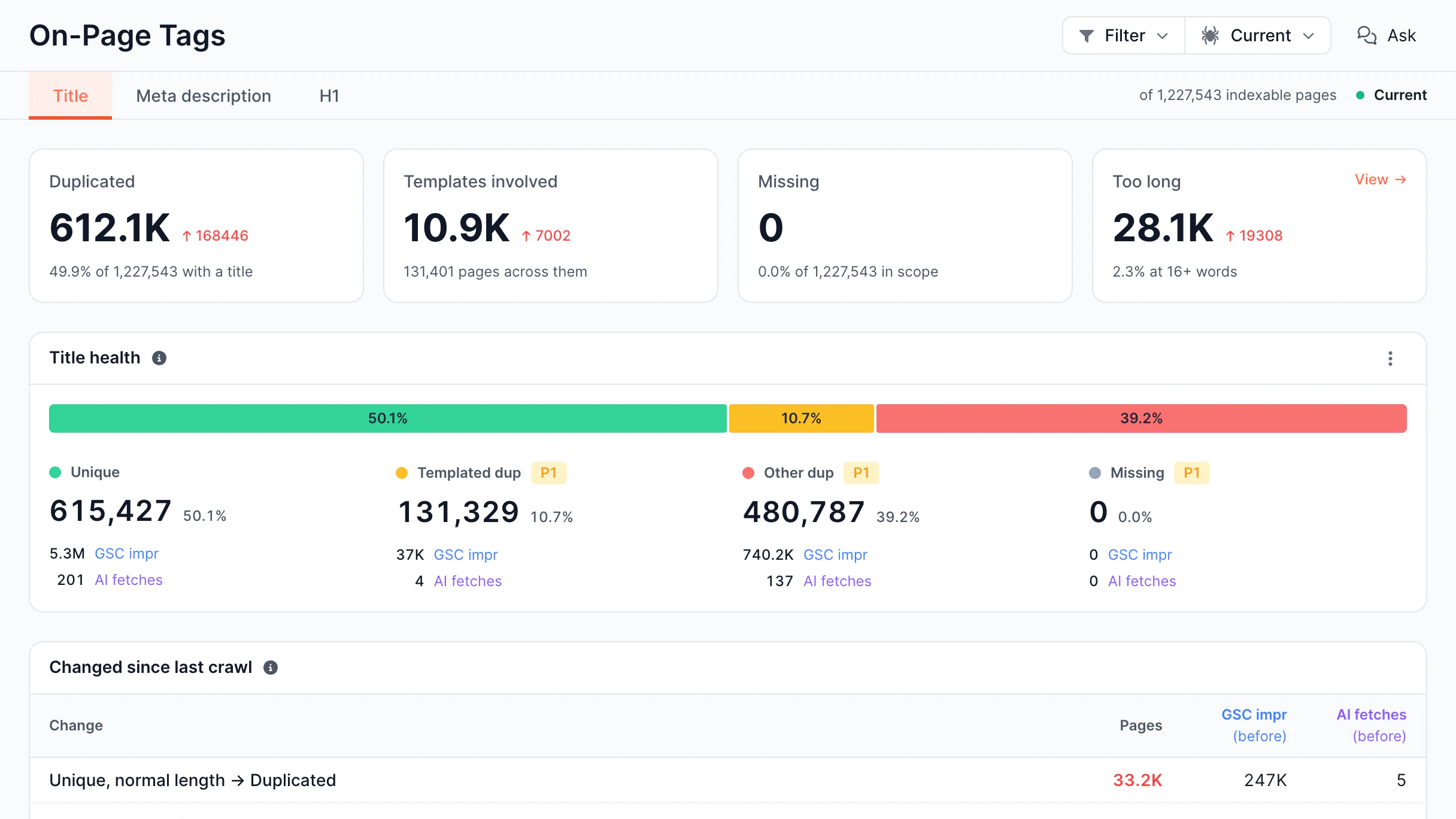
Duplicate, missing, and too-long titles.
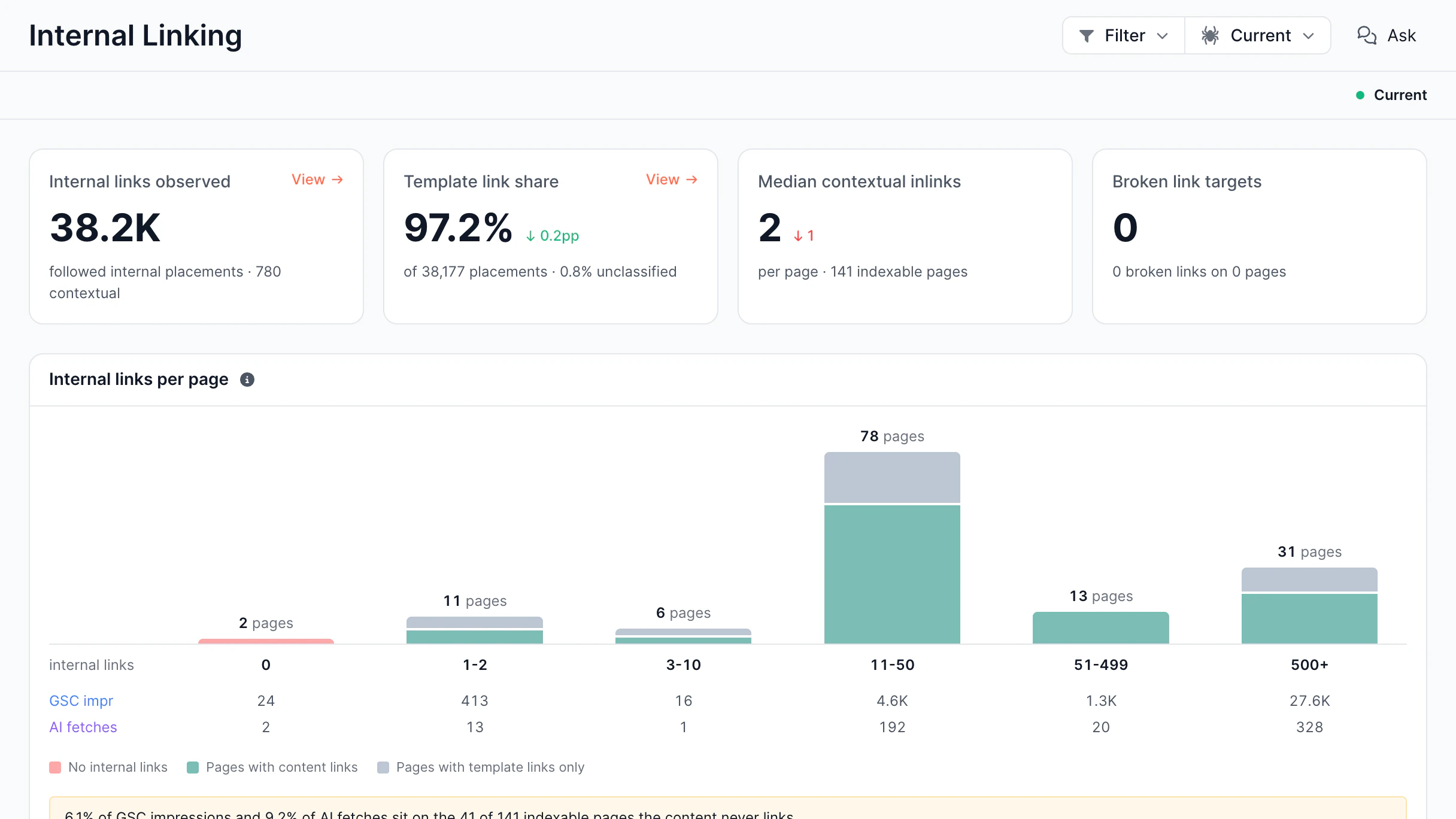
Internal links per page, content vs template.
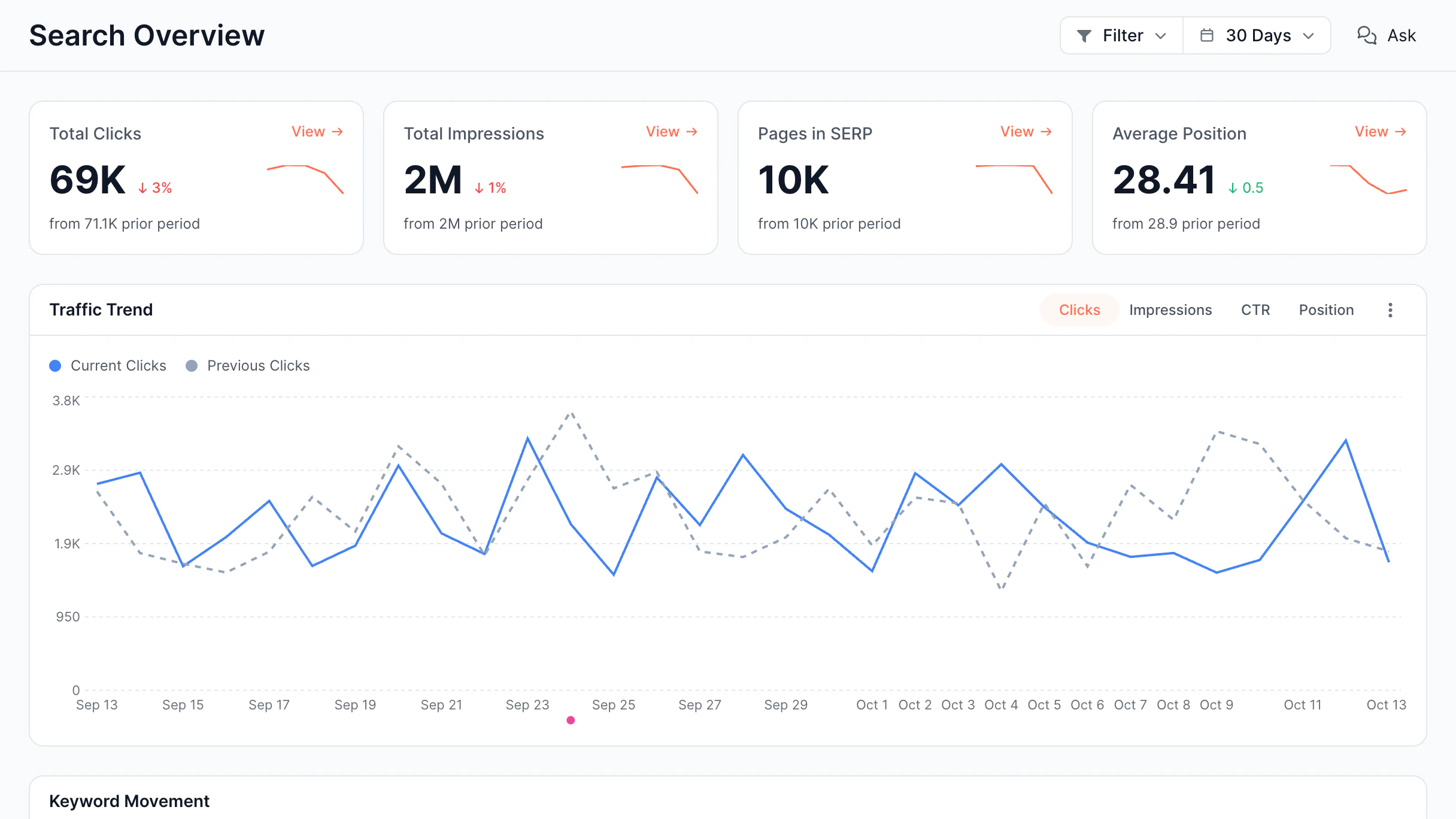
Search Console clicks, impressions, and position vs the previous period.
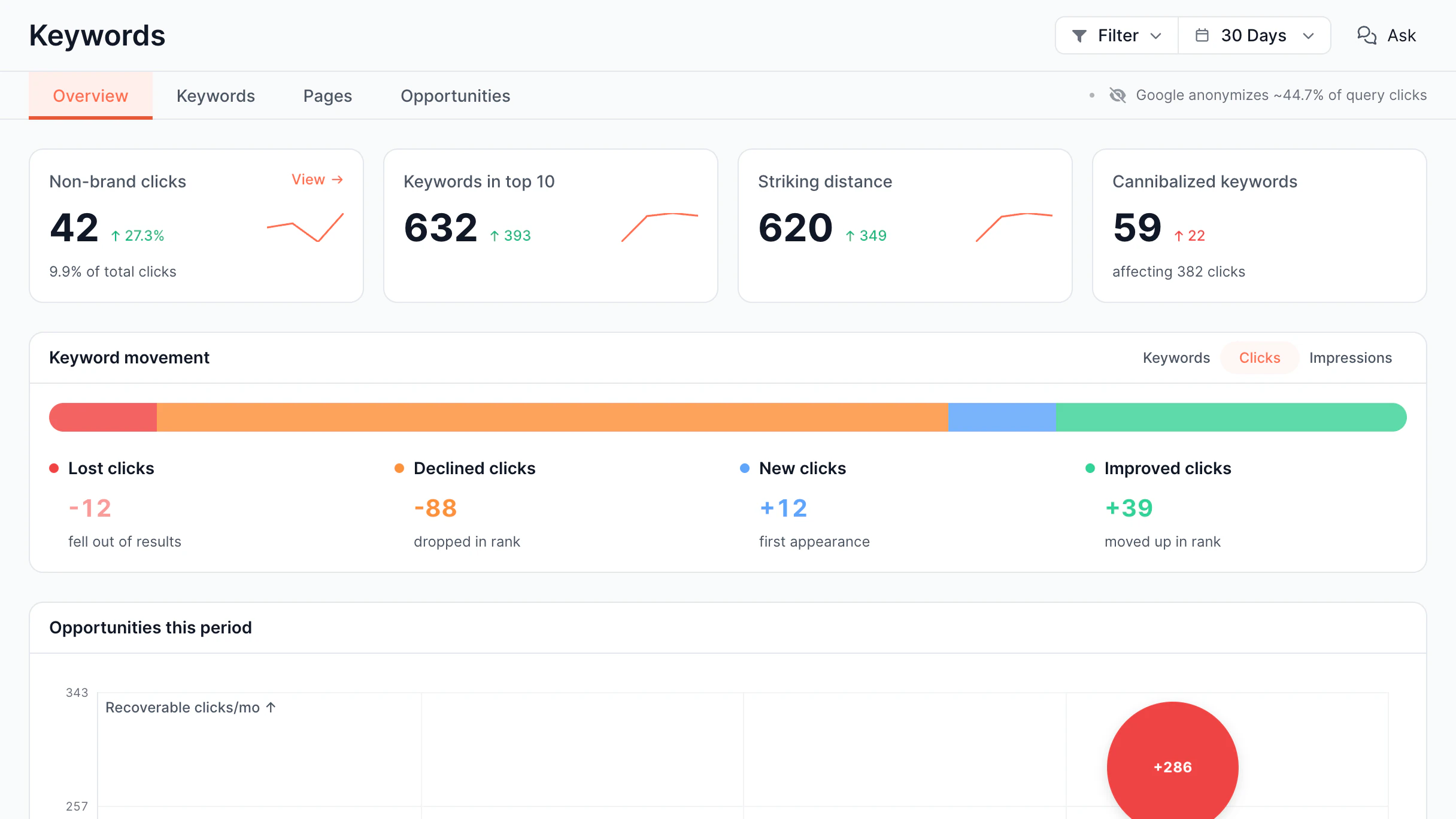
Keyword movement, top-10 counts, and striking-distance keywords.
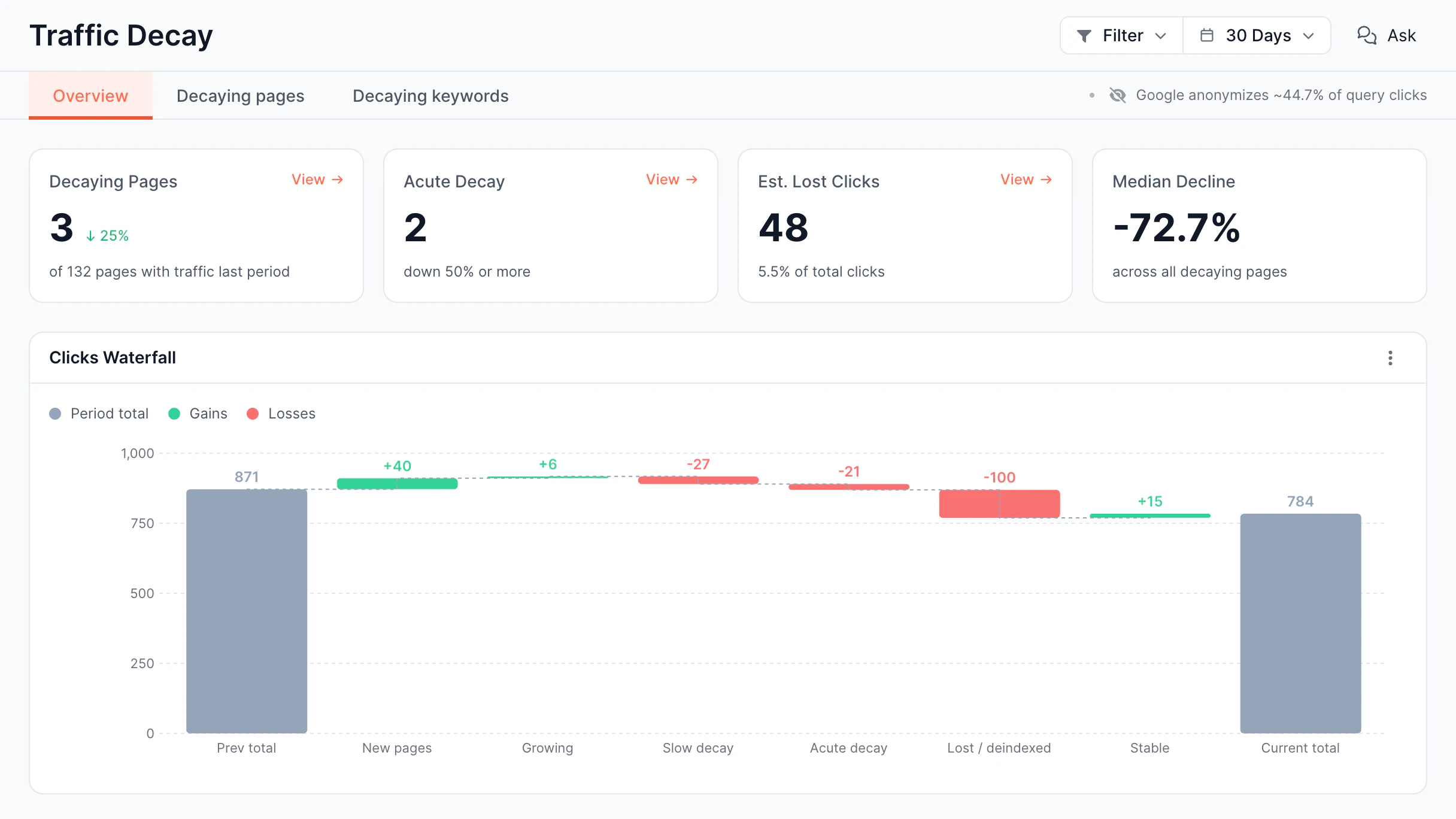
Pages losing clicks, split into slow decay, acute decay, and deindexed.
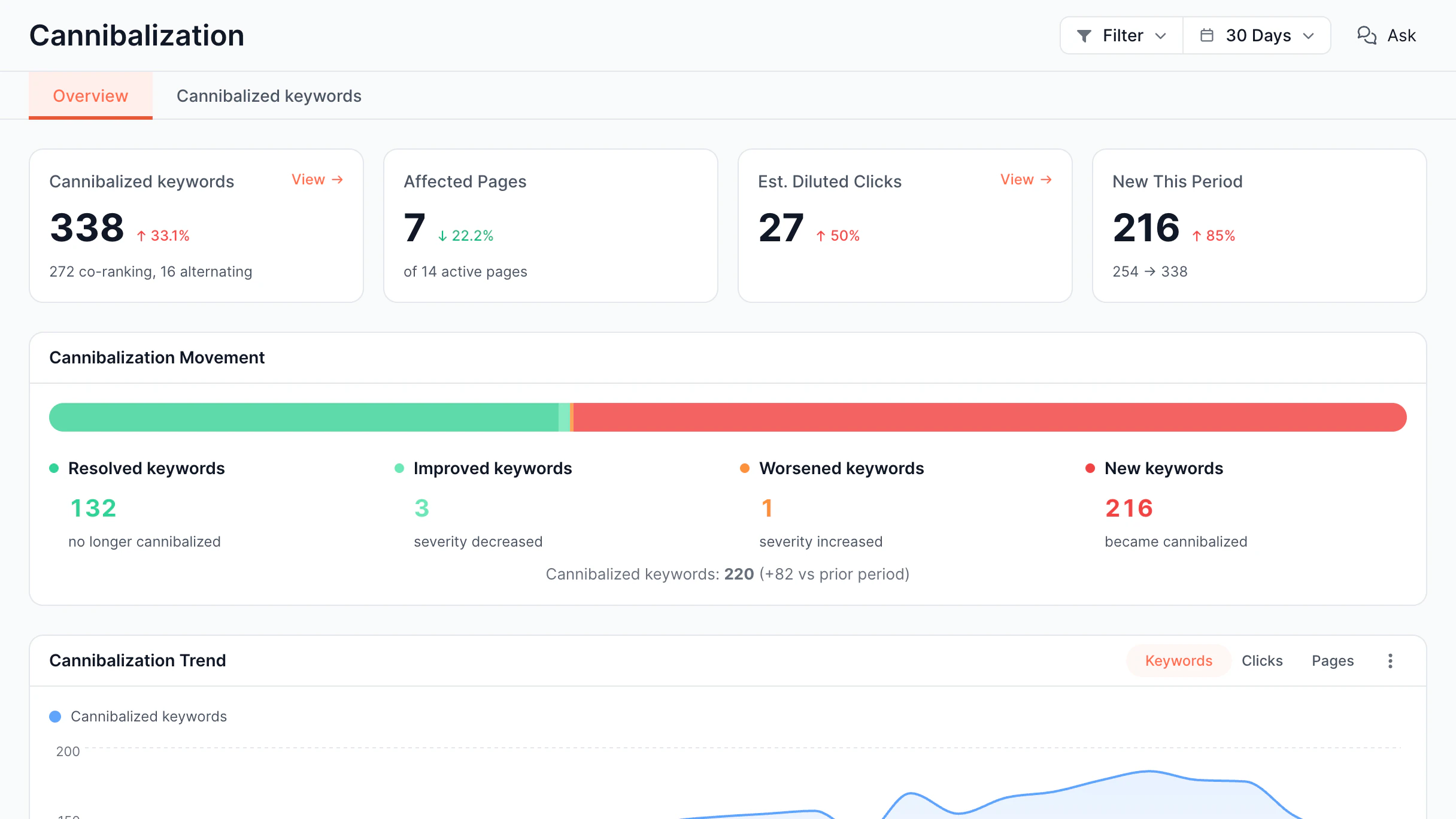
Keywords where several of your pages rank, and how that changed.
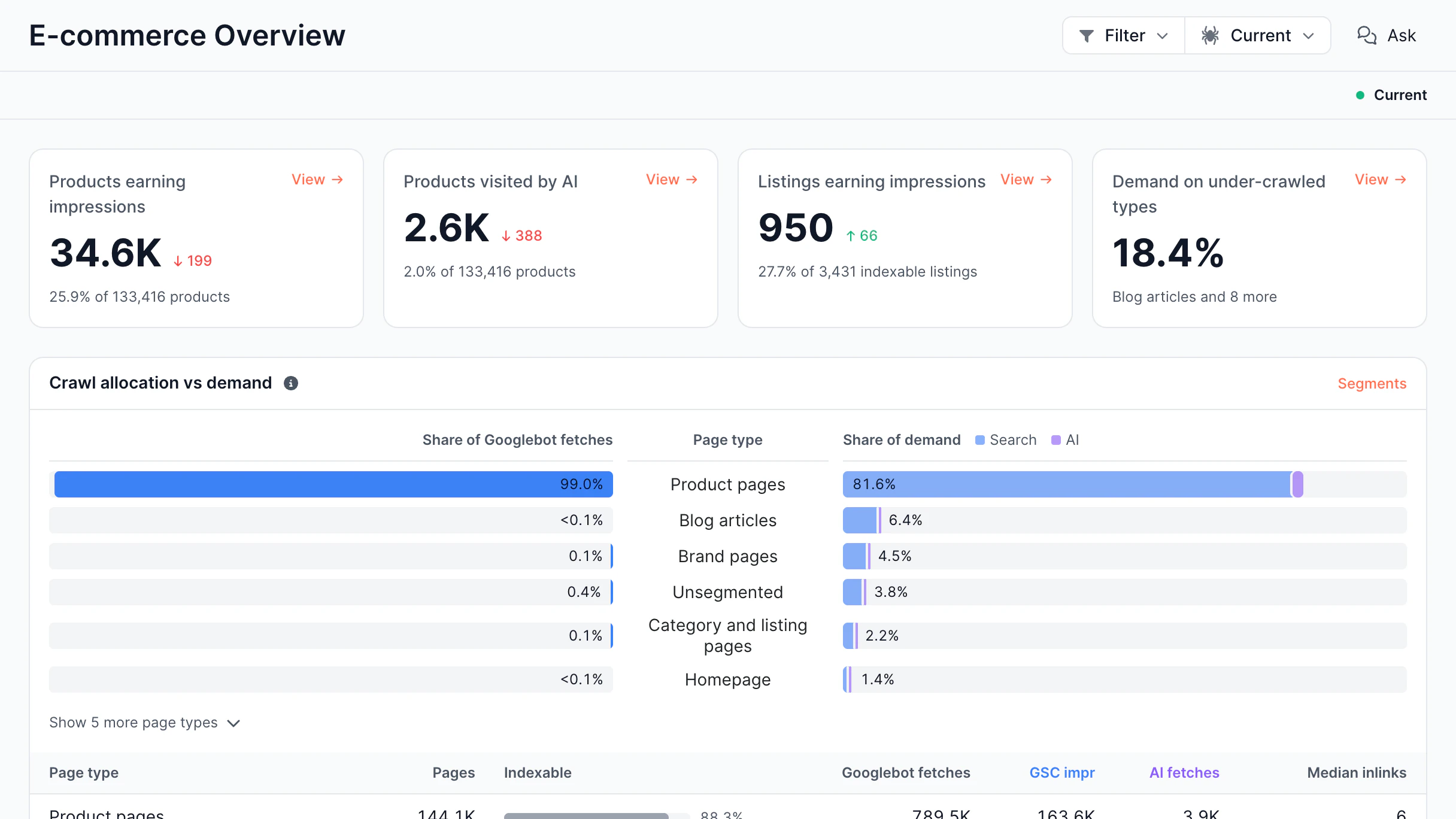
Googlebot fetches vs search and AI demand by page type.
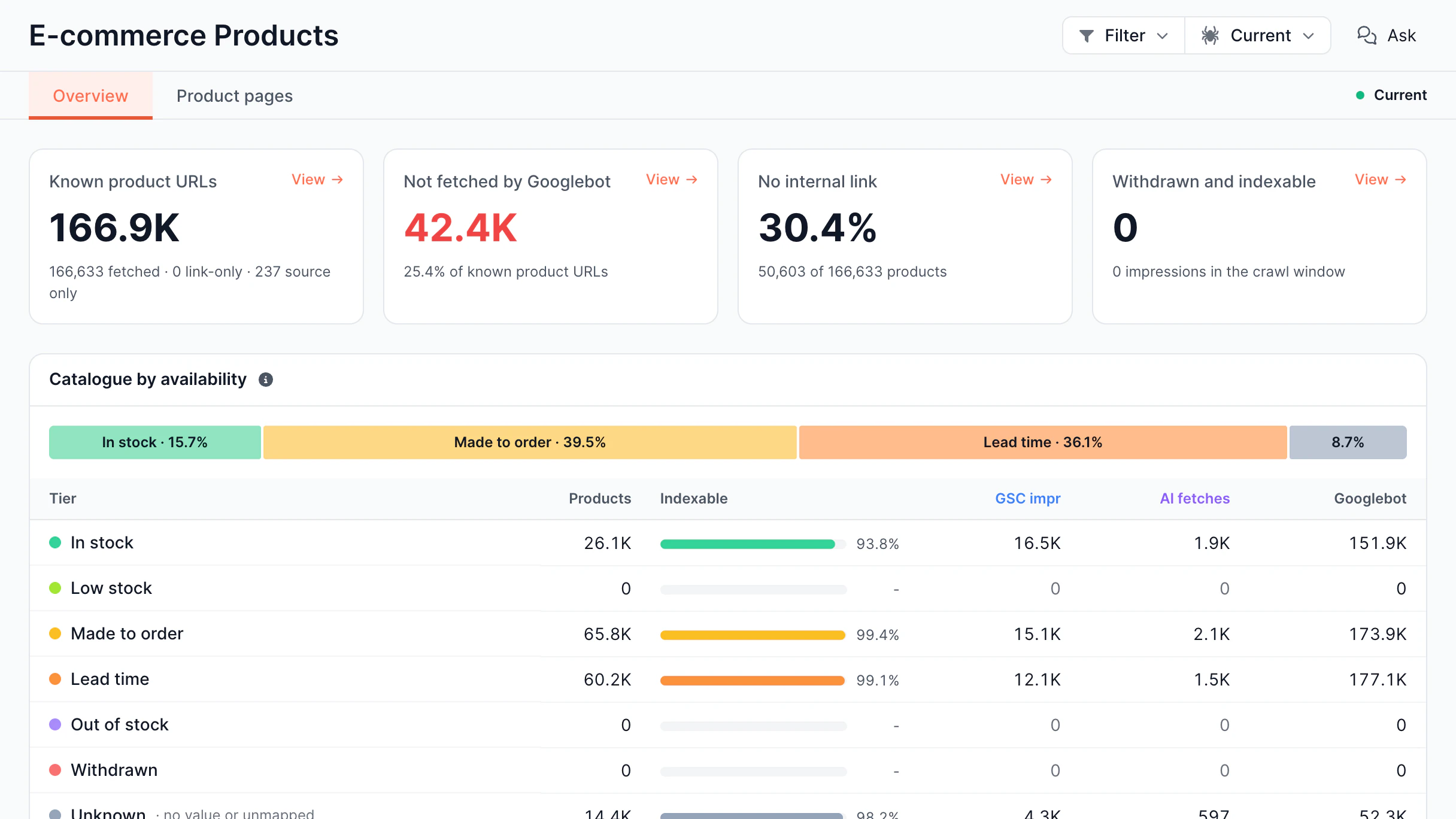
Products not fetched by Googlebot or not linked.
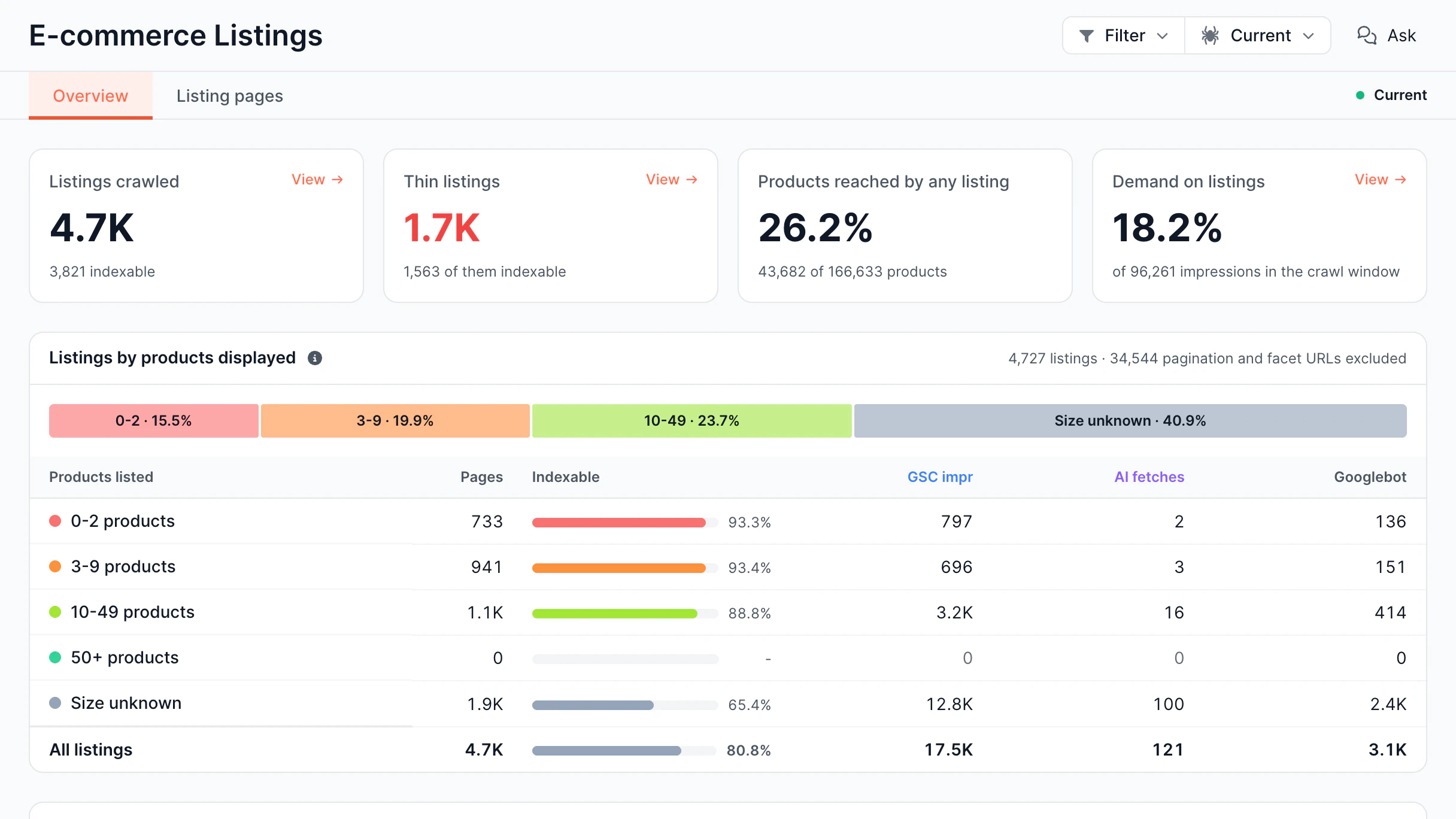
Category pages by number of products listed.
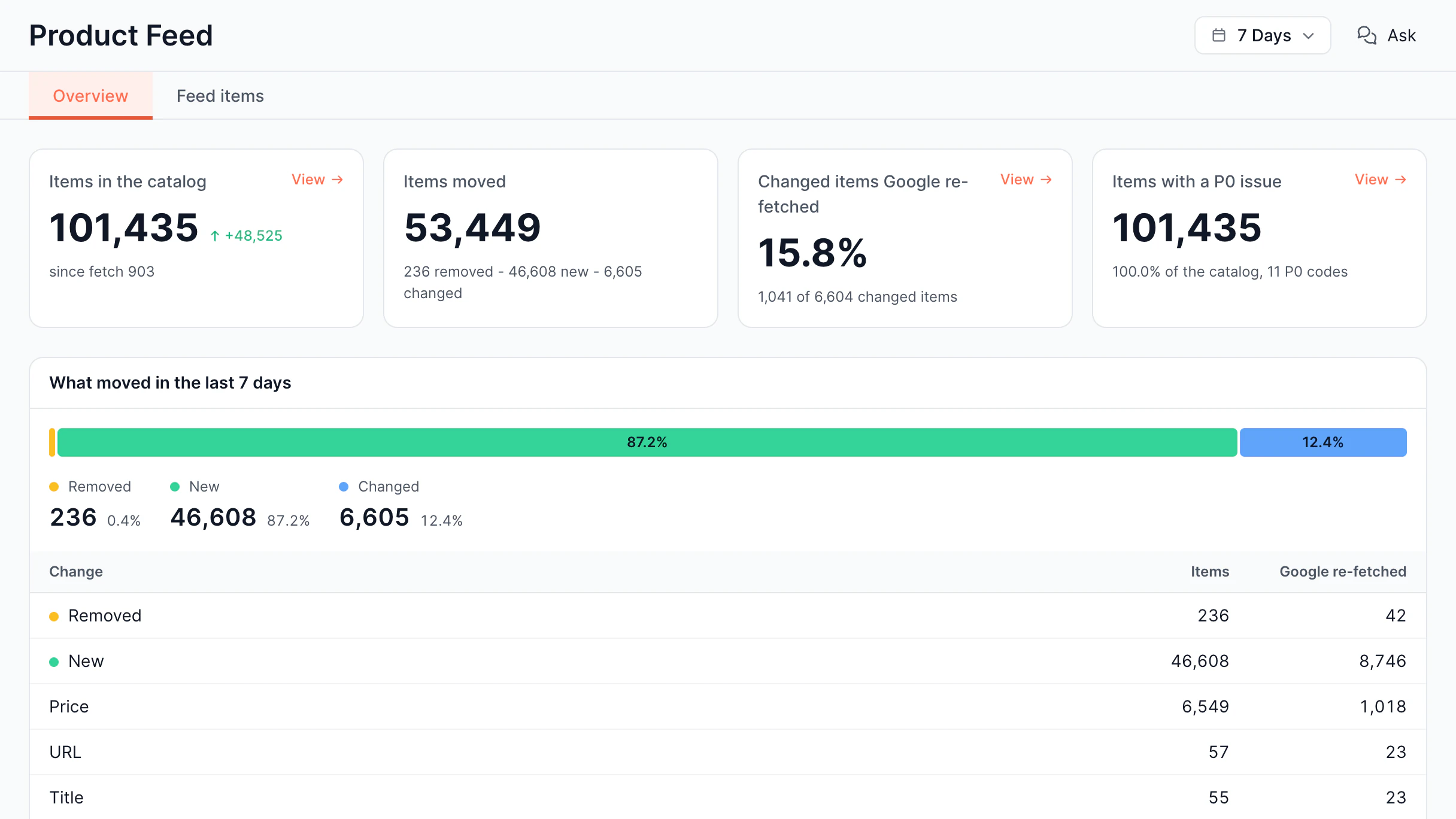
Merchant feed changes and Google re-fetches.
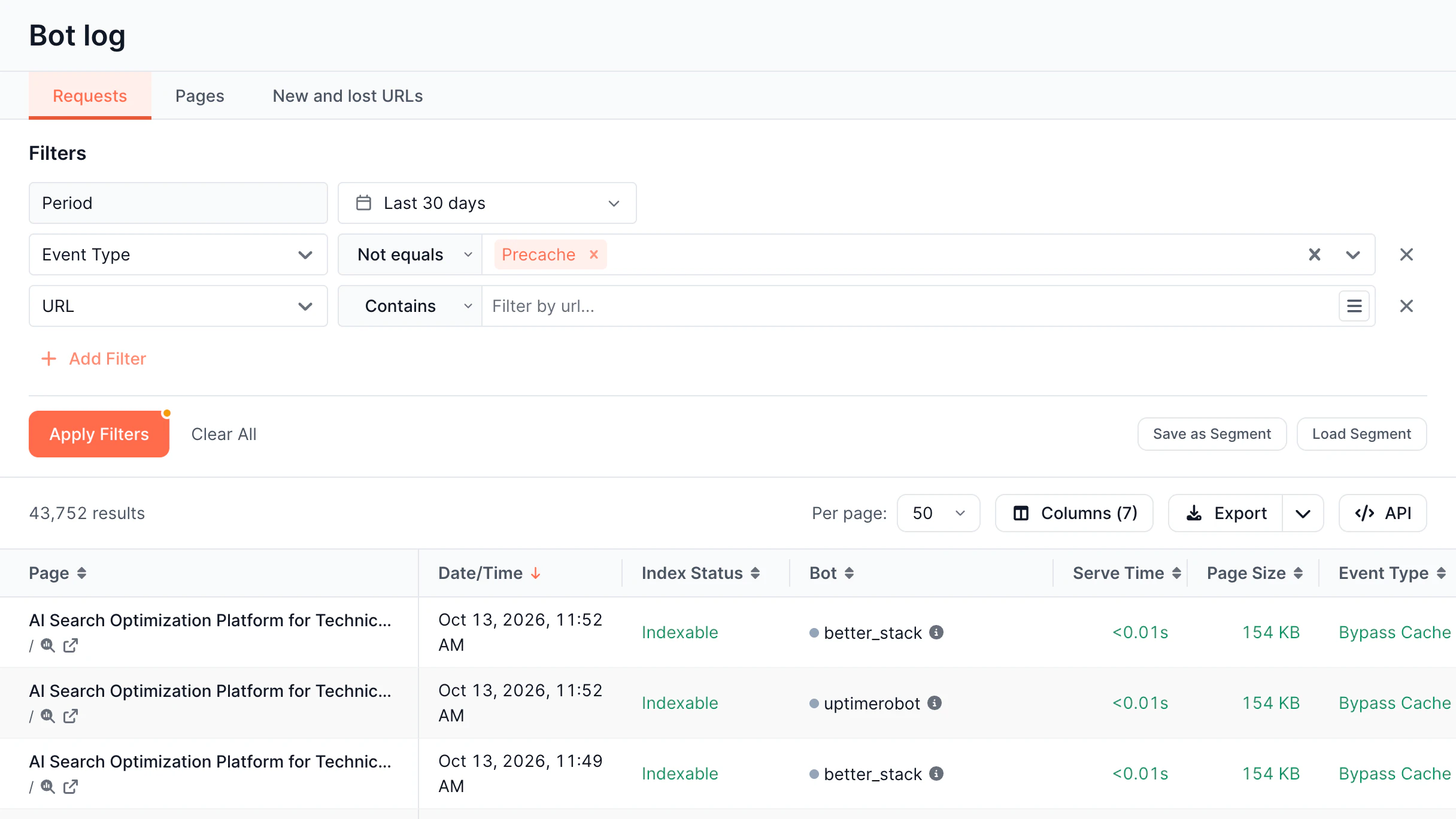
Table of every bot request with filters, segments, and export.
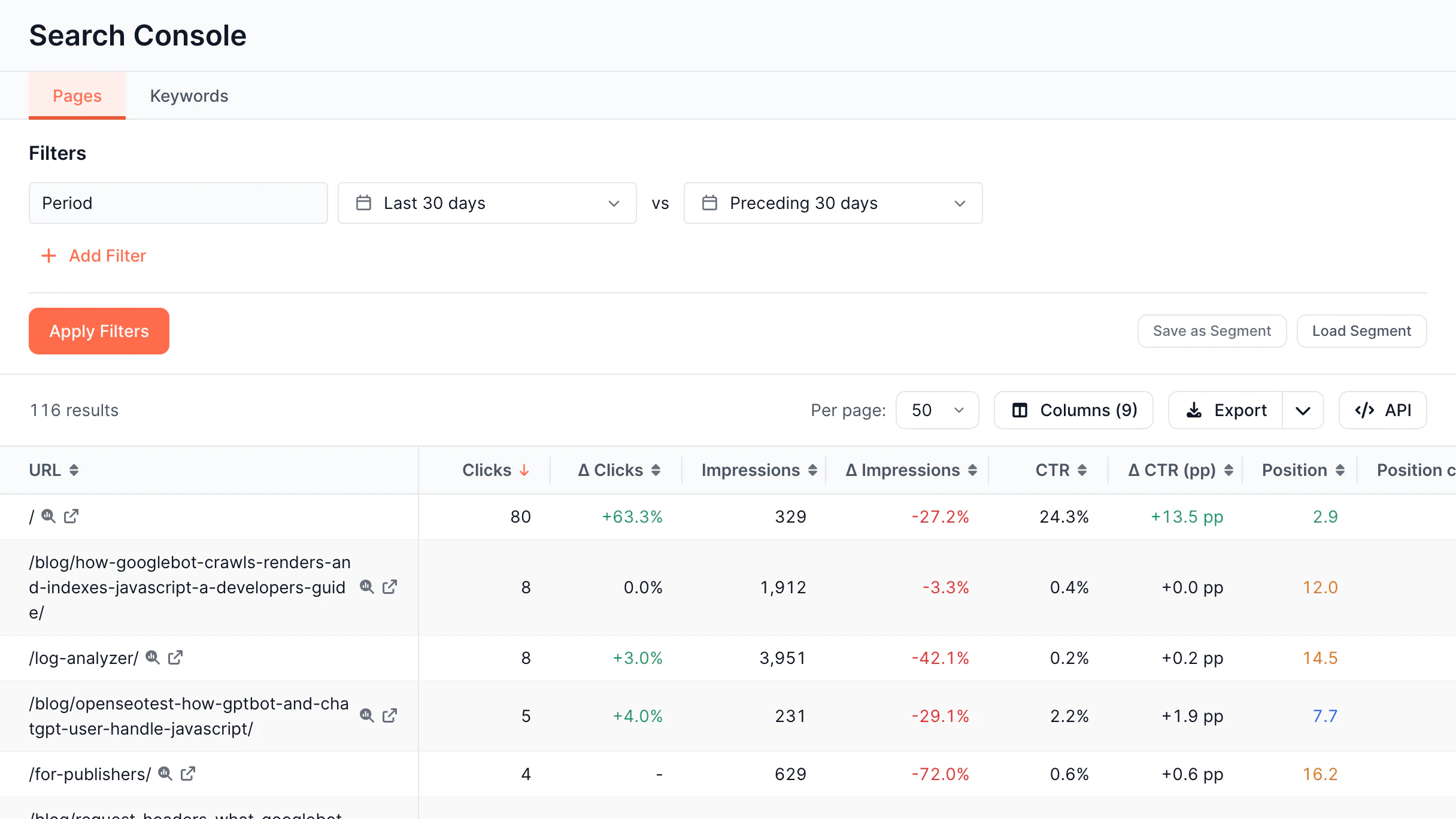
Search Console rows by page or keyword, with filters and period comparison.
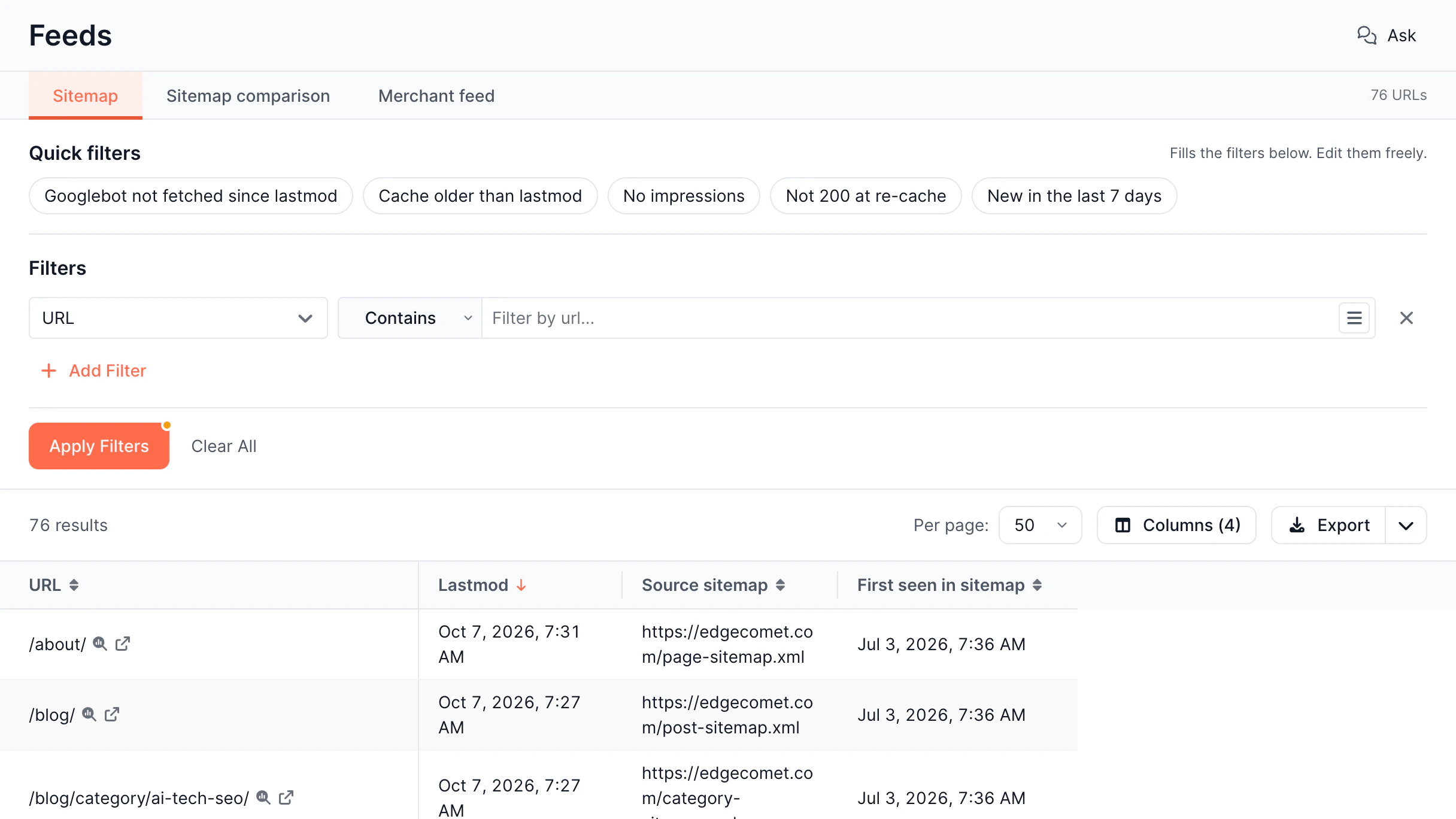
Sitemap and Merchant feed URLs with quick filters and export.
Improve indexing, visibility, and traffic from day one.
14-day free trial
SEO for classified websites is an SEO practice that makes listings easily discoverable by AI and search engines. It ensures that each listing page with its title, price, location, and other data is appropriately inspected, rendered, and indexed so buyers find it via organic search.
The key problem is scale. Classifieds post thousands of listings each day. Search engines have a limited budget per session, so many pages never get inspected before they become outdated. Add JS-heavy content that bots can’t properly render, so a large part of the inventory goes unexplored.
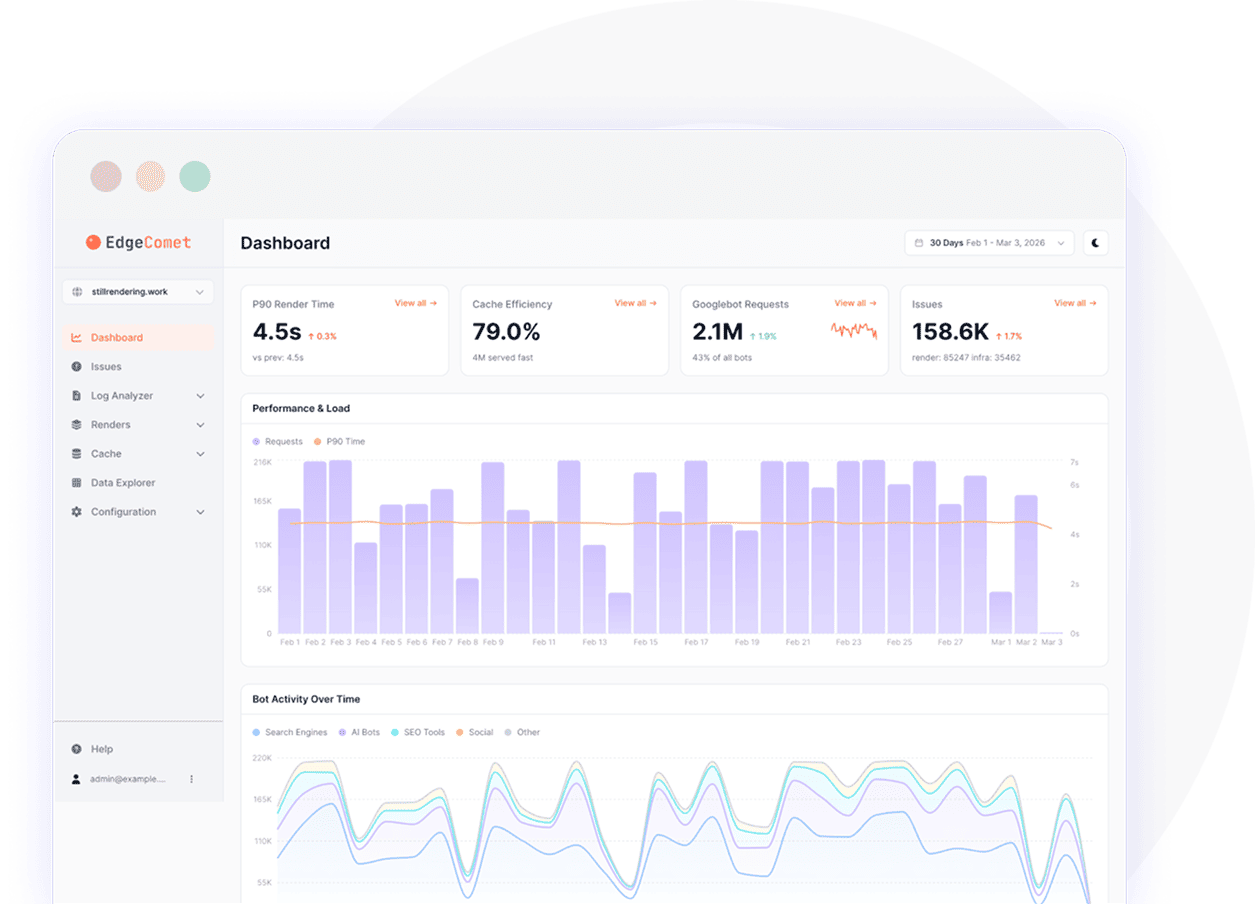
Route bot traffic through EdgeComet, and its Log Analyzer records every search bot request as it is served, with no log files. It classifies crawl as valuable, questionable, or wasted by section, and alert rules check every 5 minutes for drops in Googlebot crawling or pages that switch to noindex. Usage counts Googlebot requests only; other bots are free.
A lot of modern classified sites rely on JavaScript to load listing pages. Search engines and AI bots can process JavaScript, but it's slower and resource-consuming, which means they can skip it or see a blank page.
Multiple factors work against indexing: limited crawling budget, slow rendering, poor internal linking, duplicates, and outdated listings. When a bot ultimately reaches a page but can't render it, the listing is either skipped or indexed without meaningful content.
Rendering is the stage when a crawler processes JavaScript to see content. If it is slow or fails, bots index empty or broken pages. Reliable rendering means more listings are inspected properly and displayed in search results when users are actively searching.
EdgeComet sits in the rendering path between your site and incoming bots. It ensures that every bot gets a completely rendered page with all listing data. It speeds up indexing, extends bot coverage, and provides you with full visibility of what each crawler sees.
Stay ahead with expert insights on search visibility, AI optimization, and technical SEO
Orphan pages harm your website in many ways. They are harder to discover causing potential traffic losses, and result in...
Read Article
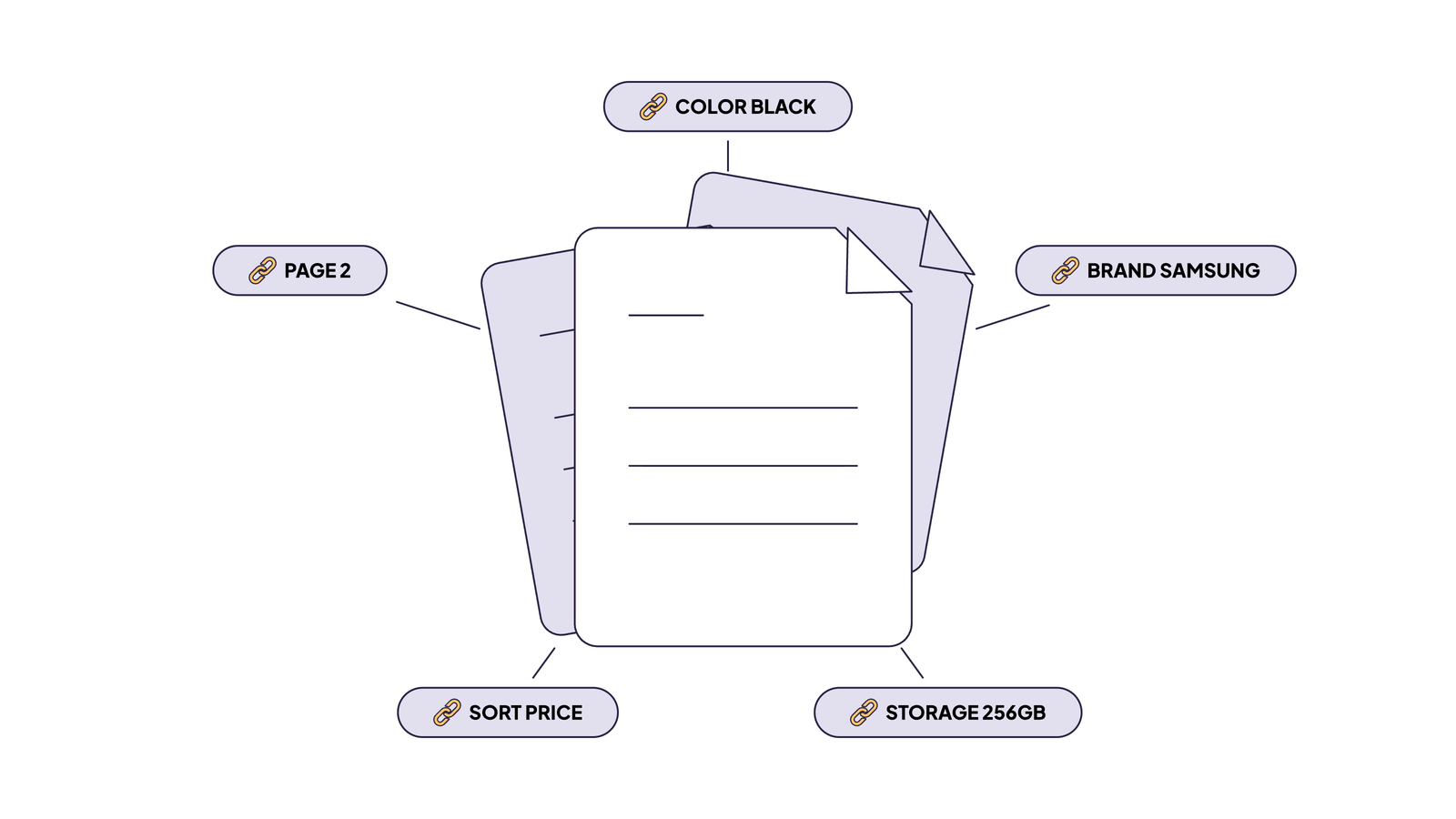
Faceted navigation SEO comes down to two decisions for every filter URL: may search engines crawl it, and may they...
Read Article
Over three months, AI crawlers made 48 million requests on one of our clients’ marketplace sites. That’s twice as many...
Read Article