In February we published an analysis of where search bots and AI crawlers actually live. Google and Bing crawl from data centers all over the world. The AI crawlers sat in a few US cities. That was the clean split across the seven bots we covered from Google, Bing, OpenAI and Perplexity. Anthropic wasn’t in the study at all, because back then it published no IP addresses for ClaudeBot.
Nine months later, we ran the same analysis again. Mostly, I wanted to know whether these lists really change, or whether vendors publish them once and forget about them. More bots deserve a check than in February. This time I used every list EdgeComet uses to validate bot traffic.
That means 27 IP lists from 16 vendors, covering 32 bots and 2,056 IPv4 subnets in 44 countries. The vendors’ lists and docs hold 193,445 IPv4 addresses.
Google and Bing barely moved. AI vendors moved a lot, but not the way I expected. They put the bot that fetches pages for a live user in more countries, yet every crawler stayed at home.
What changed in bot IP lists between February and November 2026
Source: EdgeComet, 27 published IP lists from 16 vendors, February and November 2026
We also turned the research into a free tool, the Bot Atlas, where you can look up any of these bots with its user agents, IP ranges and a map of where they sit.
Why bot locations matter: your firewall doesn’t know
A modern website sits behind a stack of blocking rules. You have the WAF, a bot management product, rate limits, and often a country filter. Someone added that filter after a bad week of scraping or a credential-stuffing attack. Each rule makes sense on its own. Together they decide which bots can reach your pages, and nobody on the SEO side ever reviews them.
Some sites go further and only work in specific countries or states. An online casino licensed in New Jersey may only take bets from people inside the state, and some of these sites geofence everything. A pharmacy, a bank or an insurer licensed in one country often blocks the rest of the world. Plenty of shops and publishers block every country they don’t sell to. To them, that traffic is mostly noise.
The trouble is that bots don’t live where your customers live. GPTBot, ClaudeBot and PerplexityBot run only from the US. Mistral’s bots run from Sweden, Kimi’s from Singapore. A German shop that blocks all traffic from outside the EU shuts out every American AI crawler. US-only site shuts out Mistral, the Kimi bots, and the half of ChatGPT users’ subnets now outside the US.
State-level rules have a less obvious problem. We used MaxMind, and it gives Googlebot’s main ranges no state and no city. Those ranges are 66.249.x.x and the rest of Google’s own address space. They resolve to “United States” with a 1,000 km accuracy radius. Does Googlebot get through a “New Jersey only” rule? That depends on what your WAF does with an address that has no state, and most teams never check.
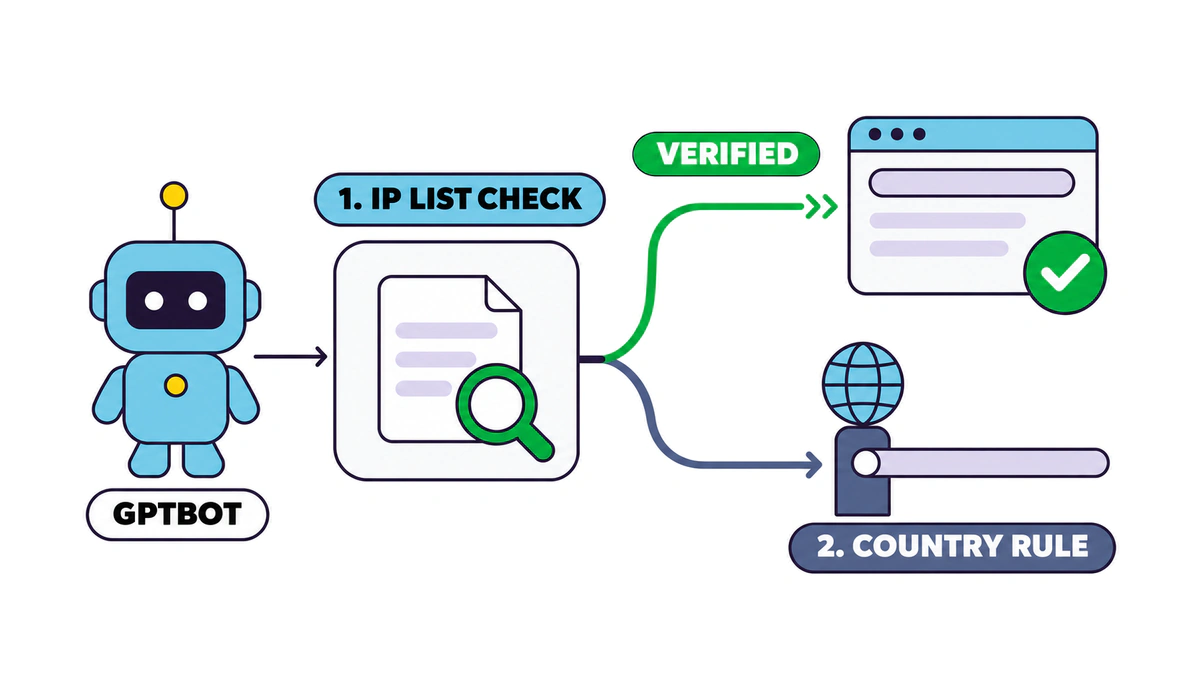
The fix is old and boring: an exception for verified bots that runs before the country rule. Verified means you check the request’s IP address against the list the vendor publishes. A user agent proves nothing, since any script can send Googlebot in its header, and in our traffic plenty of them do. I’ll call these requests fake bots: they copy a real bot’s user agent and come from somewhere else.
The good news: almost everyone publishes a list
Most vendors use the format Google introduced: a JSON file with a creationTime and an array of IPv4 and IPv6 prefixes. Those files make up 22 of the 27 lists in this study.
The other five come from somewhere else:
- Anthropic’s API egress range and You.com’s YouBot range appear only as a sentence in the vendor’s docs.
- Meta and X publish no crawler list. For their link preview bots I used the network blocks registered to each company.
- Telegram publishes a list of its whole network, not of the bot.
Are the lists correct? Mostly, yes. EdgeComet checks every bot request it sees. It compares the IP address with the lists, and for most bots the real traffic sits inside the published ranges. The exceptions are big enough to break an allowlist, though, and I’ll come back to them after the data.
How I ran it
I kept the February method so the two snapshots are comparable:
- I downloaded every list on November 11, 2026.
- For each subnet I geolocated its first usable address with the MaxMind GeoIP2 City web service, the same source as in February.
- Blocks larger than a /24 got one more lookup per /24, up to 256, because one lookup can’t describe a /16 (you’ll see why with ChatGPT-User).
- As second sources I used Team Cymru for the ASN, the cloud providers’ published region files (AWS, Google Cloud, Azure Service Tags, Oracle) and reverse DNS.
Two checks make me trust the comparison. I looked up February’s subnets again in today’s database. All but three gave the same answer. Those three moved from “Washington, DC” to “Dulles, Virginia”, about 40 km away. The changes below come from the vendors, not from MaxMind. And where a cloud provider publishes the region of an address, MaxMind’s country matched it for 1,271 of 1,272 addresses. The one miss is a Googlebot node in Google Cloud’s Belgian region that MaxMind places in the US.
Google is the weak spot. MaxMind places Google’s own address space, Applebot’s ranges and Bing’s large US blocks only at country level, with that 1,000 km radius. Google publishes no region for those ranges either. For them, “US” is all anyone outside Google knows.
Nine months, seven lists: what changed
Here are the seven lists from February, side by side:
| List | Subnets | IPv4 addresses | Countries | Kept / added / removed | |||
|---|---|---|---|---|---|---|---|
| Feb | Nov | Feb | Nov | Feb | Nov | ||
| Googlebot | 165 | 170 | 4,928 | 5,088 | 22 | 22 | 165 / 5 / 0 |
| Bingbot | 28 | 29 | 4,736 | 4,752 | 14 | 14 | 28 / 1 / 0 |
| ChatGPT-User | 224 | 237 | 3,584 | 69,312 | 15 | 23 | 115 / 122 / 109 |
| GPTBot | 21 | 18 | 3,472 | 2,704 | 1 | 1 | 18 / 0 / 3 |
| OAI-SearchBot | 35 | 39 | 2,496 | 2,560 | 1 | 1 | 35 / 4 / 0 |
| PerplexityBot | 8 | 13 | 18 | 13 | 1 | 1 | 4 / 9 / 4 |
| Perplexity-User | 4 | 10 | 14 | 10 | 1 | 1 | 2 / 8 / 2 |
So do vendors keep adding IPs? Search engines don’t. Googlebot added five US subnets and removed nothing, Bing added one, and GPTBot even shrank.
ChatGPT-User went from 3,584 to 69,312 addresses in the table. Almost all of that growth comes from a single /16 that OpenAI added. Without that block, ChatGPT-User grew by 192 addresses.
What did change is churn. OpenAI replaced almost half of ChatGPT-User’s subnets, and Perplexity swapped most of its addresses. If you copied these lists into a firewall rule in February, a good part of that rule is wrong today.
How much of each list changed between February and November
ChatGPT-User and both Perplexity lists replaced about half of their February subnets. Googlebot, Bingbot and OAI-SearchBot only added.
Show the data
| List | Subnets Feb | Subnets Nov | Kept | Added | Removed |
|---|---|---|---|---|---|
| Perplexity-User | 4 | 10 | 2 | 8 | 2 |
| PerplexityBot | 8 | 13 | 4 | 9 | 4 |
| ChatGPT-User | 224 | 237 | 115 | 122 | 109 |
| GPTBot | 21 | 18 | 18 | 0 | 3 |
| OAI-SearchBot | 35 | 39 | 35 | 4 | 0 |
| Bingbot | 28 | 29 | 28 | 1 | 0 |
| Googlebot | 165 | 170 | 165 | 5 | 0 |
Each bar is every IPv4 subnet the list had in February or November. Source: EdgeComet, the seven lists of the February study, fetched February 9-11 and November 11, 2026.
Search engines
Googlebot: same network, new hostnames
Googlebot’s list (Google calls it “common crawlers”) has 170 IPv4 subnets with 5,088 addresses, plus 147 IPv6 prefixes. All five new subnets are in the US. 87% of the subnets and 93% of the addresses are American. Almost all of them are in Google’s own ranges that MaxMind can’t place below the country level.
A thin international layer sits on top. It has one /28 (16 addresses) per Google Cloud region, in 21 countries outside the US. The Belgian node comes on top of that.
| Region | Googlebot nodes |
|---|---|
| Europe | Frankfurt, Paris, Madrid, Milan, Warsaw, Groningen, Lappeenranta, Zurich, London, Belgium (MaxMind says US) |
| Asia-Pacific | Tokyo, Seoul, Taipei, Hong Kong, Singapore, Jakarta, Mumbai, Sydney |
| Americas | Montreal, São Paulo, Santiago |
| Middle East | Tel Aviv |
New since February: 20 of these international subnets have their own reverse DNS names, like geo-crawl-34-89-198-81.geo.googlebot.com for the Frankfurt node. They’re IPv4 only. None of the 147 IPv6 prefixes has a geo-crawl name, and all of them locate to the US.
Google’s other lists
Googlebot is only one of five lists Google publishes, and an allowlist that has only the first one misses a lot:
Google’s five bot IP lists, by IPv4 addresses
The Googlebot list holds 5,088 of the 104,928 IPv4 addresses Google publishes for its bots, under 5%.
Show the data
| List | IPv4 subnets | IPv4 addresses | Countries |
|---|---|---|---|
| User-triggered agents | 12 | 70,016 | US |
| User-triggered fetchers | 544 | 17,408 | US, UK, Israel, Chile |
| User-triggered fetchers (google.com) | 252 | 8,064 | US, Canada |
| Common crawlers | 170 | 5,088 | 22 |
| Special-case crawlers | 136 | 4,352 | US, Canada |
Source: Google’s published crawler and fetcher IP lists, fetched November 11, 2026. IPv4 only.
Sixteen of the special-case subnets sit in Toronto.
Google-Agent: 70,016 addresses, all in the US
Google-Agent has the newest Google list. When a user gives a task to one of Google’s AI agents, this bot browses and acts on pages for them.
It’s small in subnets and huge in addresses: 12 prefixes and 70,016 IPv4 addresses, one of them a whole /16. Most of it runs on a separate Google network, AS396178, registered as “G-CLOUD-AGENT-TRAFFIC”, with reverse DNS names like google-proxy-136-122-0-1.google.com. Every address resolves to the US.
An agent working for a user acts more like a visitor than a crawler. Bot management products love to challenge that kind of traffic with a CAPTCHA.
Bingbot: one new node in China, the same old timestamp
Bingbot’s list grew from 28 to 29 subnets. The new one is a /28 in Zhangjiakou, a second Azure China node beside the one in Beijing. Shanghai Blue Cloud, Microsoft’s local operator, owns the network.
By subnets, Bing has the most even spread of any search engine: 14 of its 29 subnets sit outside the US, one /28 each in 13 countries, China and the UAE included. The address count tells a different story. Bing’s US blocks are /22 to /24, so 95% of Bingbot’s address space is American.
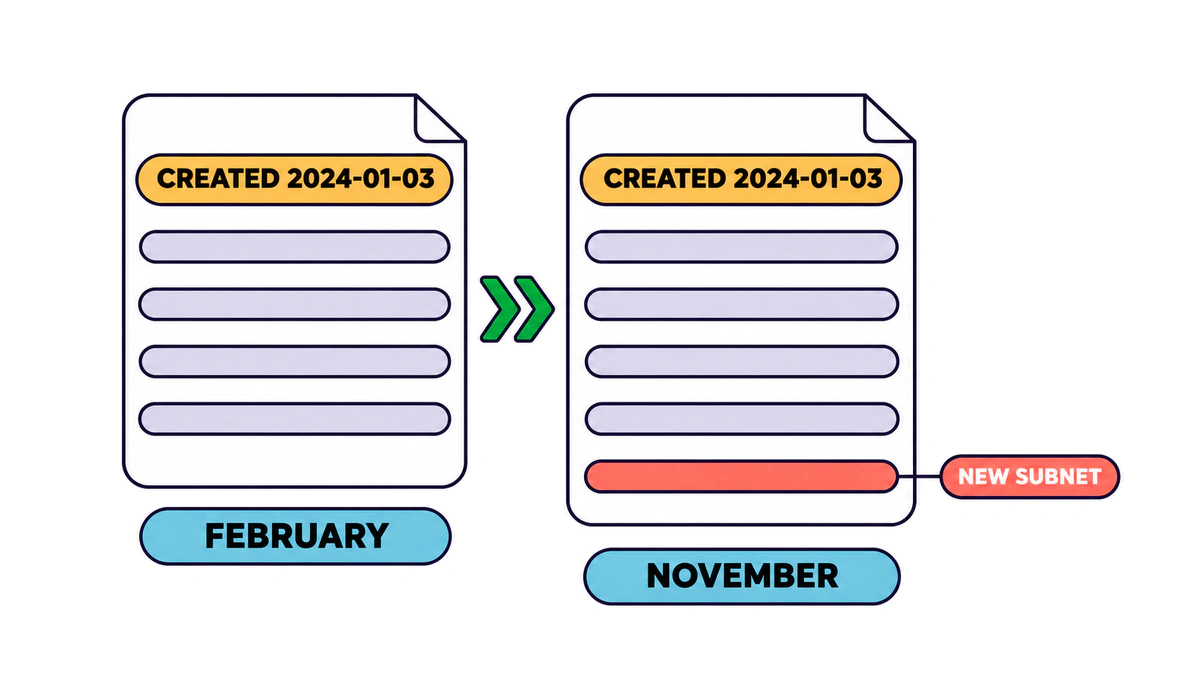
The content changed, but Bing’s file still says "creationTime": "2024-01-03T10:00:00.121331". That’s the same value it had in February. The timestamp never moved. A script that refreshes the list only on a new timestamp would have missed Zhangjiakou.
The same list covers AdIdxBot (Microsoft Advertising), BingPreview and the old msnbot, so all of them share Bingbot’s map.
Applebot
Apple publishes 24 IPv4 subnets (4,752 addresses), all on Apple’s own network (AS714) with *.applebot.apple.com reverse DNS. Three /28s sit in Tokyo. Everything else resolves to the US at the country level, so 99% of the address space is American.
Apple never sends requests as Applebot-Extended, and the same goes for it as a crawler: it isn’t one. It’s a robots.txt token. You use it to control whether Apple may use your pages for AI training. Any request with an Applebot-Extended user agent is a fake bot.
DuckDuckBot and DuckAssistBot
DuckDuckGo’s list looks different from everyone else’s: 486 single addresses, all on Azure, in 13 countries. The biggest groups sit in Dulles (108), Des Moines (89), Amsterdam (44), Dublin (40) and Singapore (29). DuckAssistBot, the fetcher behind DuckDuckGo’s AI answers, publishes an identical file. That’s the only reason an AI fetcher shows up in 13 countries here; it inherited the search crawler’s map.
DuckDuckGo publishes only Azure addresses. Yet about a third of the requests in our data that use a DuckAssistBot user agent come from Google Cloud. All of those are fake bots.
OpenAI
ChatGPT-User: the bot that moved
ChatGPT-User is the one list that changed in every direction. It went from 224 subnets in 15 countries to 237 subnets in 23 countries, and along the way OpenAI removed 109 of the February subnets and added 122. In nine months, almost half of the list was replaced.
| Country | Subnets Feb | Subnets Nov |
|---|---|---|
| United States | 117 | 119 |
| India | 9 | 14 |
| Germany | 2 | 12 |
| Brazil | 14 | 11 |
| Japan | 10 | 10 |
| Australia | 14 | 8 |
| Denmark | 0 | 8 |
| Switzerland | 0 | 8 |
| South Korea | 9 | 7 |
| Belgium | 0 | 6 |
| Singapore | 9 | 6 |
| Poland | 16 | 5 |
| Netherlands | 0 | 4 |
| Malaysia | 0 | 4 |
| Indonesia | 0 | 4 |
| Ireland | 6 | 2 |
| Spain | 5 | 2 |
| United Kingdom | 6 | 2 |
| Sweden | 0 | 2 |
| New Zealand | 1 | 2 |
| Canada | 1 | 1 |
| Italy | 5 | 0 |
Italy dropped to zero: all five Milan /28s are gone. It didn’t really leave, though, and that’s the interesting part.
OpenAI added one large block, 9.129.0.0/16, with 65,536 addresses on Microsoft’s network. A single lookup puts it in Phoenix. Look up each /24 instead, and you see more. Azure’s own Service Tags split the block across 35 regions. MaxMind places it in 20 countries.
About two-thirds of it is in the US (Phoenix, Des Moines, Chicago, Cheyenne, San Jose, San Antonio, Virginia), and the rest is spread over Poland, the UK, Australia, Korea, India, Japan, Belgium, Italy, the UAE and others. Several countries that lost their small subnets show up inside this block. Poland lost 12 of its 16 Warsaw /28s and holds 10 /24s of the /16, and Italy, gone from the list as its own entry, appears here.
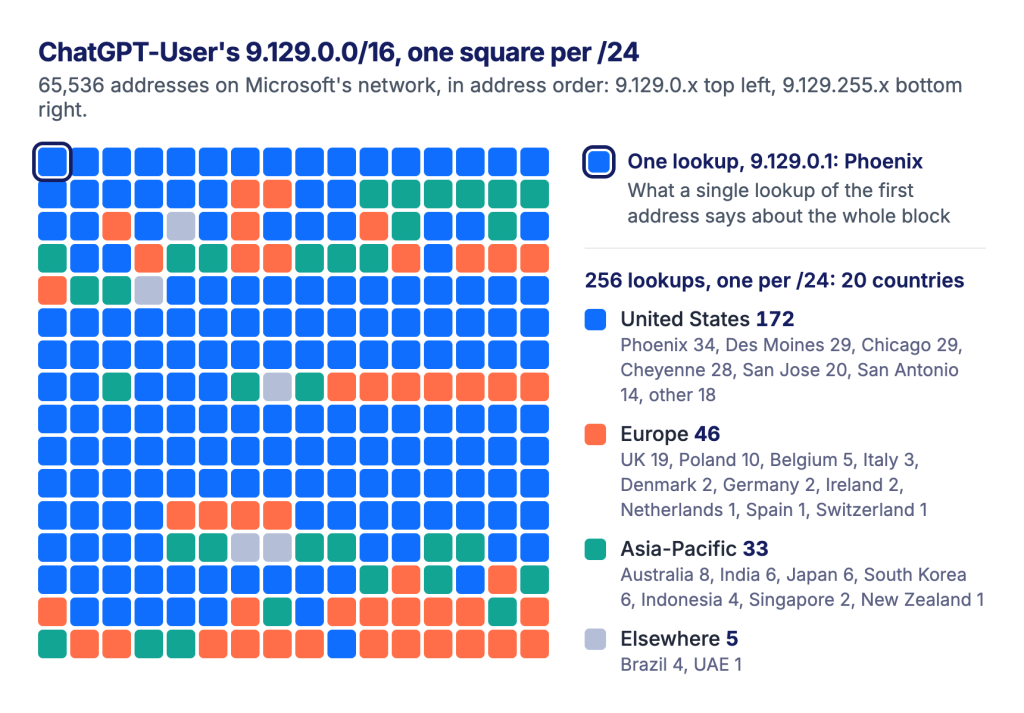
It looks like OpenAI is moving ChatGPT-User from scattered /28s onto slices of one big block. Two-thirds of the new /16 is American, so the US share of ChatGPT-User’s address space rose from 52% to 66%. The country count went up too, which skews the numbers oddly.
ChatGPT-User subnets by country outside the US, February and November
Sorted by change. Germany, Denmark, Switzerland and Belgium gained the most subnets; Poland, Australia and Italy lost the most. The US had 117 in February and 119 in November.
Source: OpenAI’s chatgpt-user.json, fetched February 9-11 and November 11, 2026; MaxMind GeoIP2 City. Subnets by the location of their first address. The new 9.129.0.0/16 counts once, under the US; the UAE and Italy appear only inside it.
Why spread a user fetcher at all? ChatGPT-User opens a page while a person waits for the answer, a fetch from a nearby region saves time. That’s my reading. OpenAI doesn’t say which region serves which user. Either way, the practical side is clear. If your site blocks non-US traffic, the rule catches 118 of ChatGPT-User’s 237 subnets, with the new /16 counted once as a single entry. The other 119 are in the US. When OpenAI routes a fetch through one of them, ChatGPT can’t open your page.
OAI-AdsBot
OAI-AdsBot checks the landing pages of ads that run in ChatGPT. Its own list is tiny: two /25s (256 addresses) in Des Moines and Phoenix. In our data, about 99% of real OAI-AdsBot traffic doesn’t come from that list. The two older forms of its user agent come from the ChatGPT-User fleet, not from that list. They use the same IPs that send ChatGPT-User requests. Only the newest form uses those addresses.
Verify OAI-AdsBot against adsbot.json alone and you’ll mark almost all of it as fake, so allow both lists for it.
GPTBot and OAI-SearchBot: still US only
GPTBot, OpenAI’s training crawler, got smaller. Three Phoenix /24s are gone, so the count fell from 3,472 to 2,704 addresses. That puts Atlanta (10 subnets) ahead of Phoenix (6). Des Moines has 2.
OAI-SearchBot indexes pages for ChatGPT search. It added four subnets: two in Dulles, one in San Antonio and one that MaxMind places only in the US.
It now has 39: 19 in Phoenix, 10 in Atlanta, 5 in Dulles, 2 in San Antonio, 1 in Des Moines and 2 at country level. The file still says "creationTime": "2026-01-02T11:00:00", just as in February, though the list has changed. OpenAI is the second vendor in this study to do this.
Neither bot has a single address outside the US. Across all four OpenAI lists, Phoenix still hosts the most subnets (42), ahead of Atlanta (30).
Anthropic: one list, one city
The biggest change since February is that Anthropic publishes its crawler IPs. The list lives at https://claude.com/crawling/bots.json in the same format as Google’s.
It’s small: 14 prefixes and 1,037 addresses. Thirteen are single Google Cloud addresses in the us-east5 region, and the fourteenth is a /22 (216.73.216.0/22) announced through AWS. Every one of them, including all four samples of the /22, locates to Columbus, Ohio. Anthropic’s entire published crawler fleet sits in one metro area.
| Range | Source | Addresses | Location | Network |
|---|---|---|---|---|
| 13 single IPs | bots.json | 13 | Columbus, Ohio | Google Cloud us-east5 |
216.73.216.0/22 | bots.json | 1,024 | Columbus, Ohio | announced through AWS |
160.79.104.0/21 | API docs | 2,048 | US (country only) | Anthropic, AS399358 |
Before you put it in an allowlist, know two things about it.
One list covers three bots: ClaudeBot (training), Claude-SearchBot (search) and Claude-User (fetches for a user’s question). The IP address can’t tell them apart, only the user agent can. If you want to block training and allow search, robots.txt handles that fine, but a firewall rule based on IPs can’t.
The list is also incomplete. Anthropic’s API documentation lists a separate range, 160.79.104.0/21, as the source of outbound tool calls. It sits on Anthropic’s own network. Tool calls include the MCP connector, web search and web fetch. bots.json doesn’t include it. In late October Claude-User moved onto that range. On October 28 and 29, every Claude-User request we saw came from 160.79.106.x, and not one came from an address in bots.json, so any check built on the published list alone marked all of it as fake. We added the /21 to our validator on October 29.
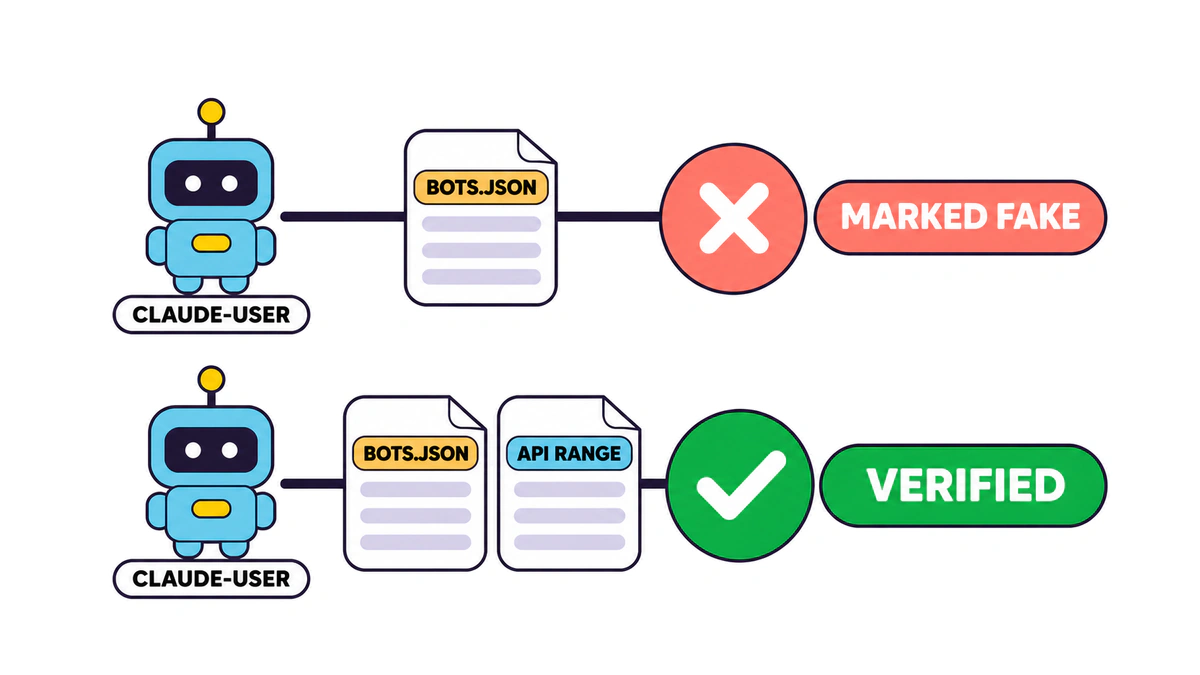
For Anthropic, allow both: bots.json and the API egress range.
Perplexity: new addresses, same building
Perplexity rebuilt both of its lists on October 28, 2026, without moving an inch. PerplexityBot now has 13 single addresses and Perplexity-User has 10, all in AWS us-east-1 in Ashburn, Virginia, exactly like in February. The addresses themselves changed: PerplexityBot kept 4 of its 8 February entries and Perplexity-User kept 2 of 4.
Both lists switched from small blocks to single /32s. The subnet count went up, but the total address count went down from 32 to 23.
Perplexity’s whole published fleet still fits into fewer addresses than one Googlebot /27. The list also says nothing about the stealth, undeclared crawlers Cloudflare accused Perplexity of using in August 2025. An IP list covers only the bots a vendor admits to.
The newcomers
Common Crawl (CCBot)
CCBot builds the Common Crawl archive, the open dataset that a lot of AI models train on, so blocking it reaches further than one company. Its list has four tiny IPv4 blocks (28 addresses) in AWS Ashburn with *.crawl.commoncrawl.org reverse DNS, and one IPv6 prefix.
That IPv6 prefix matters more than the IPv4 blocks, because most CCBot traffic in our data arrives over IPv6. A firewall that allows only the IPv4 ranges blocks most of the real CCBot. CCBot is also a favorite of fake bots: about a third of the requests with its user agent come from Google Cloud, while Common Crawl lists only AWS addresses.
Mistral AI: the first EU-only AI bots
Mistral publishes two lists, for MistralAI-User (4 addresses) and MistralAI-Index (2 addresses). All six sit in Azure’s Sweden Central region with the reverse DNS name crawlers.mistral.ai. That makes Mistral the first AI vendor in this data that crawls only from the EU, and the only one whose bots pass a “Europe only” rule. Mistral publishes no list for its training crawler.
Moonshot AI (Kimi)
Moonshot publishes three files, for KimiBot, Kimi-SearchBot and Kimi-User, and all three contain the same four addresses on Alibaba Cloud. MaxMind places them in Singapore. For this one I have no second source: Alibaba publishes no region file, and the addresses have no reverse DNS. Kimi follows the same rule as the American vendors, just from a different home. A Chinese AI company crawls from Asia.
Reflection AI and Keenable
Two smaller vendors published lists this autumn, and both did it properly. Reflectionbot (Reflection AI) uses two /23s in the US with reflectionbot-*.reflection.ai reverse DNS. Keenable, which builds search APIs for AI agents, runs KeenableBot (30 addresses) and Keenable-User (7 addresses) in Google Cloud’s us-central1 region in Council Bluffs, Iowa.
What I liked: both moved their whole fleets onto the listed addresses on the day they published, September 22 for Reflection and October 9 for Keenable. Since then, 99-100% of the requests with their documented user agents come from inside the lists. MistralAI-User, DuckDuckBot and YouBot match their lists just as closely.
YouBot
You.com publishes no JSON file. Its docs give one range, 68.67.112.0/24, on AWS, with youbot-*.search.you.com reverse DNS. That one sentence holds up: in the 90 days to October 17, all 242 addresses that sent the documented YouBot user agent to sites we monitor sat inside it. A different form of the user agent, ending in +https://you.com/bot, came from about 1,200 Google Cloud addresses (6,700 requests). It’s a fake YouBot from a bot-checking service, not You.com.
Exa: no list at all
Exa publishes no IP list. It signs its requests with Web Bot Auth, a cryptographic signature in the HTTP headers, so you verify the request instead of the address. It’s the only vendor in this study that skipped IP lists entirely, and I wouldn’t be surprised if more follow.
Link preview bots: Meta, X and Telegram
A link preview bot fetches your page when someone shares it, to build the card with the title and image. Block it, and every shared link to your site turns into a bare URL. None of the three big ones publishes a crawler list:
- Meta (facebookexternalhit). I used the nine IPv4 blocks registered to Meta’s network (AS32934), 247,808 addresses whose samples reach 33 countries, plus the IPv6 block
2a03:2880::/32. That IPv6 block carries about 98% of the facebookexternalhit traffic we see. Not everything with this user agent is Meta, either: Substack’s link fetcher sends facebookexternalhit from AWS. - X (Twitterbot). Three /22s are registered to Twitter, and in practice Twitterbot uses a handful of addresses inside them,
199.16.157.180-183and192.133.77.14-18. We saw no Twitterbot fetch over IPv6 in the 30 days to October 15. - Telegram (TelegramBot). Telegram publishes a list of its whole network: nine IPv4 ranges, mostly in Amsterdam, and five IPv6 ranges.
These ranges are much wider than the bots themselves, so read them as “this is Meta’s network”, not “this is Meta’s crawler”. LinkedIn, Pinterest, Discord and Slack publish nothing, and Discord and Slack fetch from Google Cloud and AWS. iMessage, WhatsApp and Google Messages build the preview on the sender’s phone, so the address is simply the user’s.
The map: who lives where
Put together, the picture is simpler than 27 lists suggest. Every vendor crawls from home.
| Vendor | Bots | Home | Countries outside home |
|---|---|---|---|
| Googlebot and other crawlers | US | 21, plus Belgium | |
| Microsoft | Bingbot, AdIdxBot, BingPreview | US | 13 |
| Apple | Applebot | US | 1 (Japan) |
| DuckDuckGo | DuckDuckBot, DuckAssistBot | US | 12 |
| OpenAI | ChatGPT-User | US | 22 |
| OpenAI | GPTBot, OAI-SearchBot, OAI-AdsBot | US | 0 |
| Google-Agent | US | 0 | |
| Anthropic | ClaudeBot, Claude-SearchBot, Claude-User | US (Columbus, Ohio) | 0 |
| Perplexity | PerplexityBot, Perplexity-User | US (Ashburn, Virginia) | 0 |
| Common Crawl | CCBot | US (Ashburn, Virginia) | 0 |
| Reflection AI, Keenable, You.com | Reflectionbot, KeenableBot, Keenable-User, YouBot | US | 0 |
| Mistral AI | MistralAI-User, MistralAI-Index | Sweden | 0 |
| Moonshot AI | KimiBot, Kimi-SearchBot, Kimi-User | Singapore | 0 |
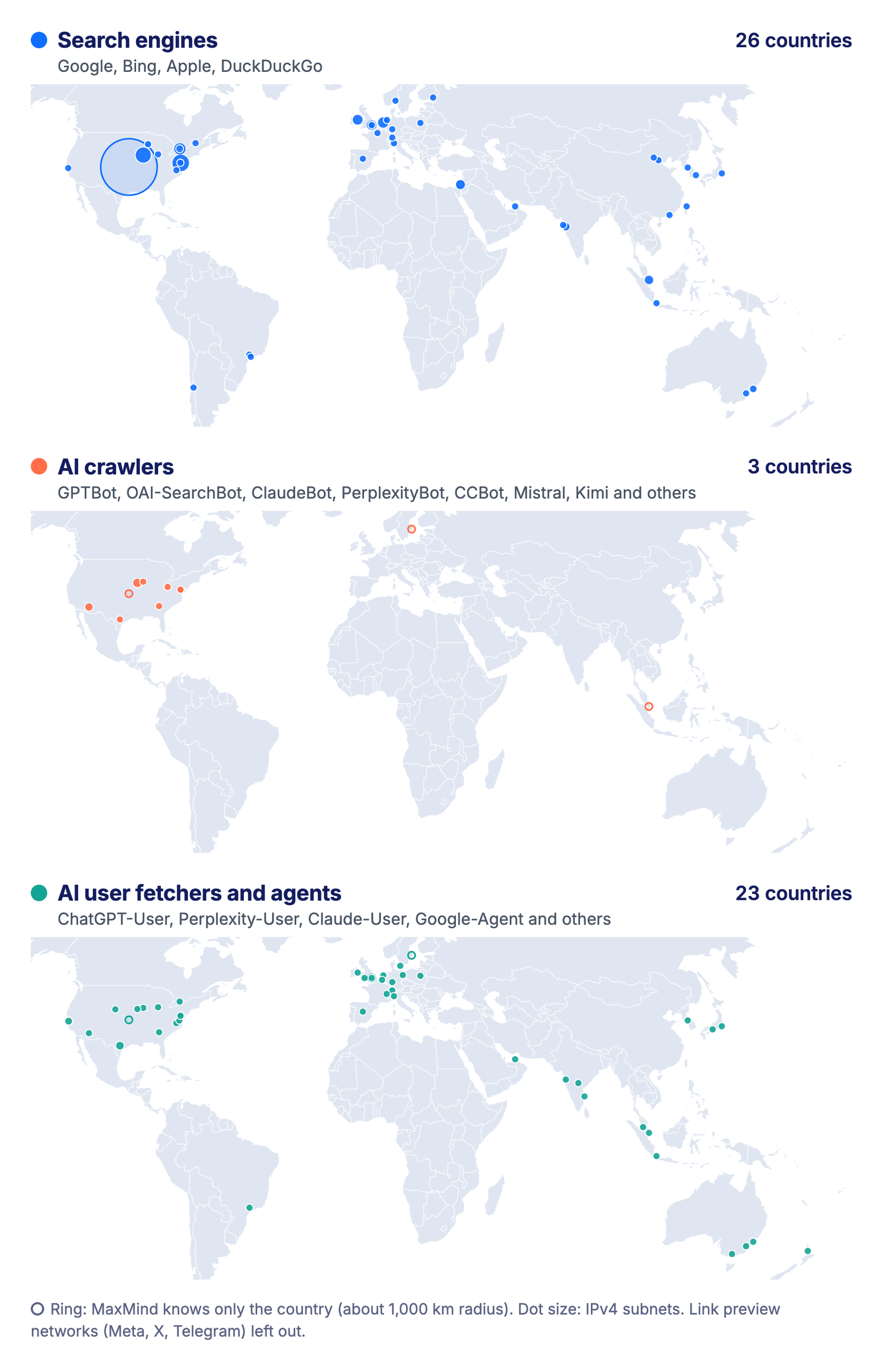
Search engines put a small node in many regions while the bulk of their crawling stays at home. AI companies split their bots by job instead. Crawlers stay home, and the only AI bot that spread out is a user fetcher, ChatGPT-User. The other user fetchers, Perplexity-User, Claude-User and Keenable-User, stayed in the US.
US share of each list, by subnets and by addresses
Counted by subnets, Bingbot is half American. Counted by addresses, it is 95% American: its US blocks are /22 to /24, its nodes abroad are /28s.
Source: EdgeComet analysis of published bot IP lists, fetched November 11, 2026; locations from MaxMind GeoIP2 City. ChatGPT-User’s 9.129.0.0/16 is counted by its 256 /24 samples.
The US AI cluster sits in a few places: Phoenix, Atlanta and Des Moines for OpenAI, Ashburn for Perplexity and Common Crawl, Columbus for Anthropic, Council Bluffs for Keenable.
Europe
If you run a site in Europe, or for European users only, this is the table to look at:
| Bot | EU countries | Other Europe |
|---|---|---|
| Googlebot | DE, ES, FI, FR, IT, NL, PL, plus the Belgian node | CH, GB |
| Bingbot | DE, FR, NL | GB |
| DuckDuckBot, DuckAssistBot | DE, FR, IE, NL | CH, GB, NO |
| ChatGPT-User | BE, DE, DK, ES, IE, NL, PL, SE, and IT inside the /16 | CH, GB |
| MistralAI-User, MistralAI-Index | SE | none |
| GPTBot, OAI-SearchBot, ClaudeBot, Claude-SearchBot, Claude-User, PerplexityBot, Perplexity-User, CCBot, Applebot, Google-Agent | none | none |
An “EU only” rule lets through Mistral, part of ChatGPT-User and the European nodes of the search engines. It blocks every other AI bot in this study.
Distance has a second cost, which we covered in February: a bot in Phoenix pays 130-150 ms of round trip for every request to a server in Frankfurt before your server does any work. The AI bots in this study don’t render JavaScript either, so whatever isn’t in the first HTML response doesn’t exist for them.
Published lists vs real traffic
The lists are mostly right. For most bots, the genuine traffic we see sits inside the published ranges, often at 99-100%. The exceptions are specific, and each one breaks an allowlist in its own way:
| Bot | What the list says | What we see in traffic | What breaks |
|---|---|---|---|
| Claude-User | Anthropic’s bots.json | On Oct 28-29, 2026, every request came from 160.79.106.x, a range only the API docs mention | All genuine Claude-User traffic looks fake |
| OAI-AdsBot | adsbot.json, two /25s | About 99% of real requests come from the ChatGPT-User fleet | Almost all of it looks fake |
| CCBot | 4 IPv4 blocks, 1 IPv6 prefix | Most requests arrive over IPv6 | An IPv4-only allowlist blocks most of it |
| Reflectionbot, KeenableBot | Published Sep 22 and Oct 9, 2026 | The fleets moved onto the listed IPs on those days | Traffic from before those dates doesn’t match |
| Applebot | IPv4 only | All 47 IPv6 requests with its user agent came from Cloudflare WARP or Meta | Nothing; those were fake bots |
The other side of the problem is fake bots. About a third of CCBot and DuckAssistBot requests come from Google Cloud. A bot-checking service sends a YouBot-like user agent from about 1,200 Google Cloud addresses, and Substack sends facebookexternalhit from AWS. Not every fake bot is an attacker, since Substack only wants a link preview, but none of them is the bot it names. A rule based on the user agent lets all of them in; an IP check stops them.
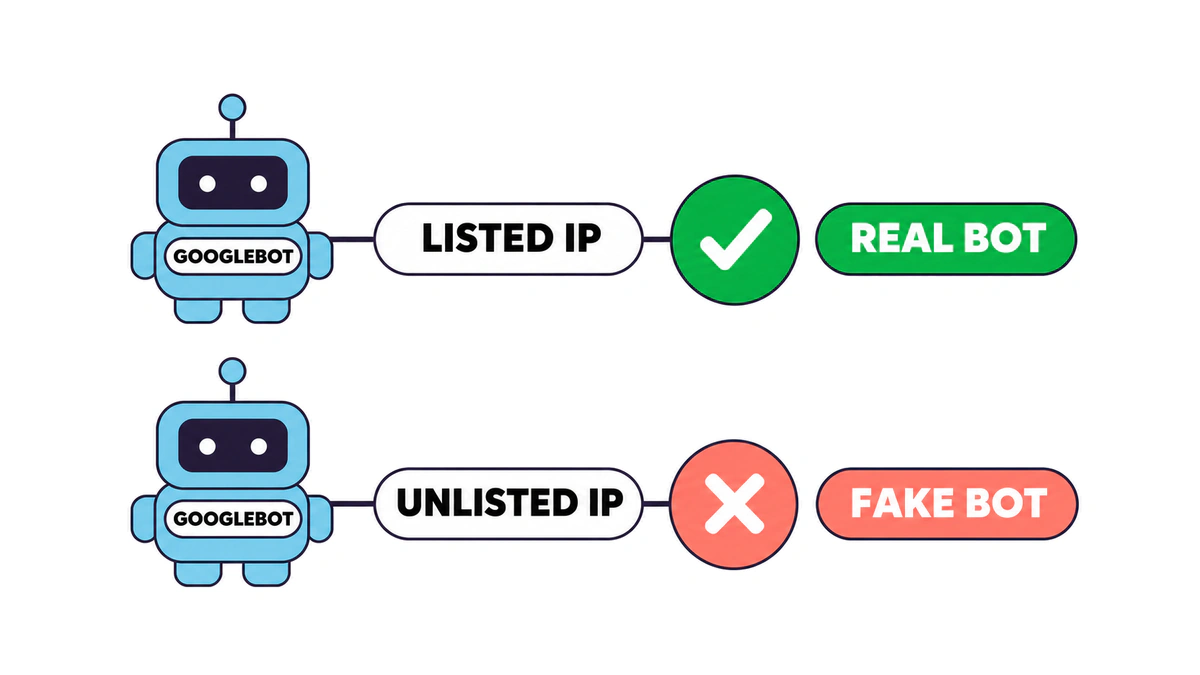
There’s also a gap coming. OpenAI, Perplexity, Microsoft, Anthropic, Apple, DuckDuckGo, Mistral and the smaller AI vendors publish no IPv6 ranges at all. That’s fine today, because their bots crawl over IPv4. If any of them starts crawling over IPv6 before it updates its list, every IP-based check will reject the real bot.
Allowlists go stale
Comparing two snapshots taught me one thing above all: a copied list starts going wrong the day you copy it.
- ChatGPT-User replaced almost half of its subnets in nine months.
- Perplexity replaced most of its addresses in a single update.
- Bing and OpenAI (OAI-SearchBot) changed their lists without changing
creationTime, so the timestamp can’t tell you whether a list changed. - Anthropic’s list missed the range its own user fetcher used for at least two days.
That’s why the Bot Atlas and our validator both fetch the vendor files on a schedule and compare the prefixes, not the timestamp. If you build your own, add one rule: a list that fails to download, or comes back empty, is an error, not a list with zero bots. Keep the last good copy, or one broken vendor file will block a bot across your whole site.
What I’d check on your site
- The order of rules. The verified-bot exception goes before any country, region or ASN block. Verify by IP against the vendor’s list, or by reverse DNS where the vendor supports it (Google, Bing and Apple do), never by user agent alone.
- Addresses with only a country. Ask what your WAF does with an IP that has a country but no state or city. In MaxMind, Google’s main ranges look exactly like that. If you geofence by state, test the rule against Googlebot’s ranges, not from your browser.
- Every list a bot uses. Google has five lists. Anthropic needs
bots.jsonplus its API range, OAI-AdsBot needsadsbot.jsonpluschatgpt-user.json, and CCBot needs its IPv6 prefix. - Automatic refresh. Pull the lists daily or weekly and compare the prefixes. Ignore
creationTime. - Your logs, before you block. A bot user agent from an address outside the list is usually a fake bot, but look at the network first. A Claude-User request from Anthropic’s own ASN isn’t a scraper. It’s a list that fell behind.
- The handoff between SEO and DevOps. Firewall rules change without anyone telling the SEO team. A monthly check that GPTBot, ClaudeBot and Googlebot can still reach your most important pages takes ten minutes and catches most of it.
The Bot Atlas
By the time I finished this research, it could already be out of date. Between two snapshots, ChatGPT-User alone replaced almost half of its subnets. So we turned it into a free page that keeps itself current, the Bot Atlas. It runs on the same lists EdgeComet uses to validate bot traffic.
I’d use it in a few places:
- Before a country rule. The country table shows which bots run where. An “EU only” rule keeps Mistral, part of ChatGPT-User and the search engines’ European nodes, and drops every other AI bot.
- On an odd request in your logs. All 18 GPTBot subnets sit on Microsoft Azure, so a GPTBot request from Google Cloud is a fake bot.
- With DevOps. Every bot has its own link, like
edgecomet.com/bot-atlas/?bot=gptbot, with the exact ranges and the vendor’s source file.
Vendors don’t announce list changes. Bing and OpenAI don’t even update the timestamp. The Atlas checks every list once a week and compares the prefixes. When something changes, the changelog shows the subnets added and removed and any country a list gained or lost. The first entry is this article’s comparison with February.
It’s a page for people, not a feed: there’s no API or download, so rules that run unattended should read the vendor files directly.
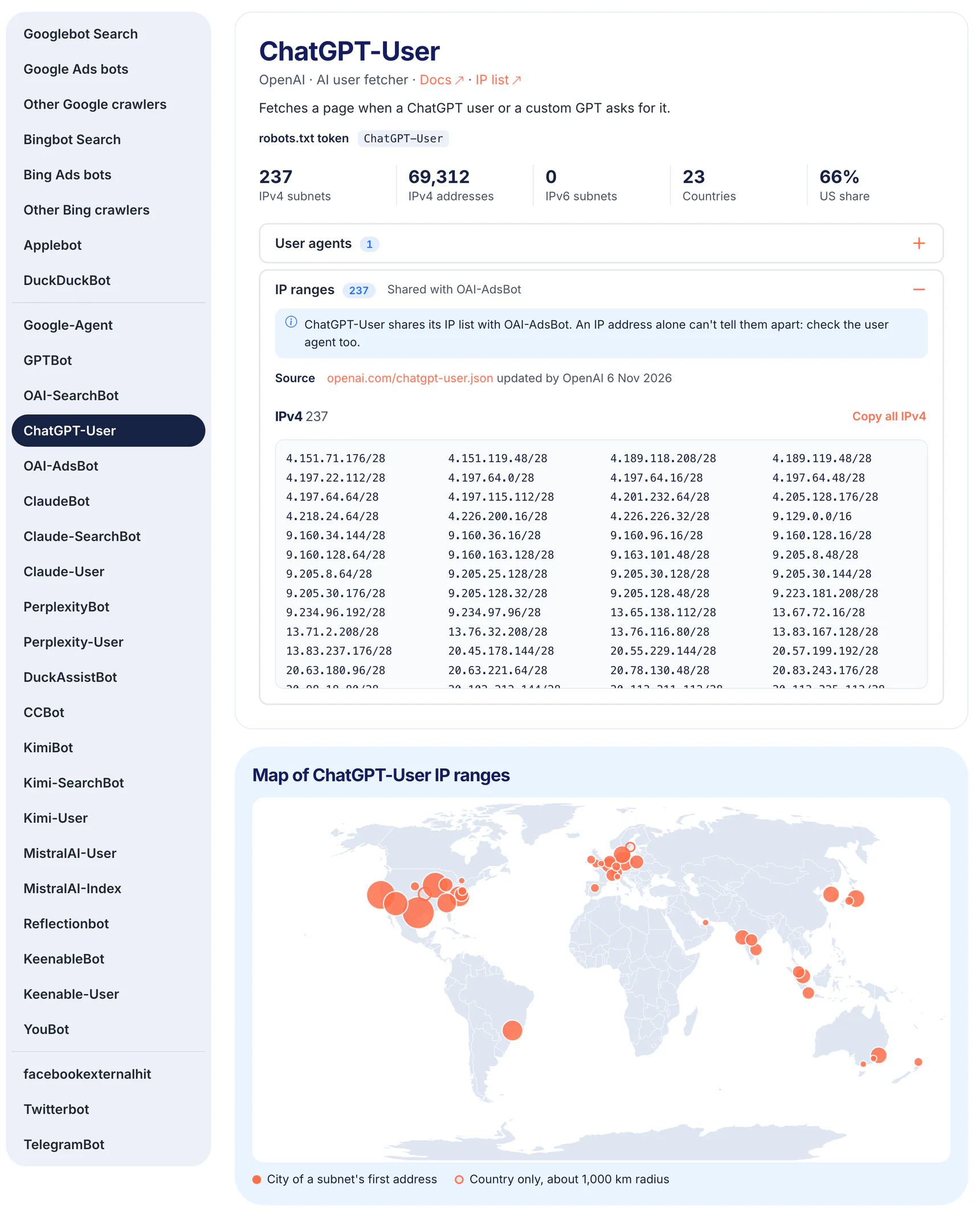
The Atlas covers 32 main bots from 16 vendors today. If a bot you care about is missing, tell us and we’ll add it.
EdgeComet runs the same check every day on every bot request that reaches a connected site. You can then see which Googlebot and GPTBot visits are real. The rest are fake bots that only borrowed the name.
Conclusion
In February, the conclusion was that search engines crawl from everywhere and AI crawlers don’t. Nine months later, that still holds. AI companies now treat their bots differently depending on who’s waiting. Crawlers that build training sets and search indexes stay at home. At OpenAI, the fetcher that opens a page for a waiting user went to where the users are.
The lists changed more than the map did. Google and Bing barely moved. ChatGPT-User replaced almost half of its subnets, though, and Perplexity rebuilt both of its lists in one day. A list you copied into a firewall rule in February is partly wrong today.
The fix is still old and boring. Verify bots by IP before any country rule, allow every list a vendor publishes, and refresh the lists on a schedule. If your firewall was built with human visitors in mind, check which of these bots it actually lets in.