
Tech SEO Connect 2026 is over, and after my third year in a row in Durham/Raleigh, I can say it’s one of the best events in our industry. The tech content is the obvious reason, but what keeps me coming back is the community and a team that runs two full days without a single visible hiccup.
The 2026 edition ran on November 5 and 6 at Bay 7 in Durham, North Carolina: two days, one track, 18 talks, and a free livestream for everyone who couldn’t travel. A single track matters more than it sounds. Everyone in the room has seen the same talks, so the hallway conversations pick up exactly where the stage left off. The recordings go to YouTube for free, and I’ve added the ones I mention below.
It was also my third time on that stage. In 2024 I asked whether Google Search Console can be the source of SEO decisions, in 2025 I talked about AI internal linking for e-commerce, and this year I brought Evergreen Crawl.
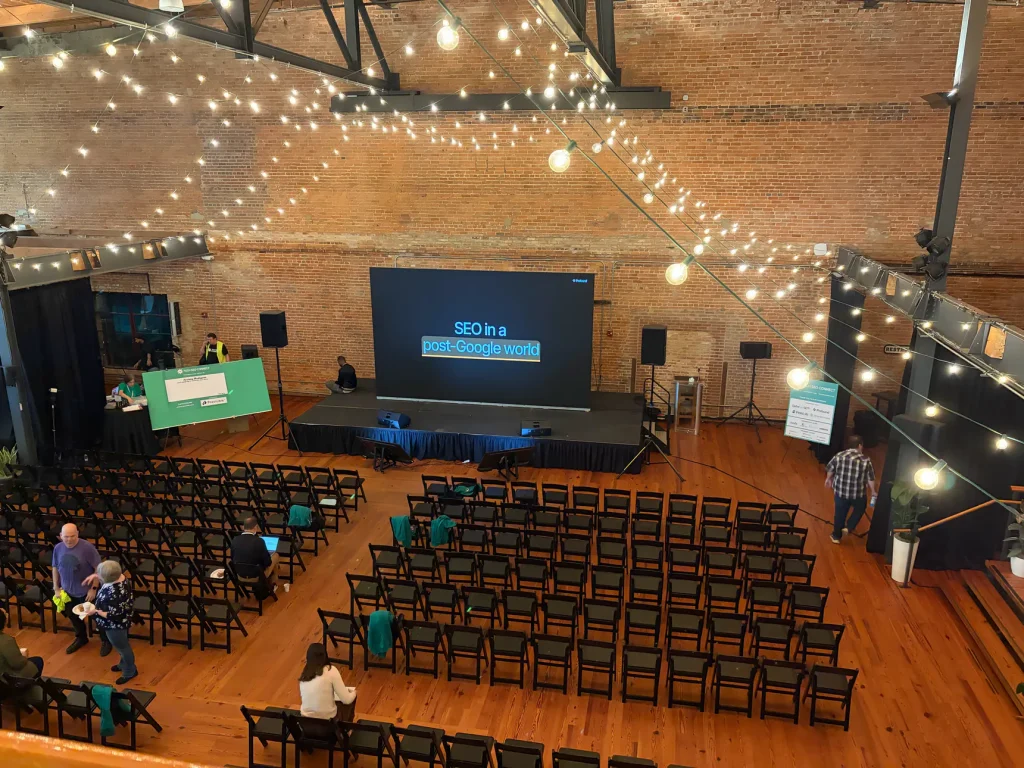
Thursday was the day of logs
I can’t remember another conference day with this much log analysis in it. Lauren Green covered AI bots before lunch. In the afternoon, Jori Ford and Jamie Indigo spoke back to back, and each took a different angle on log files.
Jori Ford: when server logs lie
Jori Ford has been on the program every year, and every talk comes back to one question: what did Googlebot actually get? At last year’s edition, Jori asked, more or less, how anyone could test these things. That question is one reason we built OpenSeoTest.
This year’s talk, “When Server Logs Lie: The Wire-Level Truth Behind Googlebot’s Ghost Errors,” was an example of how simple things can go wrong. The logs looked correct, while in reality the server closed the connection mid-request. Googlebot never received the full page, traffic went down, and nothing in the access log explained why.
I’ve spent the last 15 years working with web servers and CDNs, and it still sounds unbelievable to me. It’s also completely logical once you look at how a log line gets written. The server sends the status code in the headers, before the body. A 200 can’t turn into an error once it’s on the wire. So if the connection drops halfway through the HTML, the log still says 200. Most log dashboards stop at the status column, which is why nobody notices.
The field that can give it away is the number of bytes sent, if your server logs it. Say a product template normally goes out at around 180 KB, but some Googlebot requests to it show 40 KB. Those aren’t healthy 200s, whatever the status column says.
Jamie Indigo: The Philosophy Minor’s Guide to Log Files
Right after Jori, Jamie Indigo delivered logs in a way I’d never seen before: through philosophy. Log files are one of the driest subjects in technical SEO. Most talks about them turn into a tour of columns and status codes. Jamie built a whole way of thinking around them instead. Even the complicated parts reached the room. Big bravo for the creativity.
There is no such thing as “an AI bot”
Lauren Green gave the talk “AI Bots on Your Site: What They See, Why It Matters, and Where to Draw the Line.” I liked that it put the differences between bots at the center, because we still hear “AI bot” in the singular all the time, as if one crawler did everything. There are many of them, and you need to understand what each one is for before you decide anything about it.
My own position hasn’t changed: don’t block them. If a bot costs your servers too much, bring down the cost of retrieval instead of shutting the door.
Aleyda Solís: three editions of the state of tech SEO
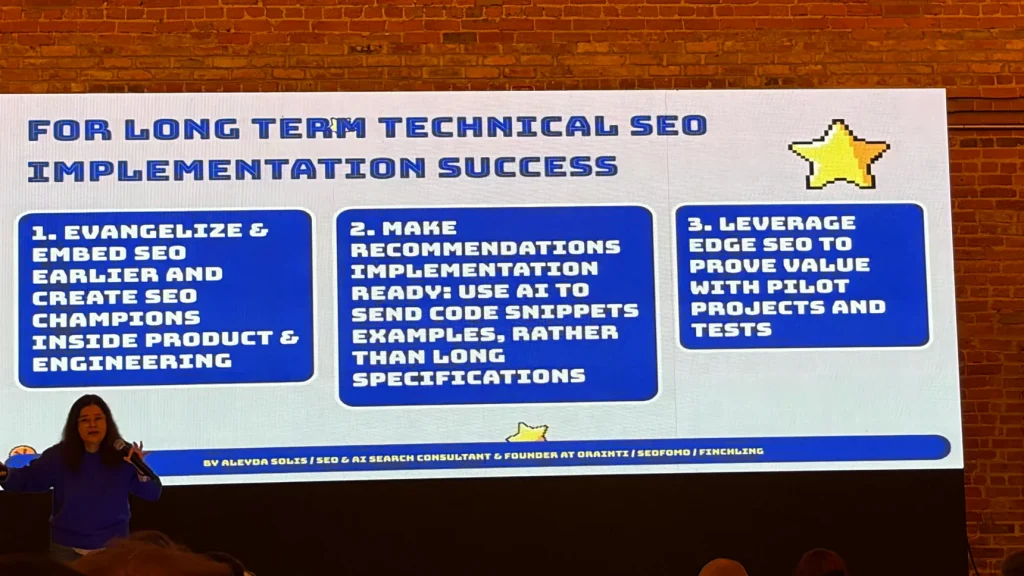
I remember Aleyda’s talk at the very first Tech SEO Connect, in Raleigh in October 2024. It was “The State of Technical SEO in 2024,” built on the SEOFOMO technical SEO survey, and this year Aleyda came back with fresh survey data in “Technical SEO in the AI Search Era: The Shifts, Trends and What to Do About Them.” Put the two decks side by side and you can see how much has changed in two years.
In 2024, almost half of respondents automated tech SEO tasks with AI or LLMs. Just 13% used AI for implementation. Most SEOs saw teams put 40% to 60% of their recommendations into action. The 2026 deck shows this:
- 58% say AI has changed their tech SEO work significantly or more, and 84% say it cut the time they spend on the tasks where they use it
- Claude is now the fourth most-used technical SEO tool, after Screaming Frog, Google Search Console and Ahrefs
- only 5% have let AI apply changes without human approval
- only 28% get more than 80% of their recommendations implemented, with developer capacity at the top of the barriers list
The numbers don’t line up one to one, since the surveys asked different questions. But look at the direction. Within two years AI moved into analysis, and implementation barely moved. One of Aleyda’s recommendations was to use Edge SEO for pilot projects and tests that prove value, and I agree with it completely. I’ll come back to it at the end.
Metehan Yeşilyurt: numbers from inside ChatGPT
Metehan brought “The Leaked ChatGPT Ranking Stack: How OpenAI Scores Every Webpage,” and it was packed with numbers from ChatGPT internals. What I liked most is that many of them are actionable rather than trivia. We’re going to run a couple of experiments based on the talk, most likely on OpenSeoTest, and publish what we find.
Zach Chahalis: what 100 migrations teach you
Zach had a very practical, case-based talk, “What I’ve Learned Doing Over 100 Website Replatformings and Migrations.” The topic is close to me. Migrations break websites in more ways than I expect, even now. A redirect map can send every URL to the homepage. A staging noindex can ship to production. A new frontend framework can quietly move content behind JavaScript, and I hear about it each time I talk with someone about a migration. Zach has seen a hundred versions of that list, and it showed.
Here’s one more thing from our side. After launch, check what Googlebot had from the old website and what it gets on the new site, and compare it. Your crawler only saw staging.
Sam Torres: build things with AI, keep them simple
Sam did a great job explaining how to vibe code build things with AI when you’re not a developer. The talk was called “It Works on My Data: Dev Habits for SEOs Who Code With AI,” and the message I took home was that simple is better. As a developer, I’d sign under that twice: the smaller the tool, the easier it is to check what it actually does.
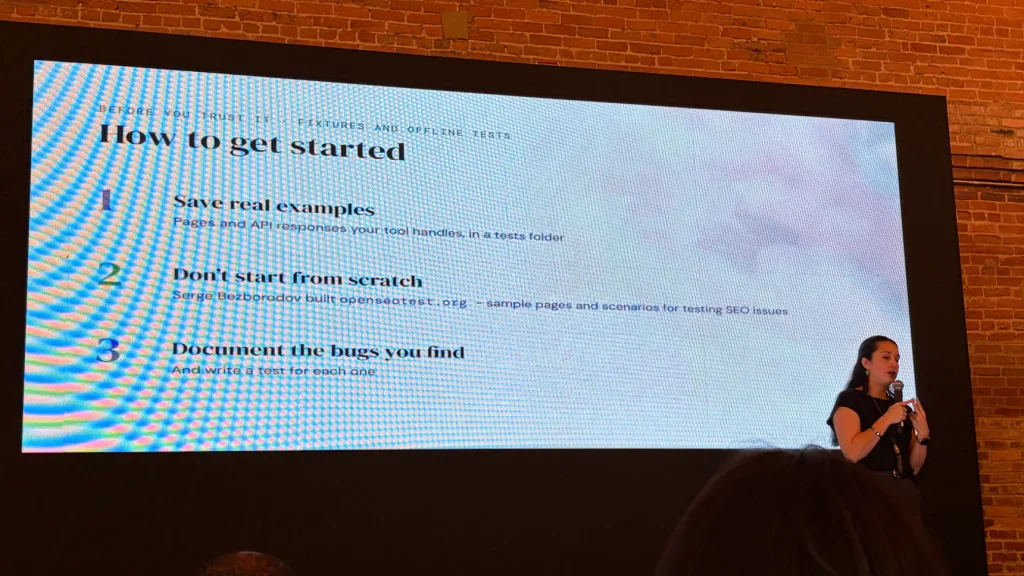
Sam’s talk inspired me to write an article about Git for SEOs. No developer wants to work without version control. SEOs who build with AI need it as well. Git shows you what the AI changed, and it lets you roll back what broke. I’ll cover both sides of it, how Git fits into an everyday SEO workflow and how it helps when you build your own internal tools.
My talk: Evergreen Crawl
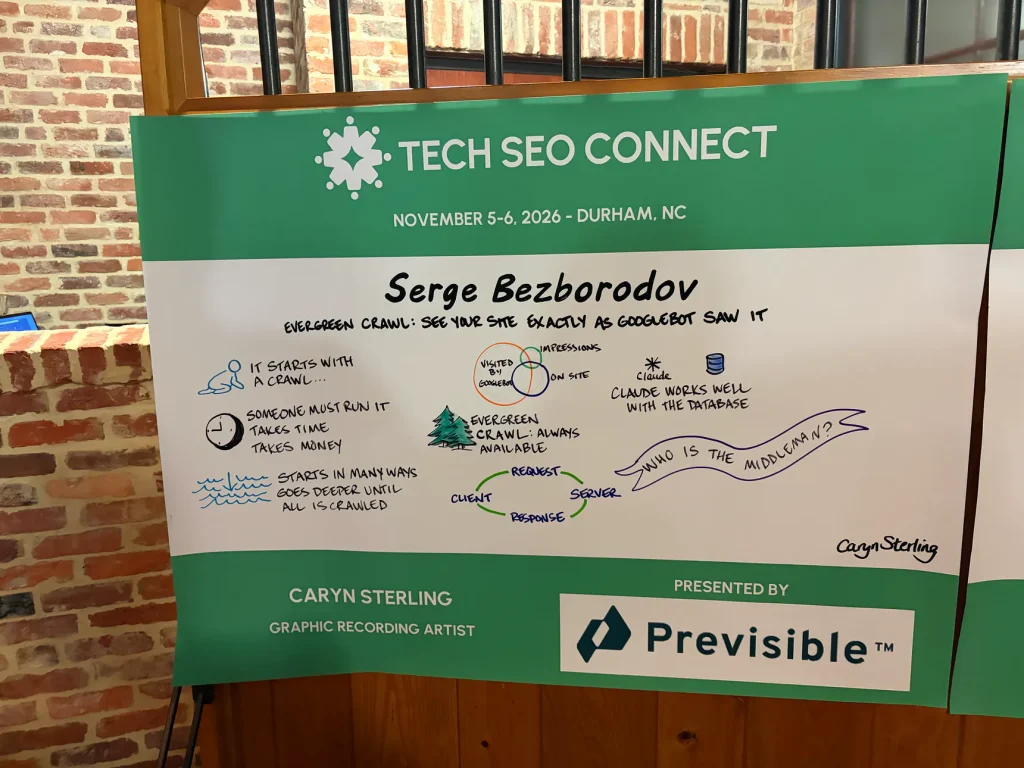
My talk was “Evergreen Crawl: See Your Site Exactly as Googlebot Saw It.” It starts from a simple observation. For decades we’ve analyzed websites with SEO crawlers. Googlebot and AI bots aren’t SEO crawlers. They find and schedule pages by their own rules. On a large site, your crawler and the bots end up seeing two different websites.
So instead of crawling, evergreen crawl catches bot traffic at the edge, parses the page each bot actually received, and builds the audit from that. There’s no synthetic crawl and no extra load on the origin. The data stays fresh because the bots keep coming back. Want to try this on your own site? CometTrail is an open source (MIT) version that runs on Cloudflare’s free tier, and the full write-up is on our blog.
I received a lot of positive feedback about the idea. I believe we need to keep pushing the technology and its boundaries. That’s how technical SEO shows it can deliver more results.
Edge SEO came up in almost every conversation
I was delighted to hear more and more about Edge SEO, on stage and off. I had tens of conversations over the two days. In nearly all of them, one of the biggest problems was that SEO depends on developers. You find the issue, you write the ticket, and the fix waits for a sprint that keeps moving.
That’s the gap we built EdgeComet to close: fixes to tags, content, internal linking, markup, redirects and status codes go live at the edge without waiting for a release. AI can draft them, but a person still reviews and deploys every change.
Edge SEO doesn’t take developers out of the picture. It lets you ship the fix and prove it works first: the ticket you hand to the dev team already has results behind it.
More talks worth watching
Eighteen talks in one track is too much for one post. A few more from the program worth finding on YouTube:
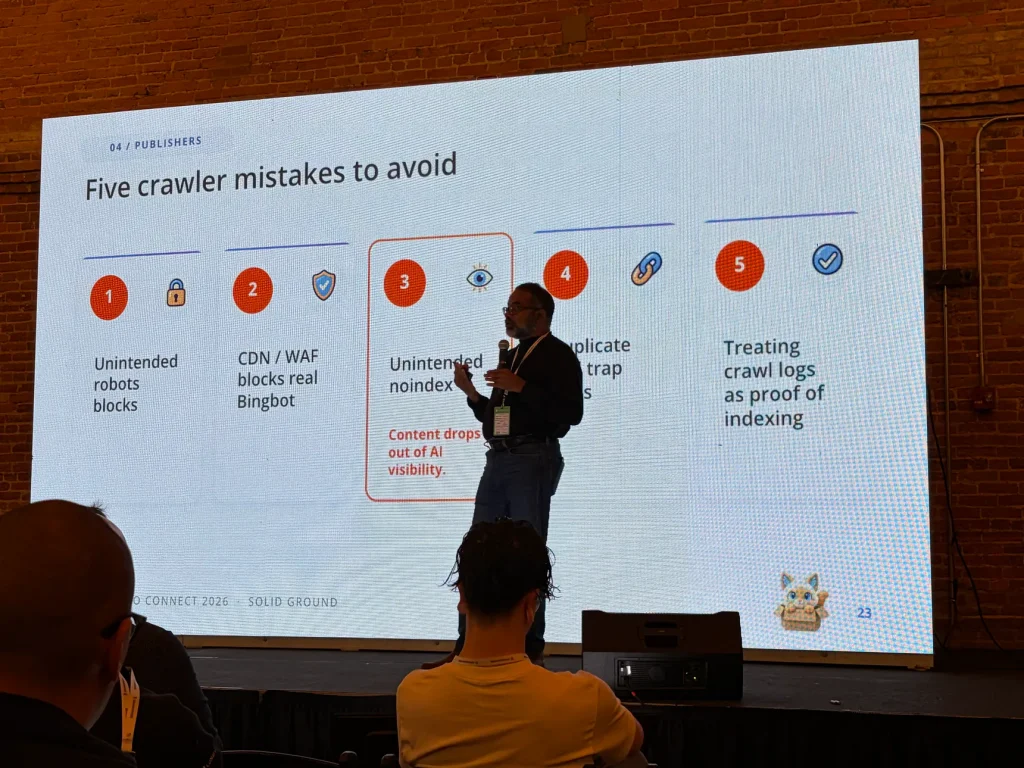
- Krishna Madhavan (Microsoft AI), “Solid Ground: What AI Agents Stand On, and Why It Shifts“
- Ray Grieselhuber (DemandSphere), “Why Google Is Taking Action on SERP Data Collection and What to Do About It“
See you in 2027
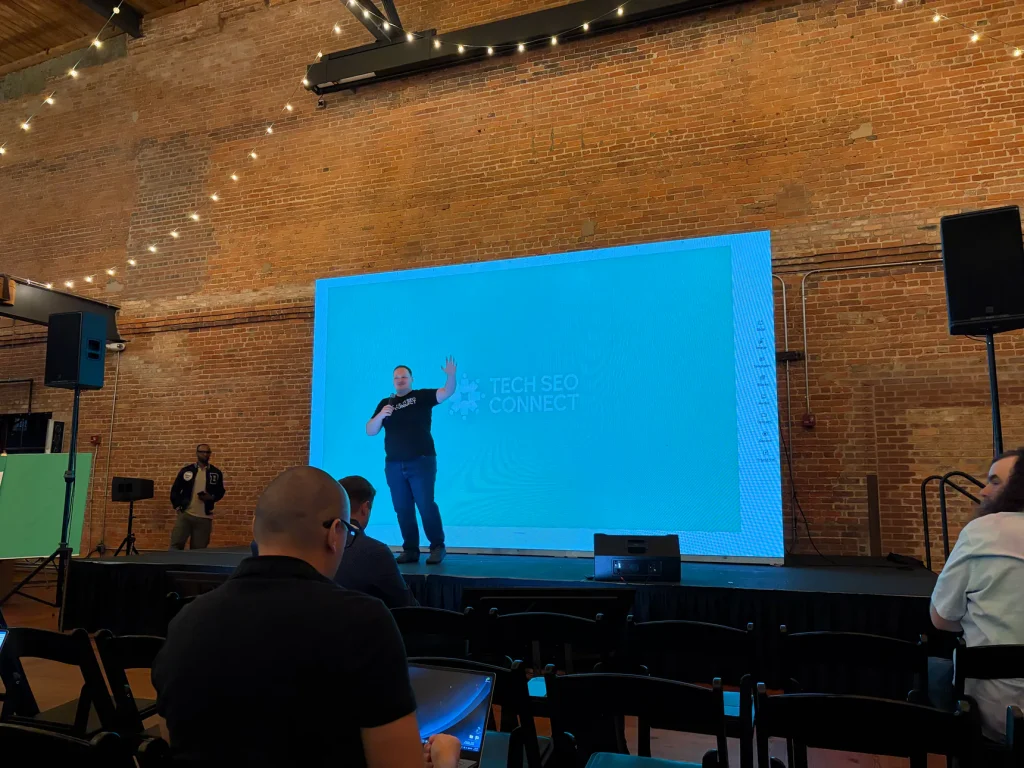
Big shoutout to Patrick Stox, Matthew Kay, JR Oakes and Mike King. You created a great conference, and three editions in, it still feels made for technical SEOs, by technical SEOs. The 2027 edition is already set for December 7 and 8 at the Durham Armory, and we’re looking forward to it.