“I’ve used ChatGPT for three years. It’s basically trained on me; it understands me perfectly.” I’ve heard this version more times than I can count.
The more we use an AI chat, the more it feels like it knows us, like there’s some training on us happening, some deep knowledge forming inside the model. Under the hood, there isn’t. It’s far simpler than that. And if you run SEO audits through ChatGPT, the gap between what it feels like and what’s actually happening should change how you work.
Here’s how an AI assistant really works, and what to adjust in your workflow to get more out of it.
What Is a Model?
In simple terms, a model is a black box that takes two main inputs:
- A base prompt defines what the model is: what it can do, what it shouldn’t do, the guardrails, and so on. When you use ChatGPT, it already runs on a base prompt you never see. If you’ve worked with models via an API, you can add your own base prompt to shape behavior, but it still sits on top of the system base prompt defined by the model creator.
- A user prompt is what you actually type into the chat.
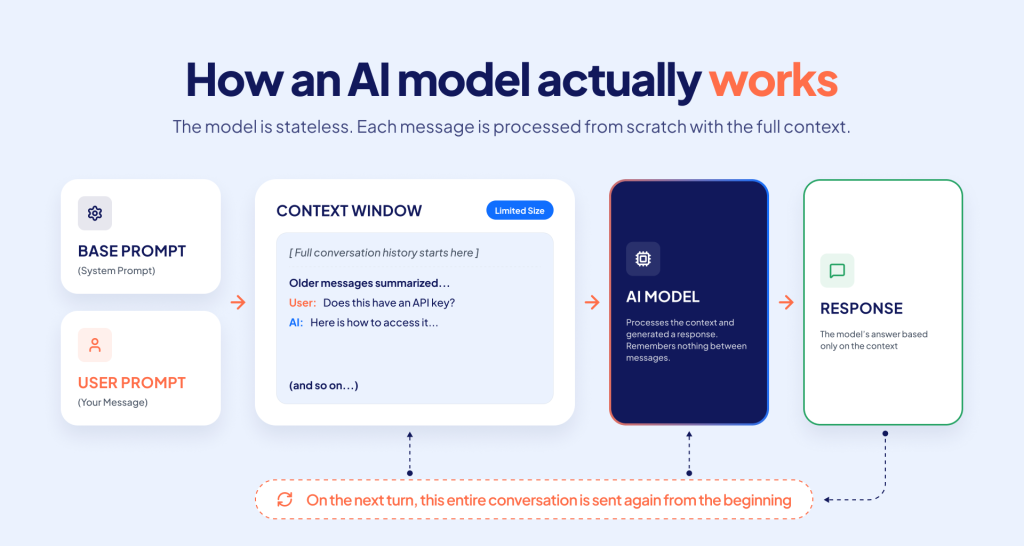
A model can only process a limited amount of text at once. You’ve heard the word for it: context. Everything you write in the chat piles up in the context. That’s why, in a very long conversation, or when you paste in a lot of documents, the model starts to “forget” things you covered earlier. They’ve dropped out of the context window.
The part most people miss: the model doesn’t store your conversation anywhere inside itself, and it can’t “go back” to it. Each time you send a message, your entire conversation from the very beginning is fed to the model again, from scratch. The model is stateless. It remembers nothing between messages; the chat app keeps the transcript and re-sends it every turn.
Because nothing is stored in the model, it doesn’t even matter where it runs. One message might be served from a data center in Virginia, the next – from Frankfurt, with no difference at all. That is also why these services scale so well: any server can handle any message.
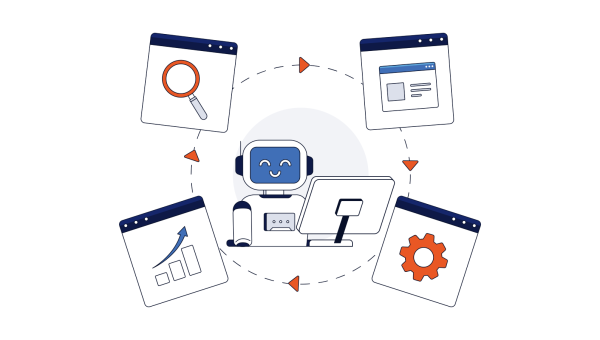
How should you picture a model? Like a car engine. An incredible piece of engineering that produces nothing useful on its own, without the rest of the car around it. That’s why so much of the recent progress has come from the tools built around models: web search, memory, coding and the rest. The engine finally got a harness.
Fun fact: the model doesn’t actually know what it is. Its name should be included in the base prompt. Ask a raw model through the API “What model are you?” and you’ll often get the wrong name. Identity lives in the prompt, not in the weights, which is the whole reason the next part works: control the context, and you control the behavior.
How Memory Works
One of the most important additions to the harness was memory, introduced in ChatGPT in 2024.
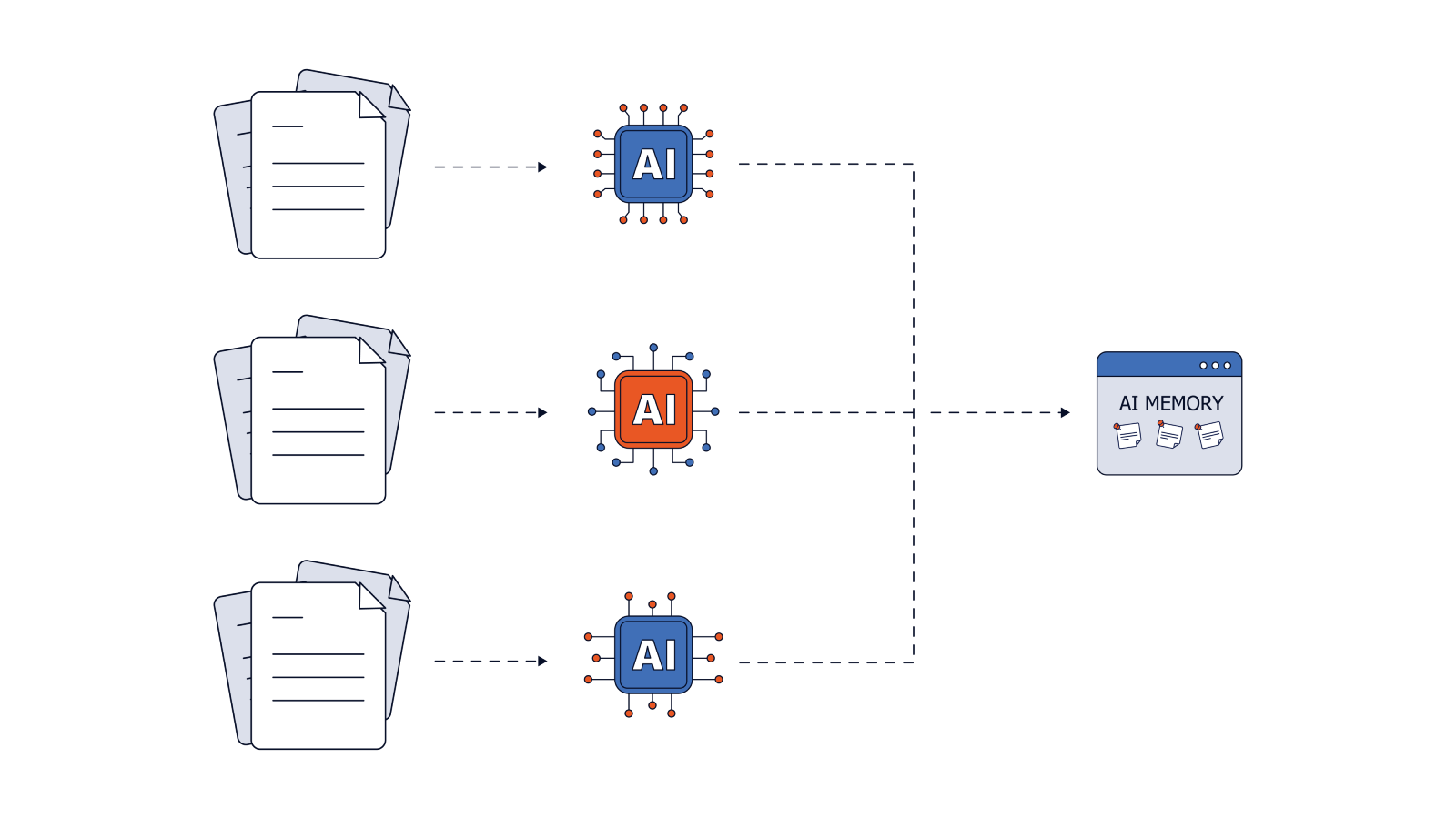
How does it work? In simple terms, your conversations are processed by a separate layer that extracts meaningful facts about you.
For example, when you ask “What bait works best for sea bass in the Mediterranean?”, that layer notes your interest: fishing, sea bass, the Mediterranean. It saves a summary of that fact, with a link to the conversation, in a separate database. You can see the result yourself in ChatGPT, under Settings -> Personalization -> Manage your saved memories.
When you start a new conversation, your prompt is matched against those saved summaries to find anything relevant. So when I ask something about fishing, it pulls back “fishes for sea bass in the Mediterranean,” and those few words give the model a lot of context about what I really mean.
Notice what is actually happening: the system extracts a fact, stores a summary, searches for it on your next prompt, and injects the match back into the context. That is retrieval, not learning. The model was never retrained on you; it is just being handed a relevant note at the right moment.
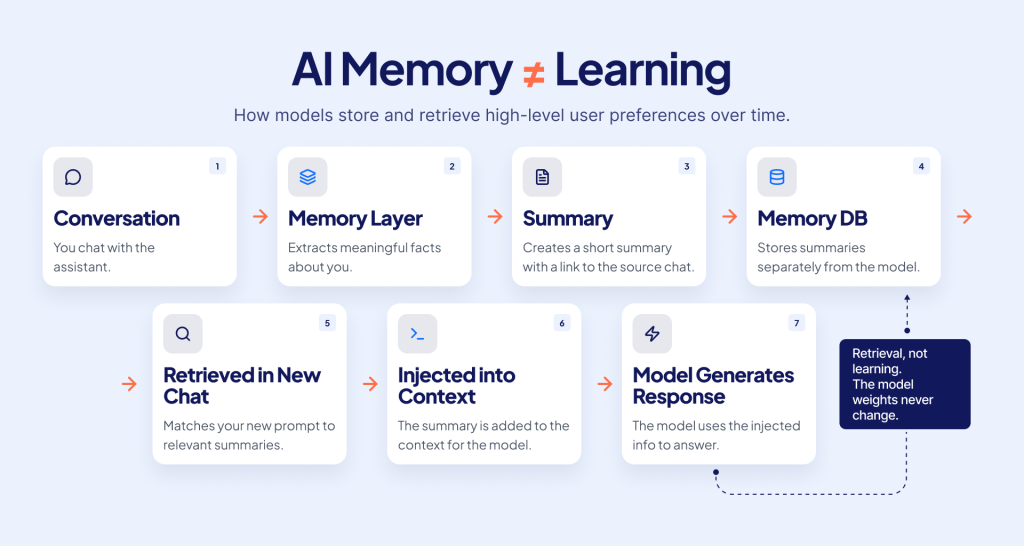
Worth knowing: since 2025, ChatGPT also draws on your broader past chats, not only the short saved facts. The principle is the same: it retrieves and injects, it does not learn.
It works well for simple cases, and it creates the impression that the model knows you and is tailoring itself to you.
Where Memory Falls Short for SEO
This breaks down the moment the work gets complicated, like a real SEO audit.
You might analyze hundreds of sites with ChatGPT, feeding it hundreds of crawl reports, audit briefs, and other SEO-related data. That does not mean the knowledge from all of them carries over to the next analysis. The memory layer keeps its summaries short on purpose, so it doesn’t bloat the context. It might capture that you focus on technical SEO, but completely miss that on this client you were chasing broken pages with strong backlink profiles. Next session, it starts blind to the exact details that matter.
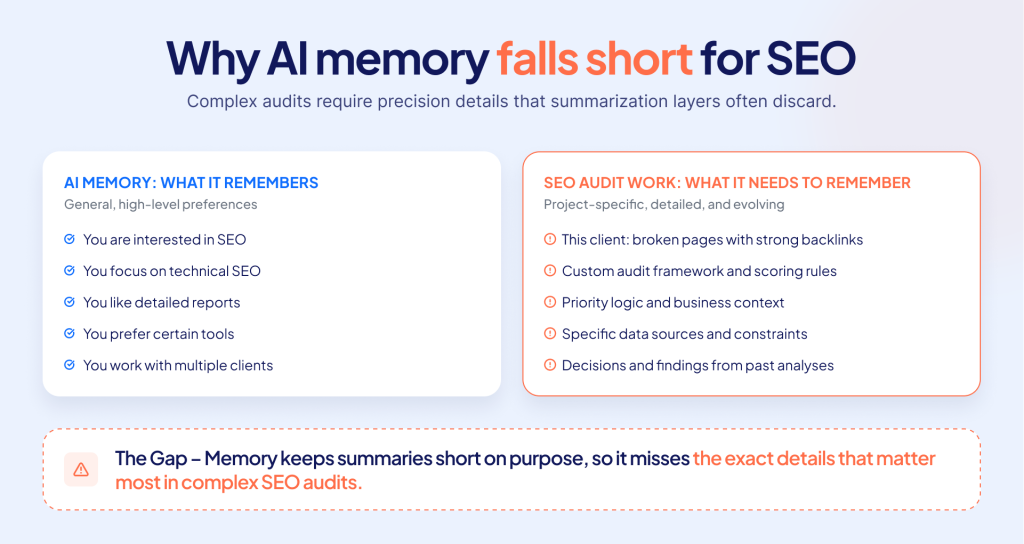
In other words, memory is built for lightweight personalization, not for carrying your methodology. It won’t hold your audit framework, your scoring rules, or your client-specific context, and you don’t control what it keeps or drops.
A Better Approach: Build Your Own Skill
Instead of leaning on an automatic black box, build your own memory and rules. It is simpler than it sounds.
First, what is a “skill” here? Just a plain markdown(text) document that captures how you work: what you look at, in what order, and how you decide. You can use it as a reusable prompt by pasting it in, and in tools like Claude, you can register it as an actual Skill that the assistant loads on its own. Same idea either way: a framework you write down once and reuse.
Say you’ve done many client reports and you want a framework where the model gathers the data, drafts the document, and you enrich it at the end.
You can do this in the web chat, but I prefer the desktop apps. They are more flexible and work directly with your files. In ChatGPT or Claude, open the desktop app and point it at the folder with your SEO reports. Then prompt something like:
You're an experienced SEO manager. I'll point you at a folder of SEO reports I've written for clients.
Reverse-engineer my method from them and turn it into a reusable skill
I can apply to future audits. Work in two steps.

Step 1 - Analyze. Read my reports and, grounded only in what you actually find (not general SEO best practice), tell me:
- the checks and analyses I run every time, and the order I run them in
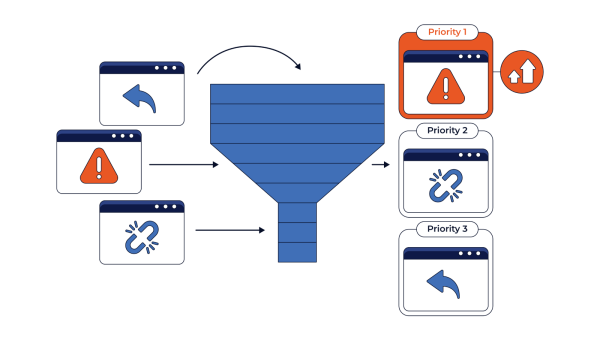
- how I prioritize issues (what I treat as critical vs. minor)
- the data sources and tools I rely on
- how my reports are structured, and the tone I write in
- any recurring recommendations or playbooks
Then show me a short outline of the skill, list anything inconsistent or missing across the reports, and ask me any clarifying questions before writing.

Step 2 - Write.
After I answer, produce one markdown document I can reuse as a skill: a step-by-step framework plus a template for the final report, written as instructions you could follow later to reproduce my analysis.
Mark anything that's your assumption rather than something you saw in my reports.

Stay specific to how I actually work. If a common SEO practice isn't in my reports, leave it out or list it separately under "not currently in your process."
What you get back is a document you can actually read and edit, something like:
# SEO Audit Skill

## What we check first
- Indexability: robots, canonicals, noindex
- Rendering: does the content survive without JS?

## How we prioritize
- Pages with backlinks AND errors = top priority

## Output format
- Summary table, then per-issue detail
The advantage is that this document is stable and clear to understand. You can edit it, improve it, and share it with your team, so everyone runs the same framework instead of each person’s private chat history.
Start by using these as copy-paste prompts. Once you have tuned them, promote them to a real skill inside your team’s Claude.
Conclusion
AI memory is a personalization layer, not a knowledge base. It retrieves short notes about you and hands them to a model that never actually learned about you, and it was never built to carry the depth a real SEO workflow needs.
So stop waiting for the chat to “get” your process. Write it down. A simple markdown skill you control beats any automatic memory: it is stable, you can read and fix it, and your whole team runs the same playbook. The model is the engine. The framework you build is the rest of the car.