Implementing an agentic SEO workflow moves a team from managing isolated tasks to governing an automated loop. While a standalone AI SEO tool addresses single queries on demand, an agentic system executes multi-step operations independently.
With the rapid expansion of AI Overviews and Generative Engine Optimization (GEO), search engines and AI crawlers are reading the web differently and more frequently. Operating at scale now requires infrastructure that can spot issues, compute priorities, and draft fixes dynamically.
This guide outlines exactly what an agentic SEO workflow is, how its architecture functions, and how to build one. We will cover the core components, step-by-step implementation, enterprise best practices, and the metrics required to measure success.
Table of Contents:
- What Is an Agentic SEO Workflow?
- Agentic-SEO-Workflow-vs.-AI-SEO-Tool-vs.-Chatbot:-What’s-the-Difference
- What Agentic SEO Workflows Automate
- How to Build an Agentic SEO Workflow: Step-by-Step
- Common Mistakes and How Enterprise Teams Avoid Them
- Measuring the Impact of an Agentic SEO Workflow
- Where EdgeComet Fits into an Agentic SEO Workflow
- Agentic SEO Workflow Launch Checklist
What Is an Agentic SEO Workflow?
An agentic SEO workflow is a goal-driven process in which one or more AI agents use SEO data, tools, instructions, and feedback to analyze issues, select actions, execute permitted tasks, and validate outcomes under defined human monitoring.
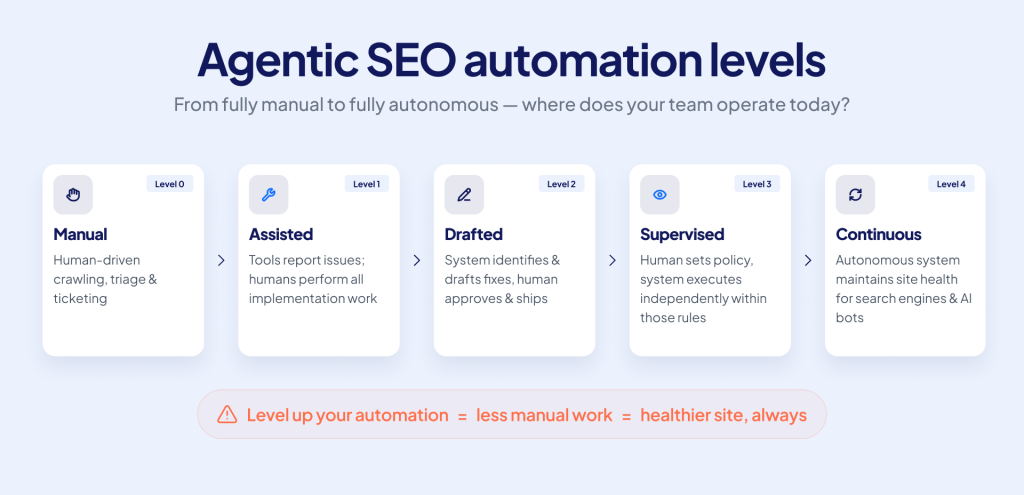
Unlike rigid scripts, this workflow evaluates live data and adjusts its next step based on the findings. It is characterized by the following traits:
- Goal-oriented: Pursues a specific outcome rather than just completing a prompt.
- Context-aware: Uses live internal and external data to inform decisions.
- Tool-enabled: Interacts actively with APIs, crawlers, and deployment platforms.
- Iterative: Adjusts its approach based on previous actions and error logs.
- Measurable: Tracks success against defined performance metrics.
- Human-governed: Operates within strict permissions and approval gates.
Agentic SEO Workflow vs. AI SEO Tool vs. Chatbot: What’s the Difference?
The defining feature of an agentic workflow is its ability to pursue a goal through multiple connected actions, evaluate the results, and adjust the next step. It does not wait for a human to prompt every individual micro-task.
| Approach | Primary function | Decision-making | Executes actions | Uses feedback | Typical SEO example |
| Chatbot | Answers questions conversationally. | None (relies on user prompts). | No. | No. | Asking a model to explain a canonical tag. |
| AI SEO tool | Performs a single, specific task on request. | Limited to the immediate task. | Partially (outputs a draft). | No. | Generating meta descriptions for a list of URLs. |
| SEO automation | Executes predefined steps based on triggers. | Fixed (if/then rules). | Yes (within rules). | Rarely. | Updating an XML sitemap when a new product is published. |
| Agentic SEO workflow | Manages an end-to-end operational loop. | Contextual (adapts based on data). | Yes (multi-step). | Yes (validates results). | Detecting rendering failures, sizing traffic impact, drafting the fix, and validating post-deployment. |
Inside an Agentic SEO Workflow: Components and Architecture
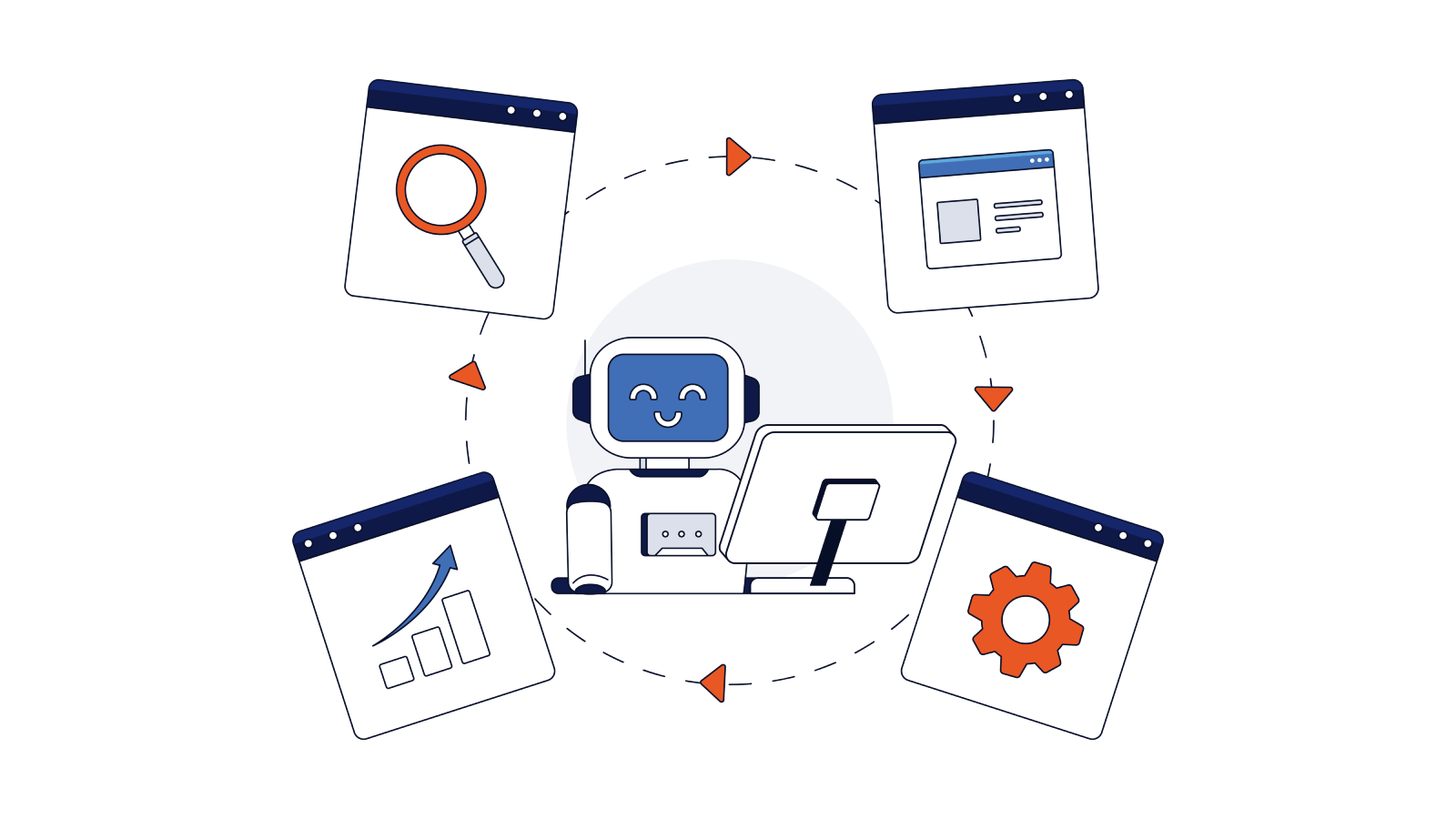
An agentic architecture coordinates data, analysis, and execution across a structured lifecycle. The complete operational cycle follows a clear path:
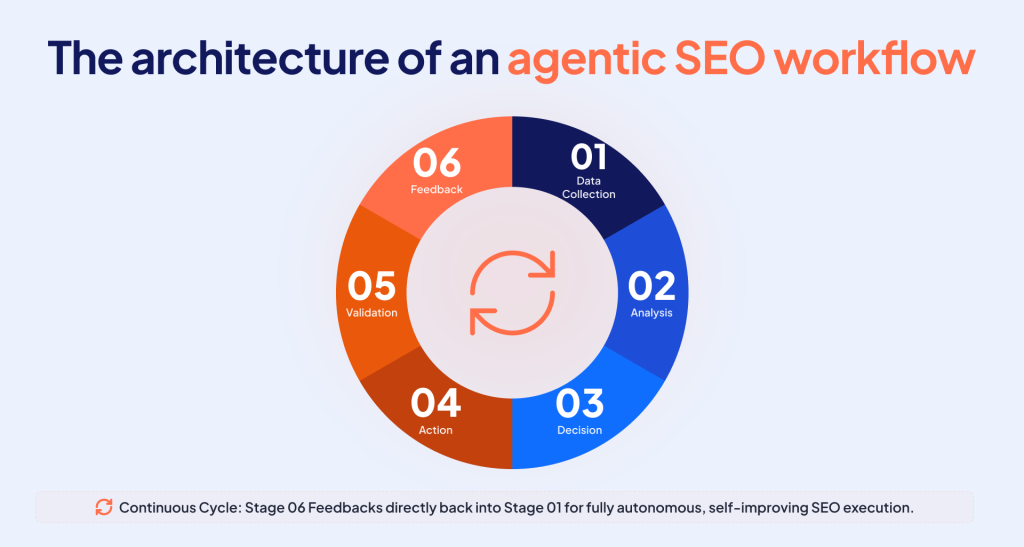
To execute this cycle, an effective agentic SEO workflow requires a combination of individual agent capabilities and system-wide operational controls.
Agent Capabilities & Integrations:
- Goals and instructions: The target state (e.g., “ensure all high-traffic product pages return a 200 status with valid schema”).
- Tools and data sources: Read/write access to external platforms (log analysers, APIs, deployment layers). This is where standards like the Model Context Protocol (MCP) ensure secure API communication, and insights from specific AI crawlers (like OpenAI’s GPTBot) can be integrated.
- Memory and contextual data: Recall of past actions, site architecture, and past results to prevent repetitive flagging or overwriting.
- Decision logic: The mechanism (often confidence scoring) used to evaluate data, select the next action, and handle exceptional cases without halting unexpectedly.
Operational Controls (Governance):
- Permissions and constraints: Strict boundaries restricting what an agent can touch, preventing accidental rewrites of core structural templates.
- Human approval points: Defined stages where a human must review and greenlight a drafted action before it affects the live site.
- Feedback and validation loops: The mechanism by which the system checks its own work (e.g., verifying an indexing issue is resolved before marking a task complete).
Workflows within this architecture can be structured as either single-agent systems (one agent handles the sequence) or multi-agent systems (tasks are divided by specialisation, such as one agent for collecting data and another for drafting edge rules).
Two Planes: Deterministic Detection vs. Agentic Exploration
A robust enterprise architecture strictly separates the deterministic detection plane from the agentic exploration plane:
- The Deterministic Detection Plane: All counts, anomaly classifications, severity scores, and metric aggregations are computed purely through deterministic code and rules. LLMs and agents are never allowed to mint numbers, traffic estimates, or raw frequencies.
- The Agentic Exploration Plane: Once code-level flags are raised, sub-agents take over to explore semantic context, draft descriptive titles, propose route adjustments, or format technical summaries. This separation prevents hallucinations from corrupting core SEO data structures.
When setting up this architecture, teams must choose between building a custom stack or configuring an existing platform:
| Criterion | Custom stack | Configured platform |
| Flexibility | High | Moderate to high |
| Implementation time | Months | Days to weeks |
| Maintenance | High (in-house engineering required) | Low (managed by vendor) |
| Integrations | Built manually from scratch | Native connections provided |
| Governance | Requires custom guardrails | Built-in permissions and rollbacks |
| Best suited for | Unique proprietary internal systems | Standardizing large-scale SEO execution |
What Agentic SEO Workflows Automate
Not every SEO task requires an agentic approach. Predictable, repetitive tasks are better suited to standard rule-based automation. Agentic workflows excel in areas calling for context, data joins, and iterative problem-solving.
| Workflow area | What can be automated | Human involvement |
| Technical monitoring | Anomaly detection, cross-referencing log files against data feeds, classifying crawl waste. | Setting alerting thresholds, reviewing edge cases. |
| Crawling and indexing | Testing JavaScript execution, mapping missing internal links, validating directives. | Defining the strategic crawl boundaries. |
| Content operations | Drafting missing metadata at scale, rewriting titles based on CTR decay, generating writer briefs. | Tone/brand review, final approval of drafts. |
| Issue management | Sizing the traffic impact of an issue, grouping affected URLs, drafting the technical fix. | Approving the deployment, setting business priorities. |
| Validation | Re-crawling updated URLs to confirm the fix, checking post-deployment status codes. | Intervening if an automated rollback fails. |
How to Build an Agentic SEO Workflow: Step-by-Step
Building the workflow requires moving from a strategic goal to a tested, operational system. Follow this sequence to implement it safely.
- Define the SEO goal: Determine exactly what the workflow should achieve (e.g., resolving duplicate meta descriptions across faceted navigation). Starting too broad leads to failure.
- Select a narrow pilot workflow: Choose one specific, measurable template or issue type for the initial rollout. Do not deploy site-wide on day one.
- Identify the required data sources: Connect necessary feeds, including Google Search Console performance data, bot log events, and live rendered DOM snapshots.
- Define the tools available to the agent: Grant the agent API access to the systems it needs to read data or stage fixes (e.g., an edge deployment layer or headless crawler).
- Set instructions, permissions, and constraints: Document what the agent is allowed to do. Explicitly state restrictions, such as “never modify URLs containing /checkout/”.
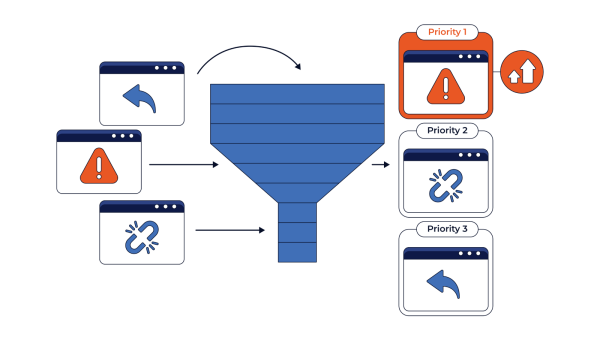
- Establish prioritization logic (Harm vs. Reach): Instruct the agent on how to rank issues using two fundamental axes: Harm (the severity of failure per URL) and Reach (breadth of affected URLs × template value). Opportunity at stake must be calculated using the site’s own CTR-by-position curve extracted from GSC data.
- Add human approval points: Configure the system so that the agent drafts the fix and pauses. A human must review the before-and-after diff before any changes go live.
- Define validation criteria: Set the exact conditions that must be met for a task to be marked as resolved (e.g., “the live URL must return a 200 status and the <title> tag must match the approved draft”).
- Test the workflow in a staging environment: Run the agent against limited data or a staging site. Review its decision logs to ensure it follows the prioritization logic correctly.
- Measure the results and scale gradually: Review the pilot outcomes. If the defect rate is low and the time-to-publish has decreased, expand the workflow to other page templates.
Example: Complete Technical Use Case
Goal: Detect JavaScript rendering failures on priority pages.
- The system compares the rendered HTML against expected page elements.
- The agent identifies missing main content, links, or metadata that only appear post-render.
- Affected URLs are grouped by page template and issue type.
- The issue is prioritized according to existing traffic, business value, and severity.
- A detailed technical task is created and assigned to the engineering queue.
- After the developers deploy the fix, the affected URLs are automatically checked again.
- The issue is closed only when the predefined validation criteria are met.
Common Mistakes and How Enterprise Teams Avoid Them
Designing an agentic system involves operational risks. Deploying these workflows in enterprise environments requires strict governance to prevent conflicting deployments or large-scale errors.
Problem: Automating unstable or undocumented processes.
- Consequences: If a human cannot explain the current manual workflow, an agent cannot replicate it accurately, leading to unpredictable loops and failures.
- How Teams Control It: Always select a narrow, well-documented, and measurable pilot project first (e.g., a specific regional subfolder) before scaling across multiple markets.
Problem: Granting excessive permissions too early.
- Consequences: Agents may stage widespread changes across critical site architecture based on a false positive, causing widespread indexing failures or ranking drops.
- How Teams Control It: Keep comprehensive logs of all agent decisions and drafted changes so human operators can audit the system’s logic. Ensure rollback and emergency stop mechanisms are configured and tested.
Problem: Relying on a single data source.
- Consequences: A workflow using only traditional crawl data creates blind spots regarding how search engines and live AI bots process JavaScript and experience the live site.
- How Teams Control It: Connect multiple, diverse feeds (in-path bot logs, GSC data, rendered DOM) to form a complete contextual picture.
Problem: Failing to define strict validation criteria.
- Consequences: The system cannot independently verify that a fix worked, causing it to close critical tasks prematurely.
- How Teams Control It: Build measurable validation conditions directly into the workflow (e.g., post-deployment DOM verification) so tasks remain open until success is proven.
Role Responsibilities for Safe Execution
To enforce these controls, teams must clearly divide responsibilities:
| Role | Responsibility |
| SEO specialist | Strategy, complex ambiguous cases, and reviewing agent-drafted changes. |
| Engineering team | Infrastructure stability, API integrations, and code-level deployments. |
| Agentic system | Continuous data analysis, issue prioritisation, and drafting routine fixes. |
| Product or business owner | Defining business value, page priority, and commercial goals. |
| Governance owner | Setting permissions, monitoring agent logs, and maintaining the human-in-the-loop oversight. |
Measuring the Impact of an Agentic SEO Workflow
Do not evaluate success using rankings and clicks alone, as these metrics operate on a delay. A mature workflow should be measured across SEO outcomes, process efficiency, quality, and cost.
| Metric Category | Specific Metrics to Track |
| Operational efficiency | Reduced issue detection time; fewer repetitive manual checks; time-to-publish for routine fixes. |
| Quality of automation | Percentage of correctly prioritised tasks; false-positive rate; percentage of fixes that pass automated validation. |
| Risk and governance | Proportion of automated actions requiring manual rollback; defect rate in generated drafts. |
| SEO outcomes | Organic clicks; ranking improvements; indexation rates of critical pages. |
Where EdgeComet Fits into an Agentic SEO Workflow
EdgeComet’s agentic control layer provides the in-path data collection, detection, and execution infrastructure necessary to power an agentic SEO workflow. By sitting between the website and the bot traffic, it supplies the real-time truth about what machines are actually receiving.
Within an agentic workflow, EdgeComet supports the following stages:
- Data collection: Capturing live bot events and JavaScript rendering outcomes via real in-path SEO log analysis to see exactly what Googlebot and AI crawlers experience.
- Issue detection & prioritization: Surfacing anomalies using the AI Action Board feature of EdgeComet, applying deterministic calculations to rank tasks by Harm vs. Reach, and real-time anomaly detection from live bot traffic via EdgeComet’s alerting and monitoring layer.
- Execution: Acting as the deployment layer using edge-layer technical SEO execution, letting teams to review agent-drafted rules and push them live to the edge in minutes without backend code changes.
- Validation: Re-verifying the live rendered DOM to ensure the deployed fix resolves the underlying problem.
Agentic SEO Workflow Launch Checklist
- A specific SEO goal has been defined.
- A narrow pilot workflow has been selected.
- Required data sources are available and reliable.
- Agent tools and permissions are documented.
- Prioritization criteria are defined using Harm vs. Reach.
- Human approval points are configured.
- Validation conditions are measurable.
- Actions and decisions are logged.
- A rollback or stop mechanism is available.
- Pilot results are reviewed prior to scaling.
Frequently Asked Questions
Is an Agentic SEO Workflow the Same as AI Content Generation?
No. AI content generation focuses on writing articles or landing page copy using large language models. An agentic SEO workflow is an operational system that manages technical health, data analysis, metadata execution, and crawling diagnostics. While an agentic workflow can draft content elements like title tags, its primary purpose is automating the discovery-to-resolution cycle for SEO issues.
Can an Agentic SEO Workflow Replace SEO Specialists?
An agentic workflow cannot replace SEO specialists. It automates repetitive data analysis, cross-referencing, and the drafting of routine technical fixes. Human experts remain strictly responsible for overall strategy, undertaking complex risk decisions, maintaining governance, and handling ambiguous cases where business context overrides technical rules.
What Data Sources Should an Agentic SEO Workflow Use?
An effective workflow requires a combination of in-path bot logs, Google Search Console data, and live rendered HTML snapshots. Relying on a single source, such as a traditional desktop crawler, creates blind spots regarding how search engines and AI bots process JavaScript and experience the live site.
How Do AI Agents Prioritize SEO Tasks?
Agents prioritize tasks by assessing the intersection of impact and urgency through Harm and Reach metrics, derived from the site’s own CTR-by-position curve. They evaluate the number of affected URLs, the existing organic traffic at stake, the severity of the technical failure, and the business value of the page type.
What Are the Risks of Autonomous SEO Automation?
The primary risks include automating undocumented processes, granting excessive deployment permissions, and failing to define strict validation loops. Without human approval gates, an agent might overwrite critical site elements based on a false positive, bringing about widespread indexing failures or the loss of established organic rankings.
Does Agentic SEO Work for Large, Multi-Site Enterprise Portfolios?
Yes, agentic workflows are highly effective for large portfolios because they can apply consistent analysis methodologies across millions of URLs. However, enterprise implementation needs rigorous governance, robust shared context memory across agents, and carefully staged pilot rollouts to prevent conflicting tasks among different regional or brand teams.
How Do You Measure the Success of an Agentic SEO Workflow?
Success is measured by evaluating SEO outcomes alongside operational and quality metrics. Teams should track the reduction in issue detection time, the percentage of fixes that pass automated validation, the false-positive rate, and the decrease in time-to-publish. Traffic and ranking improvements serve as lagging indicators of these operational gains.