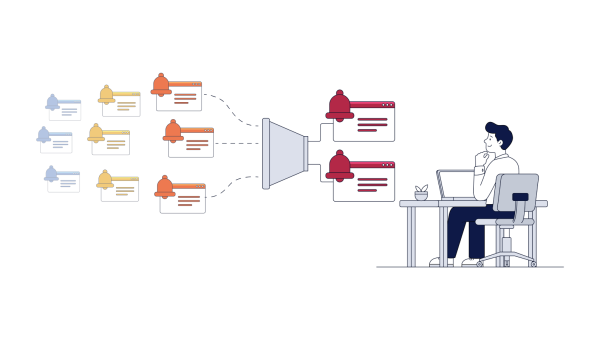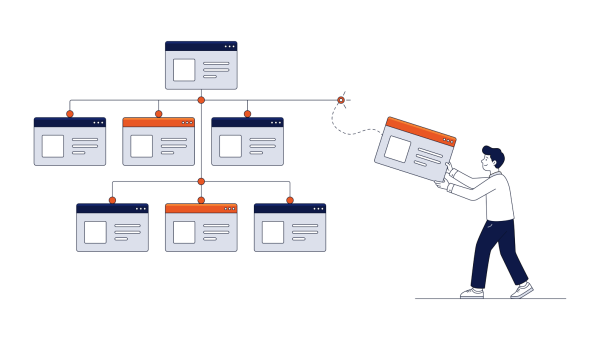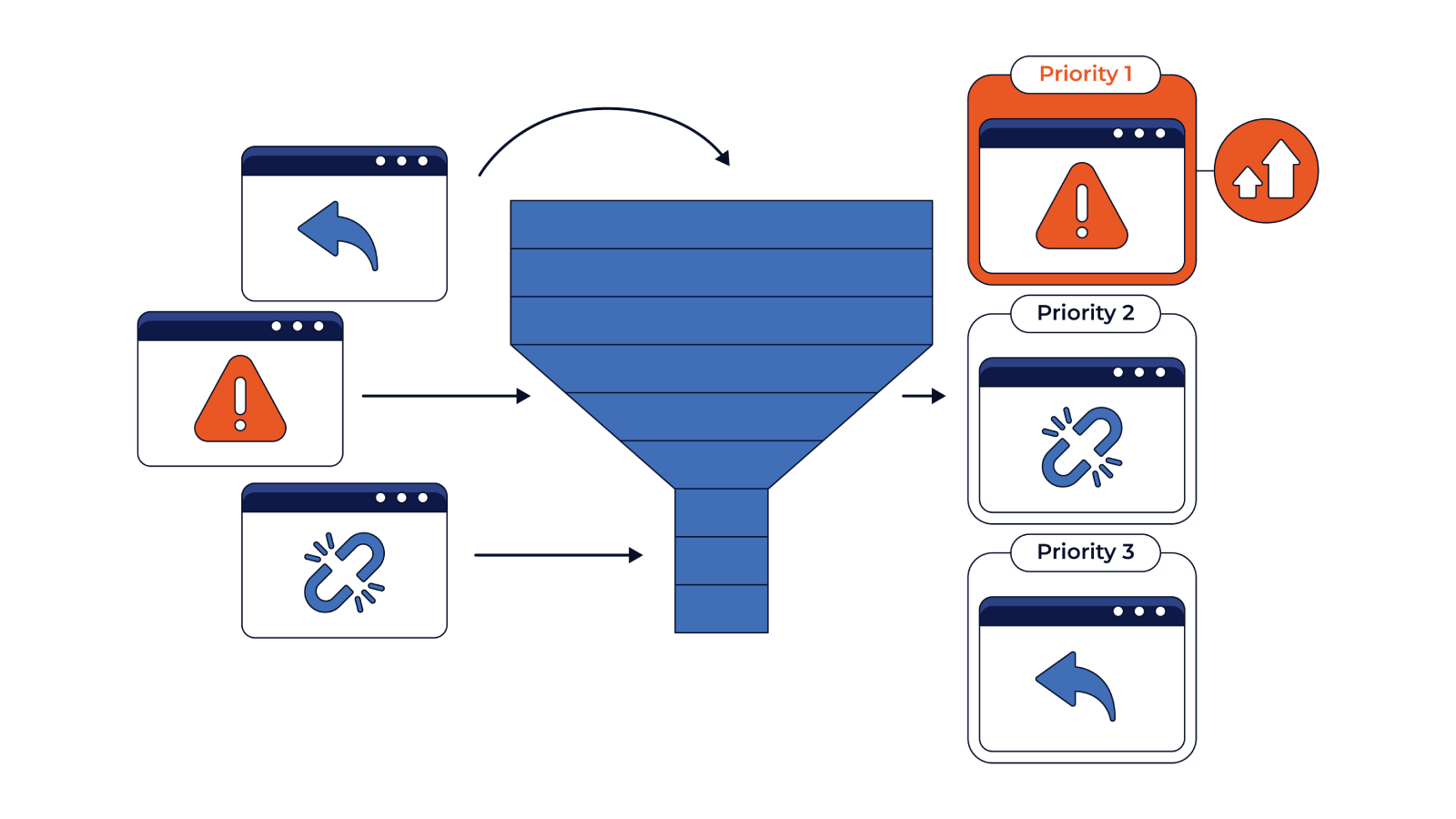
SEO prioritization is a business-critical process that ranks website technical issues by direct revenue impact, crawl efficiency, and generative AI search visibility. By moving beyond generic crawler severity scores, organizations can protect their bottom line and ensure their infrastructure supports organic growth in a search landscape increasingly dominated by non-rendered AI extraction.
Traditional audits often fail because they suffer from three systemic blind spots: total isolation from revenue data, ignorance of AI crawler rendering limitations, and a lack of real-time server log context. Adopting a structured framework is the only way to transform these complex data points into an actionable development roadmap that justifies engineering resources through commercial outcomes.
Table of Contents:
- Why Audit Severity Is Not Enough to Prioritize Technical SEO Fixes
- How to Prioritize Technical SEO Fixes: 5-Step Framework
- Technical SEO Prioritization Matrix: What Should You Fix First?
- How to Prioritize Technical SEO vs Content SEO
- How to Turn Priority Scores Into an Actionable Development Backlog
Why Audit Severity Is Not Enough to Prioritize Technical SEO Fixes
Standard technical SEO tools categorize issues into rigid, legacy buckets: “Errors”, “Warnings”, and “Notices”. This methodology is fundamentally flawed for enterprise-scale sites because it lacks a commercial “So What?” layer. Under this outdated system, a missing meta description on 10,000 low-traffic archive pages is often flagged with the same “Critical Error” status as a broken canonical tag or a TTFB (Time to First Byte) bottleneck on a primary pricing page generating £50,000 in monthly ARR.
Relying solely on tool-based severity misallocates engineering resources and bloats backlogs. If your development team spends high-value sprints fixing cosmetic warnings on legacy blog posts while high-intent landing pages suffer from origin server timeouts or DOM hydration failures, the organization loses revenue. A modern prioritization framework differentiates between simple site maintenance and high-leverage technical fixes that secure conversions. The 5-step framework below addresses these systemic blind spots.
How to Prioritize Technical SEO Fixes: 5-Step Framework
Not every technical SEO issue deserves the same priority. This five-step framework helps teams evaluate each fix by business impact, search potential, scale, effort, and confidence before deciding what to tackle first.
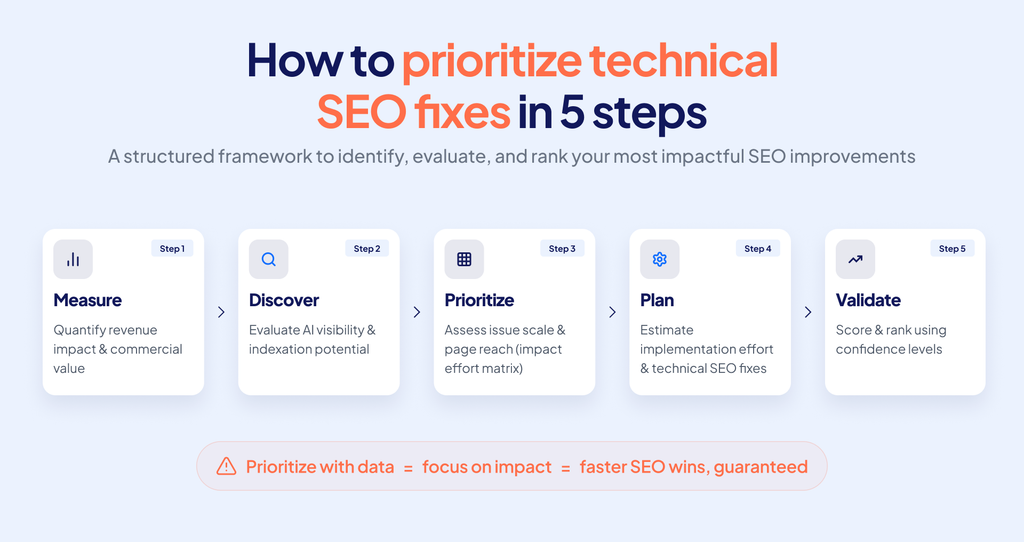
This framework is designed to align search teams with engineering sprints and overarching commercial goals, ensuring every technical task is justified by its contribution to the business’s bottom line.
Step 1: Quantify Revenue Impact & Commercial Value
Technical issues must be mapped directly to page-level revenue. Search teams should segment the site architecture into three commercial tiers:
- Tier 1 (High Revenue): Checkout flows, transactional product categories, and landing pages with high conversion value.
- Tier 2 (High Intent): Feature pages, mid-funnel comparison guides, and service hubs.
- Tier 3 (Low Intent): Archive pages, legacy blog posts, and long-tail informational content.
Step 2: Evaluate AI Visibility & Indexation Potential
Search behavior has shifted toward generative AI answers. When you prioritize technical fixes for AI visibility seo, you must assess whether search engines and AI crawlers can successfully render your core content. Currently, 69% of AI crawlers do not execute client-side JavaScript. Applications built on React, Vue, or Angular often deliver blank HTML to bots, rendering product details or pricing invisible to AI answer engines. Fixes that resolve these JavaScript rendering failures on high-intent pages should bypass standard backlogs to secure visibility in AI-generated answers.
Step 3: Assess Issue Scale & Page Reach
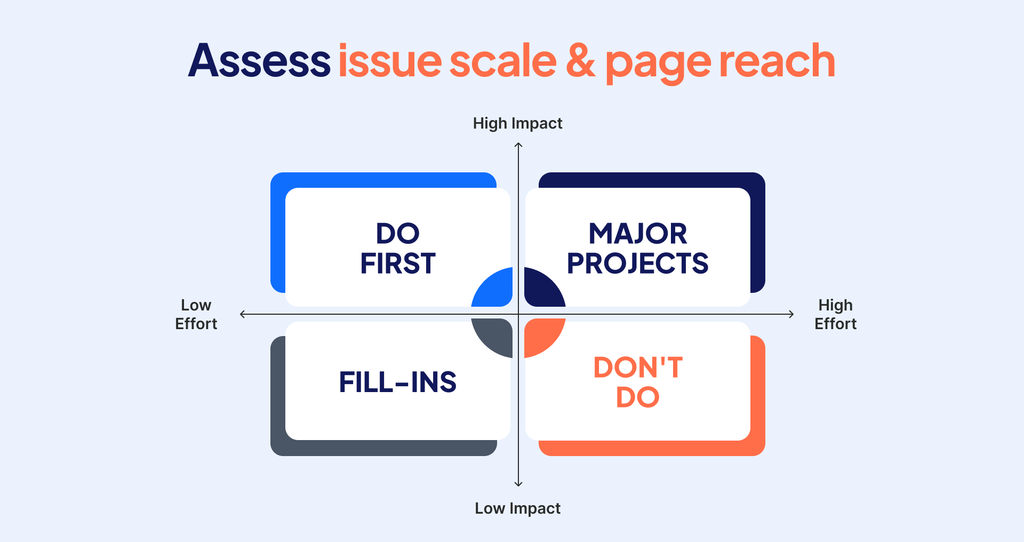
Evaluate the site-wide footprint of an issue to determine its leverage. Using an impact-effort matrix helps identify the most efficient path to recovery:
- Global Template Fixes: A single change to a shared header or template that resolves an issue across 50,000 pages (High Scale/High Impact).
- Isolated Edge-Cases: Fixing a broken link or a metadata error on a single, deep subpage (Low Scale/Low Impact).
Step 4: Estimate Implementation Effort & Technical SEO Fixes Complexity
Establish accurate effort scores by categorizing fixes based on their engineering requirements:
- Low Effort (Hours): Robots.txt tweaks, metadata updates via Edge SEO, or simple redirect maps.
- Medium Effort (Sprints): Structured data implementation or complex canonical logic updates.
- High Effort (Months): Server-side rendering (SSR) migrations or major database restructurings.
Targeting “quick wins”, high-impact fixes with low implementation complexity, allows for rapid organic ROI.
Step 5: Score & Rank Using Confidence Levels
Combine these metrics into a modified RICE framework to produce a final priority score:

Confidence is not a subjective guess; it is an analytical metric derived from real-time data. In this model, confidence increases when server logs from a Log Analyzer verify that bots are already abandoning high-value URLs due to latency or rendering errors.
Manually executing this scoring and ranking across hundreds of issues is a major bottleneck for most search teams. To solve this without getting lost in complex spreadsheets, enterprise teams are turning to automated platforms that bring crawler reports, Search Console data, bot activity, and business context into a single, cohesive workspace.
Technical SEO Prioritization Matrix: What Should You Fix First?
A shared prioritization matrix is essential for executive reporting and departmental alignment. It transforms technical jargon into a clear roadmap based on business risk.
| Issue | Revenue Impact | SEO+AI Visibility | Scale | Effort (Legacy vs Edge) | Priority |
| Robots.txt Blocking Products | High (£100k+ risk) | Critical (Blocked) | Large (10k+ pages) | Low (Hours) | P0 (Critical) |
| Client-side JS Hiding Schema | High (Conversion) | High (AI Invisible) | Enterprise-wide | Medium (Edge SEO Minutes) | P0 (Critical) |
| Broken Canonicals on Core Pages | High (Sales loss) | High (Duplication) | Medium (500 pages) | Low (Hours) | P1 (High) |
| Crawl Budget Waste (Parameters) | Medium (Indirect) | Medium (Crawl rate) | Large (50k URLs) | Medium (Sprints) | P1 (High) |
| Missing Meta (Blog Posts) | Low (Minor CTR) | Low (Rewritten) | Large (5k pages) | Low (Hours) | P2 (Medium) |
| Redirect Chain (Legacy Page) | Low (<£100 value) | Low (Historical) | Small (1 URL) | Low (Edge SEO Minutes) | P3 (Low) |
Automating Technical SEO Prioritization with Action Board
Sorting hundreds of technical SEO findings manually means combining crawler reports, Search Console data, bot activity, affected pages, and business context before you can even decide what deserves attention. EdgeComet’s Action Board brings these signals into one analysis workflow. It identifies technical SEO issues and opportunities, evaluates how many and which pages are affected, connects them with search performance and real bot activity, and helps determine what should be addressed first. For each finding, teams can:
- See why it matters: Understand the affected pages, search performance, bot activity, and potential impact behind the finding.
- Investigate it further: Ask follow-up questions and explore the underlying URLs, queries, templates, or crawler data.
- Get a recommended next action: Prepare metadata changes, create an Edge SEO rule, generate a content or developer brief, or turn the finding into a tracked task.
- Move directly toward execution: Instead of copying recommendations manually into another workflow. By combining Action Board intelligence with Edge SEO, teams can bridge the gap between audit findings and production fixes.
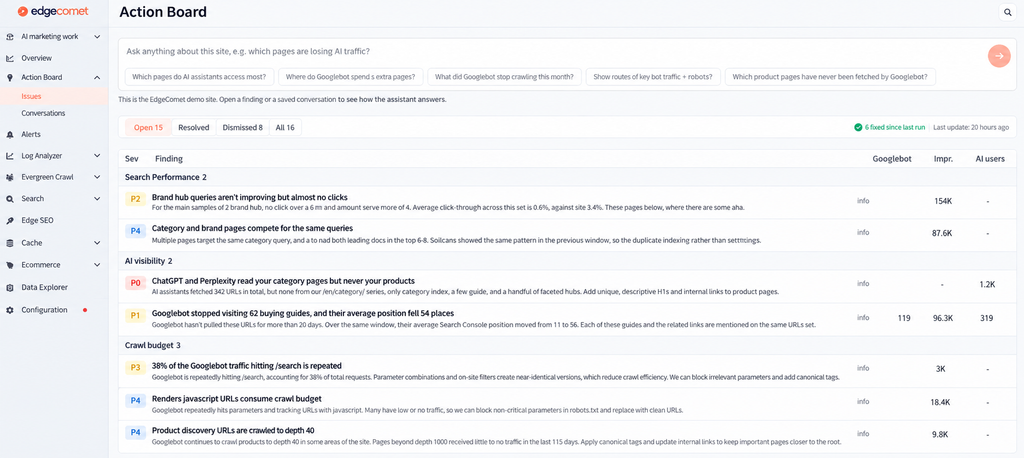
Source: Screenshot of one feature of EdgeComet – Action Board
How to Prioritize Technical SEO vs Content SEO
Prioritize technical SEO first to secure crawlability and indexation; once search engines and AI bots can successfully access and render your HTML, prioritizing content SEO will drive maximum organic traffic and conversions.
Choosing between the two depends on your site’s current technical baseline. Notably, AI search referrals have been shown to have 5x higher conversion rates compared to traditional Google organic traffic. If your technical infrastructure prevents AI bots from accessing your content, you are sacrificing the highest-converting traffic segment available.
When Technical SEO Takes Priority
- Indexation & Crawl Blockers: If bots cannot access your primary pages, adding new content is redundant.
- Infrastructure Outages: TTFB bottlenecks or origin server timeouts damage trust with search engines.
- JS Rendering Failures: If your site serves blank HTML to AI crawlers, fixing JavaScript rendering for SEO takes absolute precedence to capture high-converting AI traffic.
When Content SEO Takes Priority
- Stable Baseline: Your site has high index coverage, efficient bot crawling, and fast render times.
- Topical Gaps: Competitors outrank you because they cover user intent more deeply, not because your infrastructure is failing.
Once priorities are set, the next challenge is transforming these scores into an actionable backlog.
How to Turn Priority Scores Into an Actionable Development Backlog
The “Edge SEO Path” overcomes the traditional development bottleneck by allowing search teams to deploy fixes at the CDN layer, bypassing the need for a full engineering release cycle or wait times for origin-code modifications.
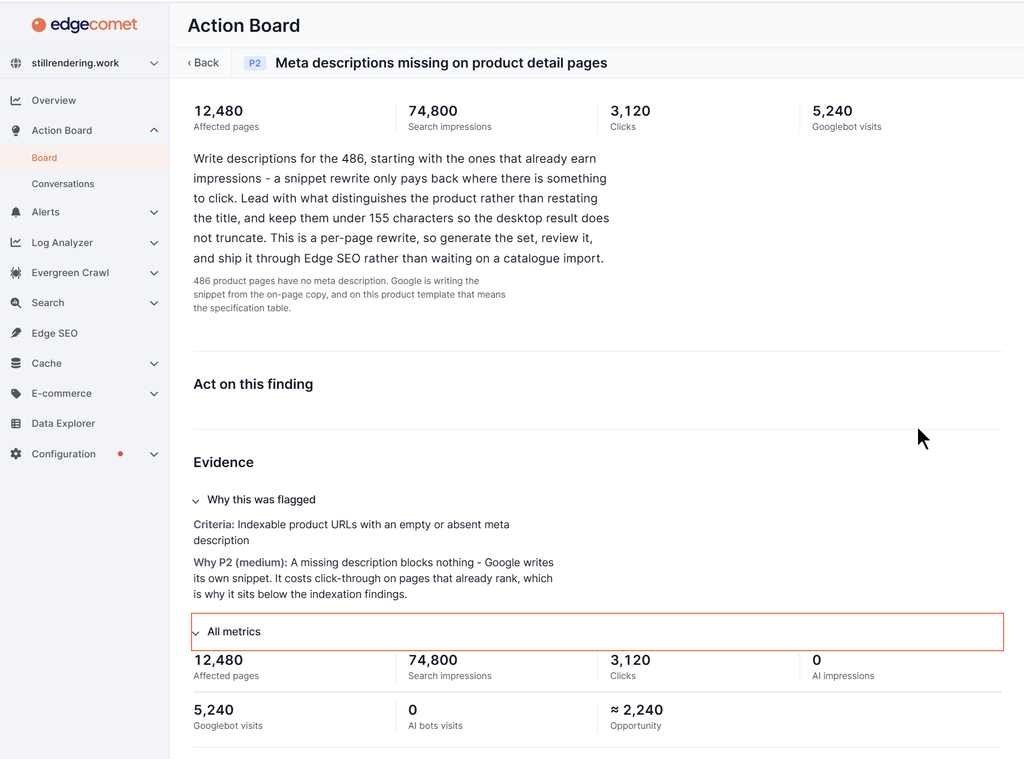
The Streamlined Execution Workflow
- Finding: The Action Board flags a critical issue, such as missing canonicals.
- Priority: The system assigns a P0 score based on impression volume and commercial value.
- Recommended Action: The system generates a ready-to-use fix (e.g., corrected metadata).
- Execution Choice:
- Edge SEO Path: Deploy meta tags, canonicals, and robots directives directly via the Edge SEO platform. The Smart Cache serves pre-rendered HTML to bots instantly, eliminating rendering latency.
- Developer Task Path: Export complex infrastructure tasks as structured engineering tickets for the development team.
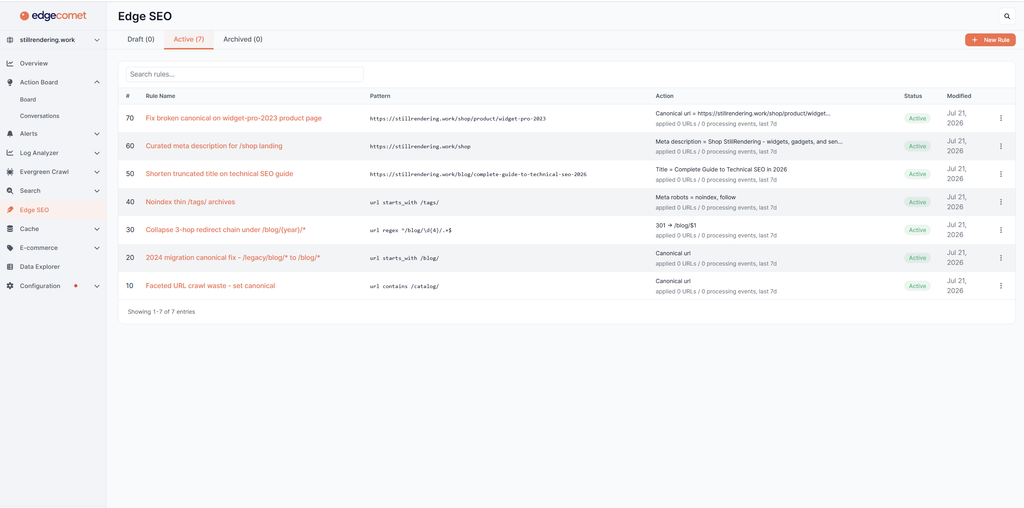
The system concludes with a verification step, monitoring real bot requests to confirm that search engines are receiving the updated, pre-rendered HTML, effectively closing the feedback loop.
FAQs
How Often Should Technical SEO Priorities Be Reassessed?
Technical SEO priorities should be reviewed bi-weekly or monthly during sprint planning. However, enterprise teams should utilize real-time SEO alerts to detect critical regressions, such as accidental noindex tags or server-wide timeouts, the moment they occur.
Which Technical SEO Issues Can Cause the Biggest Revenue Losses?
Accidental noindex directives on revenue pages, robots.txt blocks on primary hubs, and JavaScript rendering failures are the most damaging. According to TechCrunch, Google AI Overviews now have 2 billion monthly users; if your content is invisible to these bots due to rendering errors, the revenue loss is substantial.
Should You Fix Every Issue Found in a Technical SEO Audit?
No. Standard audits flag minor, low-impact notices (like isolated missing alt tags) that provide near-zero ROI. Focus exclusively on issues that impact high-revenue page groups and core indexability.
How Do You Measure Whether a Technical SEO Fix Actually Worked?
Use a Log Analyzer to confirm that search bots are crawling updated URLs with successful status codes. Then, verify in Search Console that the pages are indexed correctly and monitor changes in impressions and conversions over a 30–60 day window.
Can One Technical SEO Fix Improve Both Google Rankings and AI Visibility?
Yes. Implementing edge rendering for JavaScript applications solves indexability for Googlebot while allowing AI crawlers like GPTBot and Claude to digest and cite your content. Clean, server-side HTML is the universal language for all modern crawlers.