There is nothing worse than discovering a site-wide “noindex” error days after a deployment – when your rankings have already dropped and you’re staring down weeks of recovery. That delay isn’t just bad luck; it’s a structural limitation of how traditional monitoring works.
Most tools crawl a copy of your site on a set schedule, leaving you blind between scans. EdgeComet flips the script: it watches real bots hit your real pages, catching and fixing regressions at the edge before a scheduled crawl even begins.
Why Alerting is an SEO Manager’s Problem
Stability is a business problem first. When a commercial site goes down or breaks, it loses visitors, conversions, and revenue. But the damage does not stop at lost revenue. It reaches the part of the site no one is watching in real time: how search engines and AI bots crawl and index it.
I saw many times when a website broke, lost its visibility in Google, and then spent months clawing it back. When Googlebot or AI bots stop trusting some part of the site, it takes time to recover.
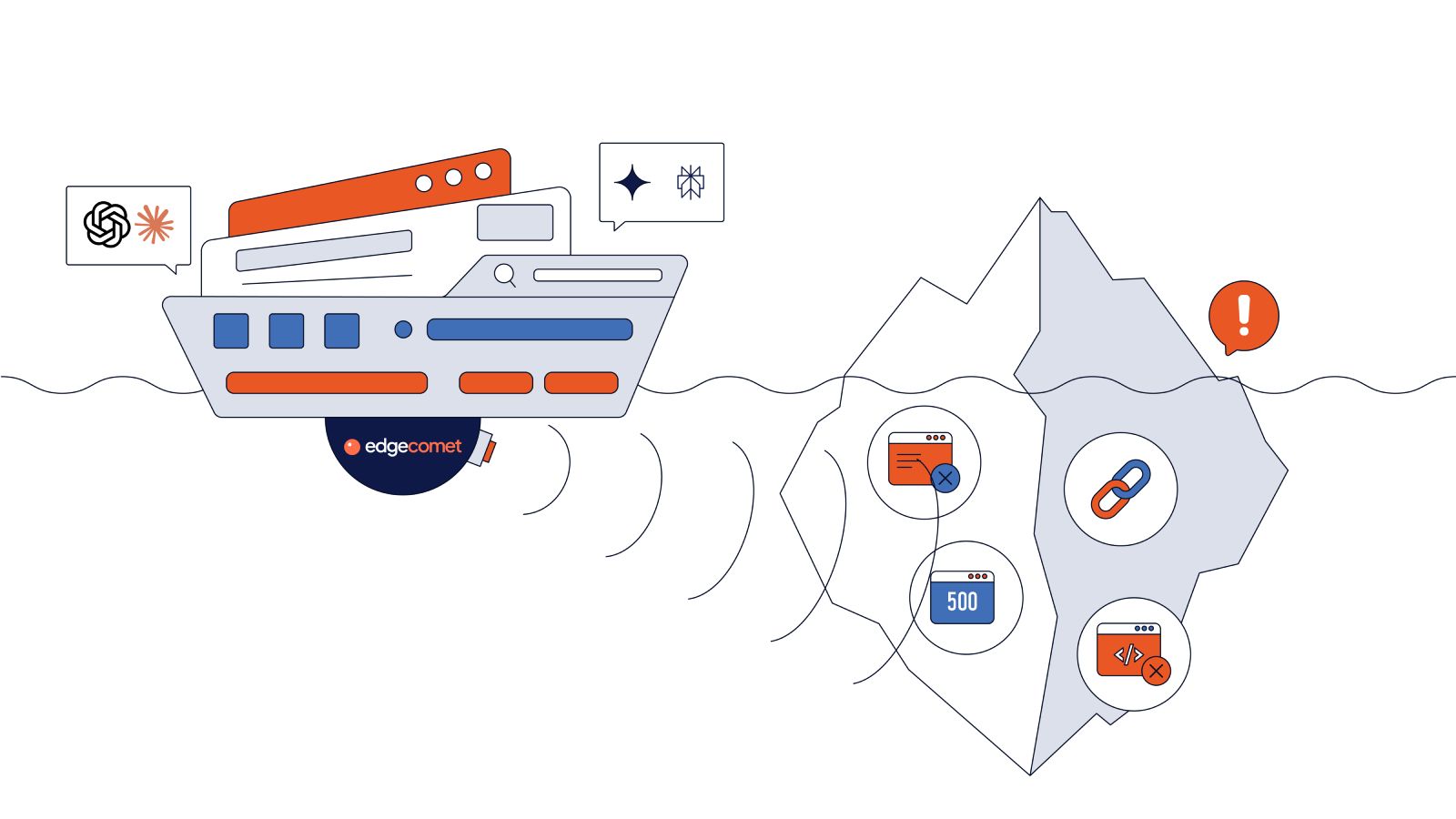
The SEO manager becomes responsible for the consequences, even if developers caused them. A deployment is delivered on Friday, and by Monday it appears as a problem on your SEO dashboard. Usually, the technical team doesn’t do any monitoring that would have noticed it, because the issues that hurt SEO are unseen to a typical health check:
- A section flipped to
noindexby a bad template change - A canonical tag rewritten to point at the wrong URL
- A broken deploy that serves HTTP
500sto Googlebot - Broken SSR for Googlebot
- A release that overwrites the titles on thousands of URLs
None of these breaks the site for a human visitor. The page loads fine in a browser. They break it only for the bots, which is exactly why they can run for days before anyone notices.
How Scheduled Monitoring Works, and Where It Stops
There is no shortage of monitoring tools. You already know a lot of them: UptimeRobot, ContentKing (popular until its acquisition), and many more. The principle is simple. They fetch a sample of your pages on a schedule, compare each page to its last snapshot, and report what changed: status codes, titles, canonicals, the presence of expected text.
It is a reasonable approach. It also has three structural limits.
- Latency. The checks are scheduled, not continuous. Depending on your plan, a page might be checked once an hour or once a day. If the site breaks right after a check, you find out at the next one, hours later. For a regression that is actively bleeding rankings, hours is a long time.
- Coverage. Big sites are the problem. An old e-commerce site is often several sites stitched together, with hundreds of thousands of URLs. Checking the top five pages, or even the top five hundred, tells you nothing about the regression buried in
/category/legacy/. To be sure everything works, you would have to crawl everything, constantly, which no scheduled tool does.
- Simulation. This is the deepest limit. A monitoring crawler visits your site pretending to be a bot and reports what it sees. That is a guess about what Googlebot or GPTBot actually received. The bot that matters might render the page differently, or, in the case of every major AI crawler, not render JavaScript at all. You are monitoring a stand-in, not the real thing.
Difference #1: EdgeComet is in the Request Path
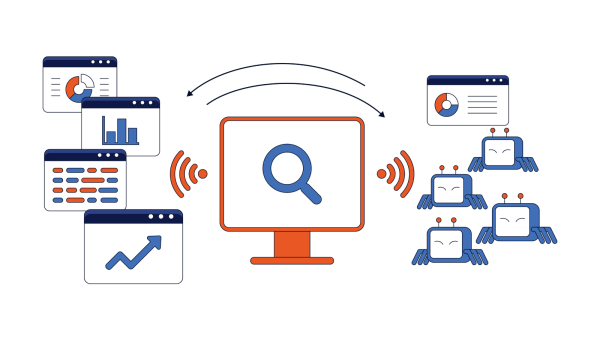
EdgeComet does not run a separate crawl because it does not need to. Every real bot request already flows through it on the way to your origin:
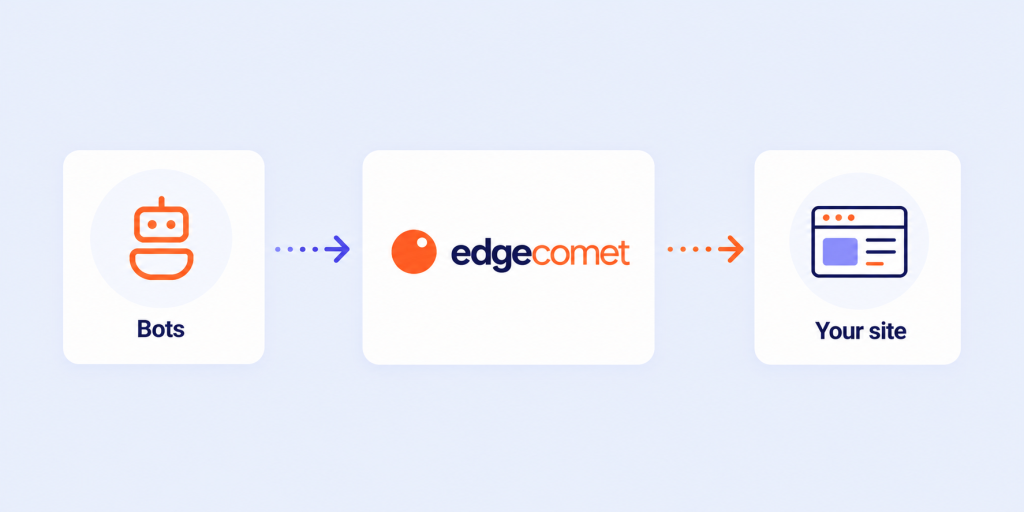
The page is rendered at the proxy, and the rendered SEO snapshot, title, canonical, index status, structured data, and status code are captured as part of serving the request. So the observation is not a simulation of a bot visit. It is the bot’s visit. When Googlebot fetches a page and the title has changed, EdgeComet sees it in the render it just served, in real time.
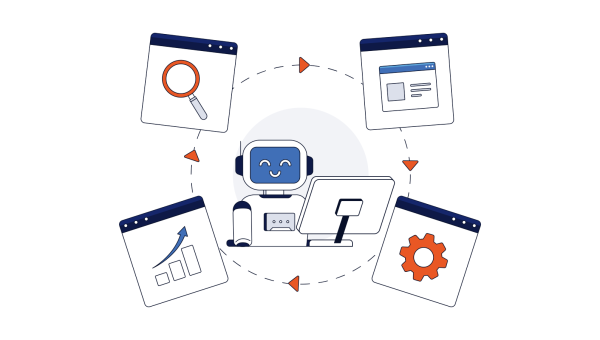
Two engines monitor the live traffic and evaluate it every 5 minutes. End-to-end, you are looking at roughly 5 to 10 minutes from a problem starting to a notification landing, with no extra crawl load on your origin because there is no extra crawl.
The two engines do different tasks:
- A metric watcher monitors the numbers, including the number of requests, render times, errors, and cache hit rates. It spots a spike against a learned normal. It doesn’t just analyze raw traffic numbers; it also understands when traffic goes up and down.
- A change watcher compares renders between two versions of the page and detects when the same change appears across enough URLs. One edited title is nothing to worry about. However, when 3,000 product pages lose their canonical tags in the same afternoon, it is a sign that something has gone wrong.
Difference #2: the Alert Explains Itself
Once you are in the request path, detecting issues fast is the easy part. The harder problem is the one most tools hand straight back to you: a metric and a number, at 2 a.m., with no context.
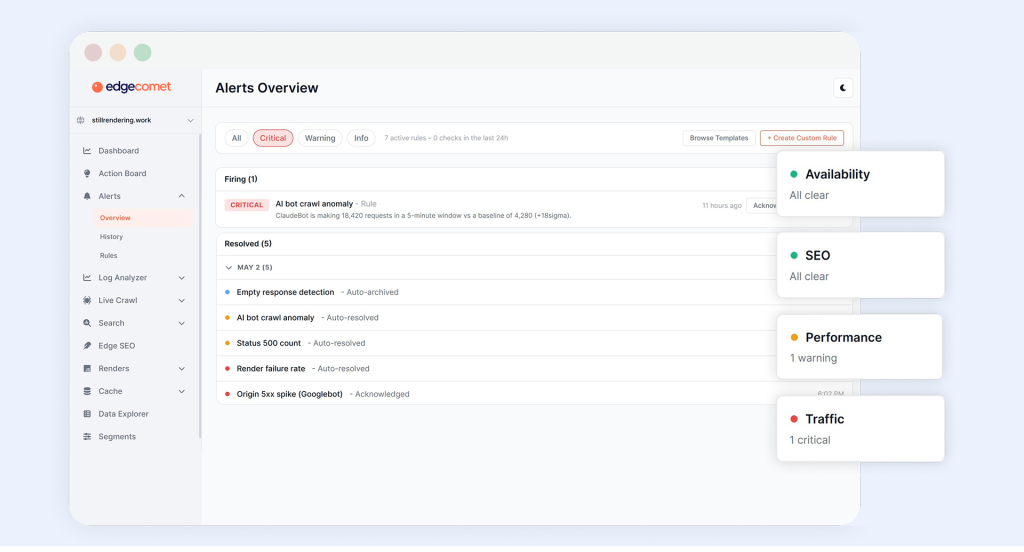
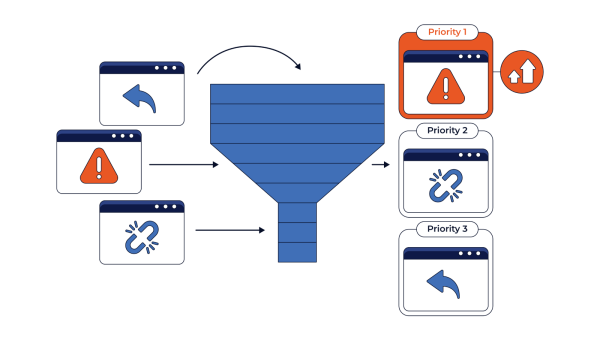
EdgeComet runs every anomaly through an AI triage step before it reaches you. Each alert arrives as three things instead of a raw metric:
- A sentence. “Googlebot is making 18,420 requests in a five-minute window, versus a normal 4,280,” not an internal metric name like
count_ai_bot_requests_threshold_exceeded.” You understand the alert before you open it.
- A severity, with the reasoning. For that spike: “Critical because it is sustained over 90 minutes and concentrated on a small set of URLs, which looks like scraping rather than organic discovery.” You can trust the priority instead of rechecking it yourself.
- A suggested-actions playbook. You start reading at “what to do,” not “what does this metric mean.”
The real payoff is correlation. A bad deploy doesn’t trigger one clean alert; it triggers a cascade. HTTP 500s spike, renders start failing, and titles change across a path, all within the same few minutes. A threshold-based tool pages you three separate times and makes you to piece it together. EdgeComet gathers these signals into a single root cause, “bad deploy to /product/*,” because it saw all three coming from the same traffic. One incident, one explanation, one fix.
That’s also why the system is worth paying attention to. Triage removes noise before it ever alerts. Cooldowns suppress duplicates while a problem is still active, about fifteen minutes for a serious spike and six hours for a slower SEO change. Alerts that fix themselves close on their own, and ones that time out are archived automatically, so the active list stays short and high-signal. You never learn to ignore the pager.
Difference #3: from Alert to Fix at the Edge
That’s where other tools stop and where sitting in the request path pays off twice. Scheduled monitoring just identifies a problem. It can describe it, but can’t fix it.
EdgeComet sits between the bots and your server. Once it detects a problem, it can fix it. When a change alert fires, say a canonical tag flipped, a section becomes noindex, titles overwritten, you can apply an Edge SEO rule that will override the regression at the edge, in minutes. Your origin is still broken. Developers still fix it on their own timeline. But at the same time, Googlebot and AI bots see the correct page, and the damage stops instead of waiting for the next sprint.
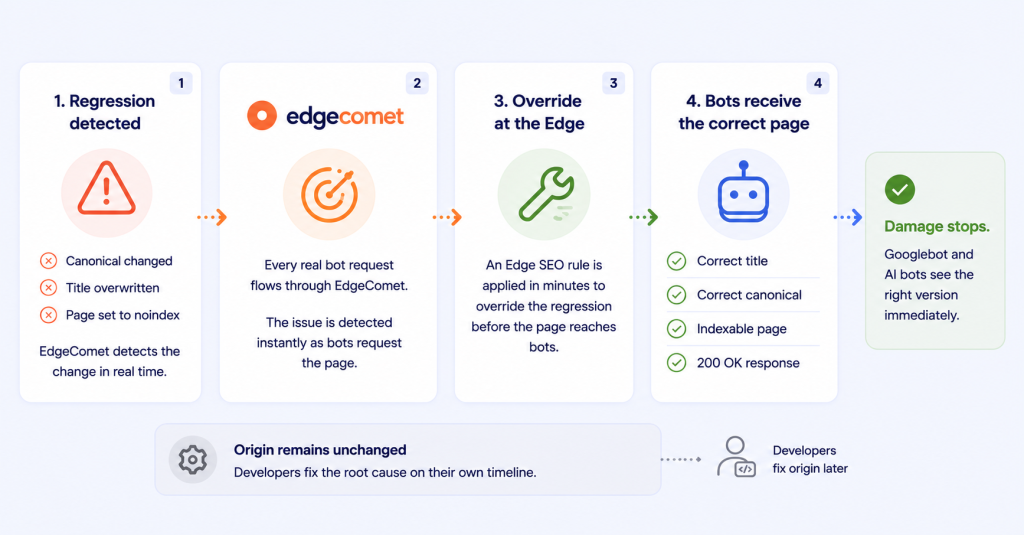
Detection and remediation are not two products with a Jira ticket between them. They are adjacent surfaces in the same tool. Monitoring tools tell you the house is on fire. EdgeComet hands you the extinguisher.
And when you do want to dig in, every alert links straight to a pre-filtered view of the underlying requests, so going from “what fired” to “show me the exact pages and bots” is one click, not a new query.
Coverage on Day One
At this point, you might think that real-time, fixable monitoring sounds like something complicated to set up. It’s not as EdgeComet provides tens of pre-built templates across four categories. Each one is a working rule that you can turn on with one click:
- Availability – error spikes, render-failure surges, origin outages, and crawl errors.
- SEO Health – title, canonical,
noindex, meta robots, H1, structured data, hreflang, and external-domain changes, plus a combined pack. - Performance – render-time degradation, slow responses, JavaScript errors, resource failures, timeouts, and cache hit-rate drops.
- Traffic: crawl traffic drops and fake-bot spikes.
- Any custom metrics alert
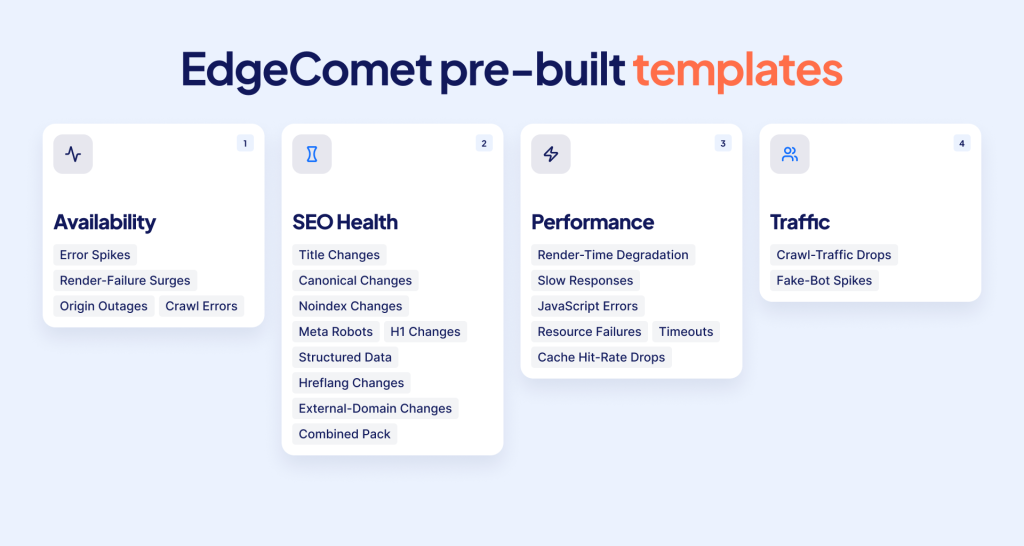
Activate a template with its sensible defaults, or customize the thresholds before saving. The one I would turn on first is the Critical SEO Elements Pack: a single activation watches title, canonical, index status, and meta robots together, the four ways a deploy quietly de-indexes a section. Coverage takes about ten minutes, with no rule-building.
Conclusion
Scheduled monitoring works on a loop measured in hours and ends with a ticket: crawl a sample, compare it, report, and hand the problem to someone else. EdgeComet works differently: in minutes, identify the problem from real bot traffic, explain it with triage, and fix it right at the edge.
| Scheduled monitoring | EdgeComet Alerts | |
|---|---|---|
| Data source | Synthetic crawl of sampled pages | Real bot traffic, every crawled URL |
| Latency | Hours, on a schedule | ~5-10 minutes, end to end |
| Coverage | A sample of top pages | Every URL a bot actually hits |
| What you get | A metric and a number | A plain sentence, severe reasoning, suggested actions |
| Multiple failures | Several separate alerts | One correlated root cause |
| Remediation | None, hand off to a ticket | Override at the edge in minutes |
| Setup | Build the rules yourself | 21 templates, one click |
| Extra load on the site | Yes, from their crawler | None, already in the path |
The economics are simple. One prevented noindex accident or broken deploy, the kind that costs weeks of lost visibility, pays for years of EdgeComet. And speed of response compounds: sites that fix critical SEO issues within 48 hours recover search visibility about 3x faster than those that take weeks (industry research). The whole point of alerting is to get you inside that window.
See it in the dashboard: SEO ranking alerts